Confidence Scoring Architecture for Document Extraction Models
Understanding three layers reveals why confidence scores don't mean what they appear to.

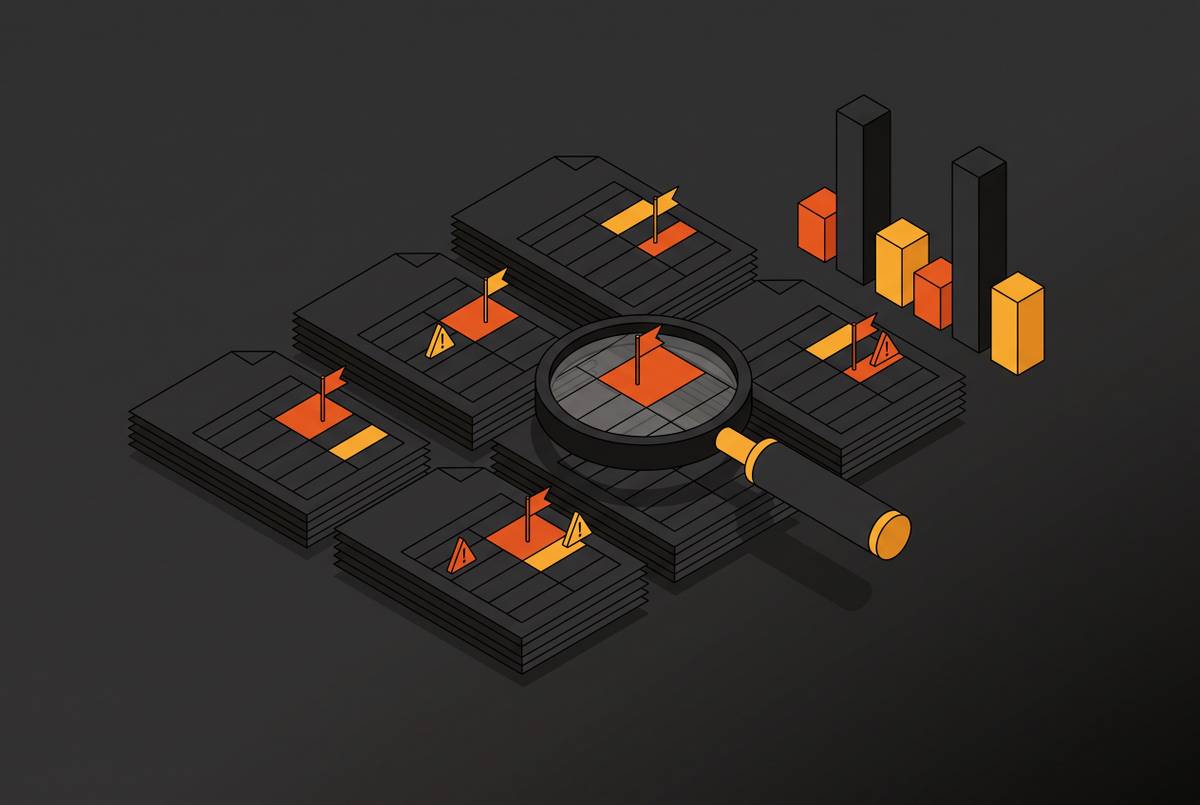
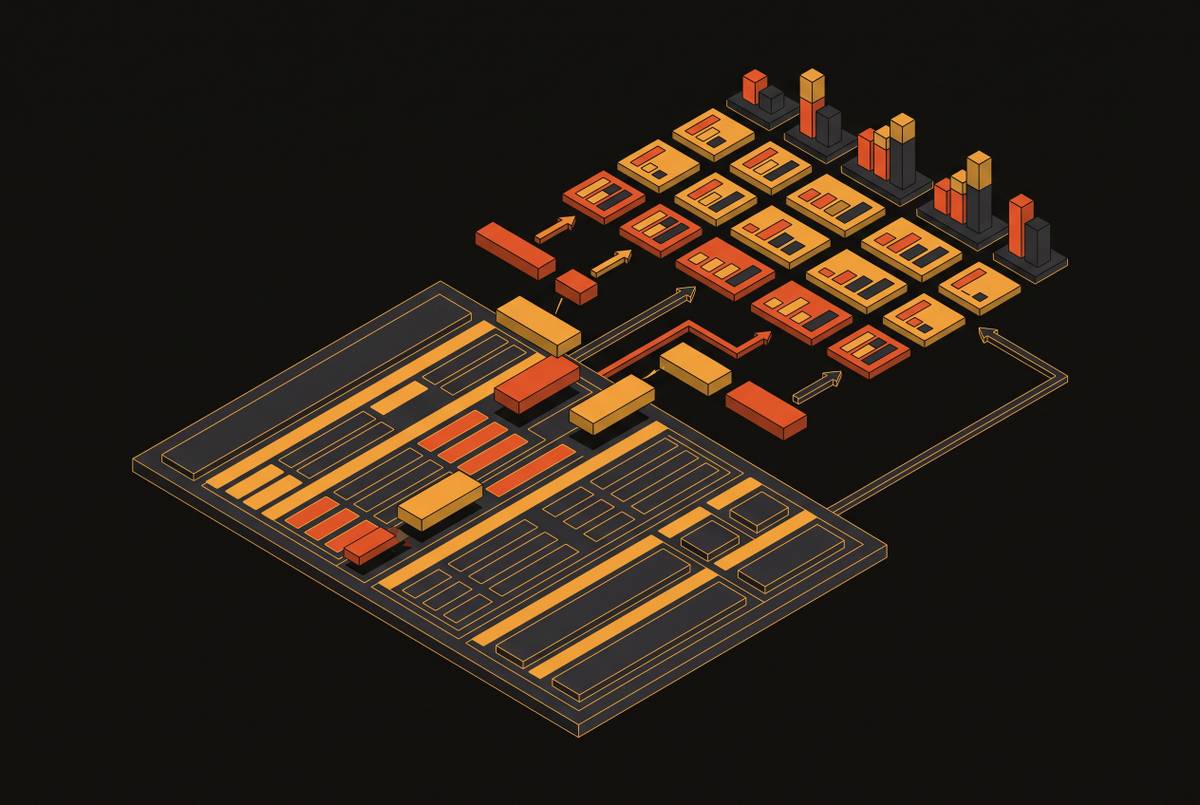
Confidence scoring in document extraction is a layered architecture, spanning how the score is generated, how it is calibrated, and how it gets translated into a routing decision, and each layer imposes its own limits on what the final number can actually tell a reviewer, rather than a single probability number attached to an output field.
Limits of a Single Confidence Float in Production Document Extraction
The intuitive picture is simple: an extraction system assigns 0.95 to a field and that means the system is 95% sure it read the invoice total correctly, while 0.60 means a human should look. But that picture falls apart in real production: document quality varies, review budgets are finite, and in some industries an error can slip through unflagged and create regulatory exposure. One audit of a Caterpillar and GoodRx extraction pipeline found an average field-level confidence of 0.781 alongside a validated extraction accuracy of 1.00 on the audited sample. That gap between what the model reported and what reviewers confirmed was correct did not come from a bug. The confidence score was built to support risk-aware prioritization, directly estimating risk rather than the true probability of correctness, so a 0.781 average sitting well under a 1.00 accuracy rate reflects how the score was designed to behave. If an organization treats that score as a literal probability, it will either route far more documents to manual review than the error rate justifies, cutting into the automation gains the system was built to deliver, or it will trust the raw number against an untested threshold and accept an error rate nobody has actually measured. Getting from a raw score to a safe routing decision requires understanding three separate layers: how the score is produced, how it is calibrated, and how a threshold converts it into an action.
The Three Estimation Methods That Produce Confidence Scores
Three distinct mechanisms generate confidence scores from a vision-language model's extraction, and each one has its own failure mode built in.
Verbalized confidence asks the model to report a numeric score as part of the same prompt that produces the extraction itself. The score comes from the same inference call as the answer, so entity-level accuracy and confidence quality rise and fall together across model families. A benchmark called ConfBench tested this method, known as 1S-TopK, across seven vision-language models, and calibration quality ranged from near-perfect to severely overconfident depending on which model family was tested. Parameter count turned out to be a poor predictor of calibration across families, but within a single family, bigger and more capable models tended to calibrate better. That matters because frontier proprietary models that don't expose token-level probabilities, including Anthropic's Claude API, have no option but verbalized confidence, so its calibration behavior is not a tuning detail but a constraint baked into the system from the start.
Log-probability scoring takes a different approach: it reads token-level probability outputs from the model directly, separating the act of extraction from the act of scoring confidence. The tradeoff is access: many hosted proprietary APIs simply don't expose token-level probabilities, so this method is closed off wherever that access doesn't exist. Within logprob scoring itself, the choice of aggregation method carries its own consequences. ConfBench found that first-token aggregation consistently beat mean-token and margin-based aggregation for distinguishing correct extractions from incorrect ones, so the aggregation method is a design decision with measurable effects on routing quality.
Consensus polling takes a third route: it generates multiple responses to the same extraction request and measures how consistent they are. Box's Extract API, documented in January 2026, varies temperature, requests multiple candidate answers, or runs differently worded prompts, then aggregates results by how often each distinct value appears for a given field, using that frequency distribution as the confidence estimate. This method trades latency and inference cost, since it requires multiple calls per field, for confidence estimates that tend to track real-world correctness more closely than a single self-reported score.
A fourth approach, embedding-based verification, uses a separate classification model trained on embedding vectors pulled from a self-critique prompt, rather than relying on the extraction model to judge itself directly. Research from ApplyBoard, published at ICPRS, found this approach distinguishes correct extractions from erroneous ones more accurately than naive self-critique, which lets a pipeline selectively flag only the fields most likely to be wrong for human review. The approach matters most for documents where errors are subtle rather than obvious, such as a misread GPA on a transcript or a misread job title on a resume, cases where the extraction looks plausible on its face but carries real consequences if wrong.
A finding from ConfBench cuts across all three methods regardless of which one a pipeline chooses: feeding the model both the OCR text and the document image produces more accurate confidence estimates than feeding it the image alone, and the gap is widest for smaller, less capable models. That means the choice of what to feed the model is itself part of the confidence estimation layer, not a separate preprocessing concern.
Calibrating Raw Scores for Routing
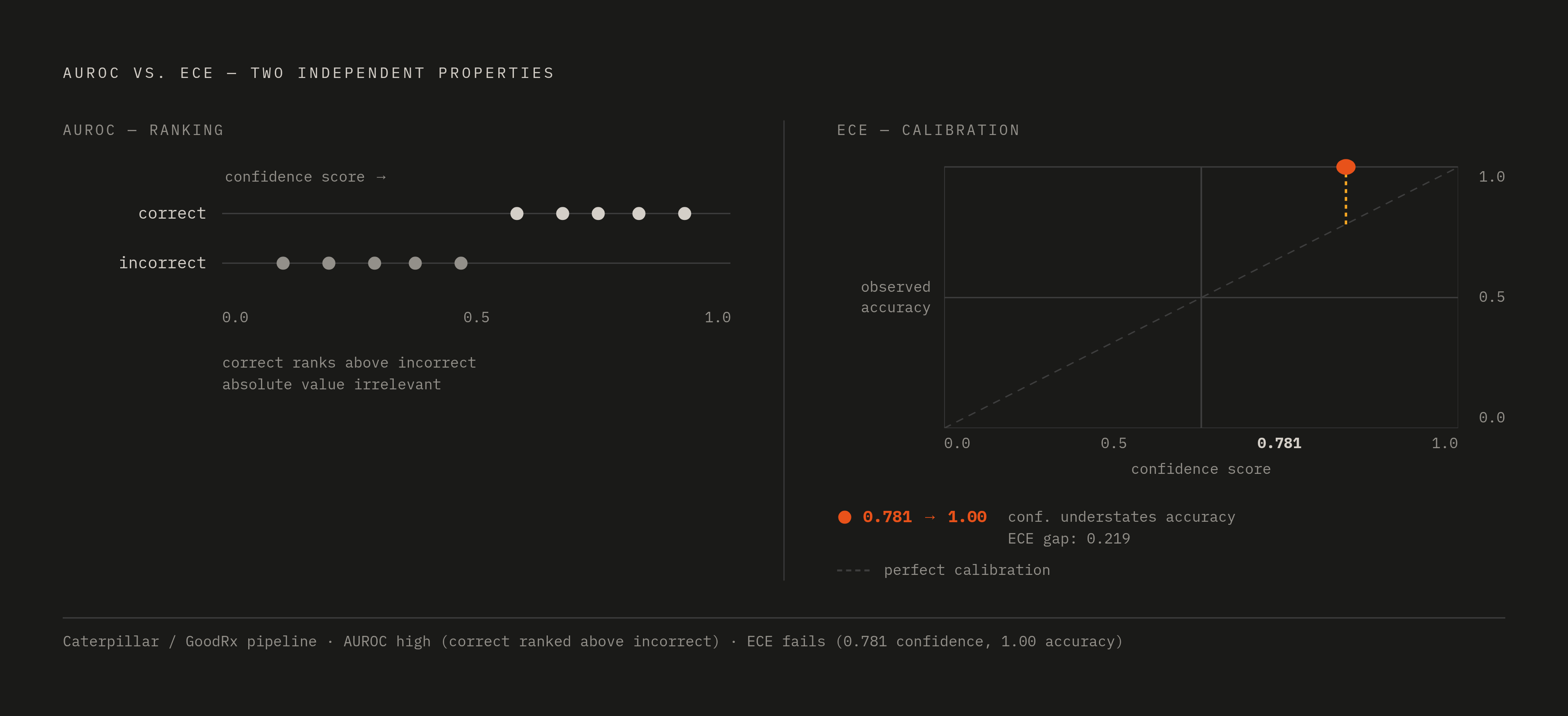
A score can rank extractions correctly relative to one another and still route them to the wrong queue if its absolute values don't match reality. That distinction, between ranking extractions correctly and reporting absolute probabilities accurately, is what separates discrimination from calibration, and production systems need both. ConfBench found that per-model post-hoc correction rescales a model's absolute confidence values so they work for threshold-based routing, but it does not change how well the score ranks correct extractions above incorrect ones. Calibration fixes the threshold problem. It leaves the ranking problem exactly as it was, because the two are separate properties and need separate evaluation.
Two metrics make this precise rather than impressionistic. AUROC measures whether a score ranks correct extractions above incorrect ones, and ECE measures whether the score's absolute values match observed correctness rates. A system can score well on one and poorly on the other, and neither metric alone tells an engineering team whether the confidence system is ready for production. A model might rank extractions almost perfectly (strong AUROC) while still reporting a confidence value lower than the true correctness rate (poor ECE), which is close to the gap between the audit paper's reported average field-level confidence of 0.781 and its validated extraction accuracy of 1.00. Document AI confidence estimates tend to be structurally conservative, understating certainty by design; that works as a feature for risk-aware prioritization, but if someone sets a threshold against the raw reported number without correcting for that conservatism first, it turns into a liability.
ConfBench also introduces a review-budget metric called ECARB, which translates a given improvement in discrimination into the operational terms engineering teams actually care about: how much smaller the human review queue gets for the same error tolerance. That framing matters because it ties an abstract calibration improvement to a number a manager can actually act on, the size of the review queue, rather than leaving calibration quality as a purely statistical property.
How the OCR and Parsing Layer Shapes Confidence
Confidence scores inherit the noise of whatever OCR layer ran before the extraction model ever saw the document, so OCR quality is a first-order part of the confidence architecture, not a preprocessing detail you can handle separately. OCR engines return per-token confidence scores of their own, within a defined numerical range, and those scores don't disappear once parsing finishes. They carry forward into the field-level confidence an extraction model later reports. A document extraction system that ignores the OCR layer's own uncertainty signal is discarding information that the later stages could have used.
Feeding the model both OCR text and the image gives it a richer basis for judging its own uncertainty, particularly on degraded documents where the image alone leaves ambiguity the OCR text can resolve. That advantage is most visible for smaller models, which benefit the most from having OCR text available alongside the image.
Production pipelines typically run through a staged sequence: ingestion, preprocessing (deskewing, denoising, contrast enhancement, resolution normalization), OCR, layout analysis, extraction, validation, and output. The preprocessing stage sits well upstream of any confidence score an end user ever sees, but it shapes the OCR accuracy that everything downstream depends on, including the extraction model's own confidence estimate. A poorly deskewed scan or a low-resolution capture degrades OCR output, and that degradation shows up two stages later as lower, and often less trustworthy, extraction confidence. The OCR layer sets the ceiling on how much the extraction confidence score can be trusted, regardless of how well the estimation method and calibration layers above it are built.
Threshold-Driven Routing, Automation Rates, and Review Queue Size
Threshold configuration is where confidence architecture turns into business architecture. If you set a threshold too conservatively, automation collapses under the weight of unnecessary manual review; if you set it too loosely, the system accepts an error rate nobody has measured.
Systems running below roughly 95% accuracy need manual review queues large enough that they cancel out whatever automation gain the system was supposed to deliver. Confidence scoring is the mechanism that keeps automation intact above that floor, by flagging only the fraction of extractions that are actually uncertain rather than routing every document to a human. Even a highly accurate model still produces enough misclassifications at production volume that you need a human backstop, so a confidence score has to tell you not whether errors exist but which specific extractions carry them.
This pattern has moved from engineering practice into formal intellectual property. US patent 12463819 describes a threshold-gating architecture in which a model extracts data and returns a confidence score alongside it: if the score clears a defined threshold, the system automatically generates and stores a new extraction template indexed to the document's layout hash; if the score falls at or below threshold, the system triggers a manual review and annotation cycle. The threshold in that architecture does more than route a single document. It also drives how the system learns new templates for future documents.
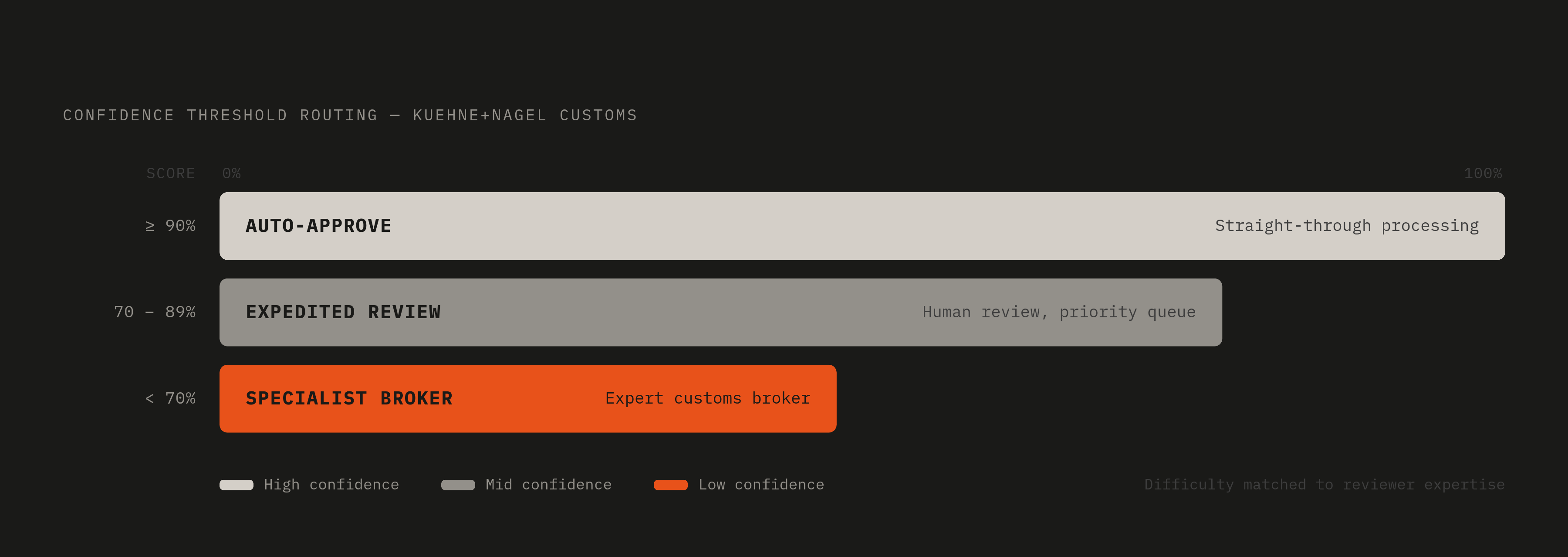
Binary pass/fail routing is not the only option, and tiered routing often performs better. Kuehne+Nagel's customs classification deployment runs three tiers: high-confidence declarations go through automatically, mid-confidence cases route to expedited human review, and low-confidence cases go to specialist customs brokers. That three-way split produced a substantial reduction in both classification errors and processing time, and it reflects something true of human review generally: reviewers are not interchangeable, and routing by confidence tier lets a system match the reviewer's expertise to the difficulty of the case.
Logistics deployments surface a constraint that has little to do with model accuracy. The real limit on adoption is getting operations, legal, and IT functions to agree on what decisions a system is allowed to make without a human signing off. A route optimizer that needs dispatcher approval on every single route will never scale, no matter how accurate its underlying model is, but if it can execute routes autonomously above a defined confidence threshold, it can scale considerably. Threshold design, in that sense, is a negotiation among stakeholders as much as it is a statistical exercise.
Evidence from a multi-agent document processing deployment running through January 2026 illustrates what well-tuned routing looks like in practice: across 955 real-world documents, the large majority were processed end-to-end with no fallback needed, while a small remaining fraction routed to legacy OCR or a manual portal. Those fallback paths represent the system degrading gracefully rather than failing outright, and that graceful degradation only works because confidence-gated routing catches the uncertain cases before they turn into silent errors.
Confidence Scoring Under Domain-Specific Pressure: Financial Services, Healthcare, and Logistics
Financial services documents, loan applications, tax forms, account statements, carry a volume and variety that stresses the estimation layer first. A single confidence score, whether verbalized or logprob-based, has to hold up across dense tabular statements, handwritten annotations, and multi-page contracts within the same pipeline, and the gap between model families that ConfBench documented in verbalized confidence becomes a live operational risk the moment a firm chooses one model over another without testing both against the same degraded documents. The conservative calibration pattern found in the Caterpillar and GoodRx audit is exactly the kind of gap a compliance team needs to know about before setting a review threshold: document AI confidence estimates are structurally designed to understate certainty, and trusting a reported score at face value without correcting for that conservatism means over-routing to manual review and losing automation the underlying accuracy would have supported.
Healthcare documents put pressure on a different layer: the subtlety of the errors themselves. A misread GPA on a transcript or a misread job title on a resume, the exact examples embedding-based verification was built to catch, have a healthcare analogue in misread dosages, lab values, or patient identifiers, where an error that looks plausible on the surface can carry serious downstream consequences. That is precisely when naive self-critique falls short, and when a separate embedding-based verification layer earns its added cost by flagging fields where the extraction looks right but needs a second, independent check before you trust it.
Logistics stresses the routing layer hardest of all, because the constraint there is organizational as much as technical. Kuehne+Nagel's three-tier customs classification system shows what tiered routing looks like when it works: it cuts errors and processing time by matching document difficulty to reviewer expertise. The deeper lesson from logistics deployments is that operations, legal, and IT functions' willingness to grant a system autonomy sets the ceiling on automation, not how good the underlying model already is. An optimizer with a well-calibrated confidence score still won't scale if every decision requires a human signature, while a system with the same accuracy but a clear, negotiated threshold for autonomous action will. That negotiation is easier when the extraction layer's actual accuracy on complex, real-world layouts is verifiable rather than assumed; Extend, a document ingestion platform for production AI pipelines whose open-source benchmarks test against unfiltered production documents rather than curated test sets, publishes that kind of independently checkable evidence.
Sources
- Automated Population-Level Audit Assurance via AI-Based Document Intelligence
- [2608.01792] Can You Trust the Confidence? ConfBench for Vision-Language Models on Document Extraction
- Cryptographic integrity verification and adaptive artificial intelligence document extractor system for workflow automation in various domains
- Agentic Document Extraction Guide March 2026
- Can You Trust the Confidence? ConfBench for Vision-Language Models on Document Extraction
- Embedding Confidence to Enhance Trust in AI Document Entity Extraction