Character Encoding and Unicode Normalization Failures in Document Parsing
Silent encoding errors compound across document pipelines undetected.

A crash tells you where to look. When an exception trace points at a line or a null return stops a pipeline cold, someone gets paged. Encoding failures do neither. The same underlying text can exist in different byte-level forms: an accented character like é can be stored as a single code point, U+00E9, or as a base letter plus a separate combining mark, U+0065 followed by U+0301. Both render identically on screen. A person reading the output would never know the difference. That gap between what a human sees and what a machine matches against is where these failures live, and it's also why they don't announce themselves. Normalization decisions made quietly, often by a library default rather than a deliberate choice, change which tokens a model sees, which embeddings get computed, and which strings match during retrieval. An index built from NFC-normalized text simply won't match a query written in NFD, and nothing in that transaction looks like an error to any system watching for one. There's no stack trace for a query that returns zero results instead of the right one. The document pipeline keeps running, the dashboard keeps showing green, and the only evidence is a slow erosion of quality, one that someone eventually notices in aggregate, usually after the damage has compounded across a few thousand documents.
Where in a pipeline encoding inconsistency enters
Encoding inconsistency is not a single bug sitting at a single address. It builds up at every point where bytes get converted, text gets split into pieces, or the output of one tool becomes the input of another. The OCR layer is the first and most reliable source: different engines make different decisions about ligatures, diacritics, superscripts, and which code point to assign to a punctuation mark. A straight quote and a curly quote are different Unicode characters. An en-dash, an em-dash, and a hyphen-minus are distinct Unicode code points, and OCR engines are inconsistent about which one they emit for a given scanned mark. None of that produces a parsing error; instead it surfaces later, as a string match that silently fails.
Script-level failures are a distinct problem with a distinct cause, and they shouldn't be confused with normalization drift. Arabic invoices that embed Latin product codes require three separate layers working correctly at once: compliance with the Unicode bidirectional algorithm, script-aware segmentation, and line-level inference of text direction. If any one of those three is missing, field boundaries shift and values drop out of the extraction entirely. It is a structurally wrong document, and because the failure is concentrated in non-Latin scripts, it hides behind an aggregate accuracy number that looks fine. A system can report a high accuracy score overall even if quality on Arabic or Hebrew documents falls sharply, because an aggregate metric averages across documents and never isolates that gap.
The third entry point sits at the normalization layer itself, and it's the one most teams assume they've already handled. Whatever preprocessing gets applied to a corpus at build time has to be applied, identically, to every query at inference time. When it isn't, an index that was lowercased when it was built will silently miss any query term that arrives in its original case, because nothing in that interaction raises a flag. Three different mechanisms, three different fixes: OCR engine configuration, script-aware segmentation logic, and a normalization spec that's enforced symmetrically. Treating them as one problem is why so many fixes address only one layer and leave the other two intact.
Tokenization and retrieval amplification of small character errors
A single mismatched character at the OCR layer looks trivial by itself. What makes it dangerous is that it gets multiplied by every downstream system that relies on exact string matching to do its job. Unicode normalization exists to stop visually identical characters from being assigned different token IDs, but the fix carries its own risk: normalize too aggressively and the process strips distinctions that tokenizers and subword models depend on to find meaningful units of text, potentially merging words incorrectly or stripping semantic signal. There's no universal setting that gets this right. A single "lowercase and strip accents" rule tuned for English breaks on French, Spanish, Vietnamese, and German, each of which has its own rules for when an accent carries meaning and when case distinguishes a proper noun from a common one.
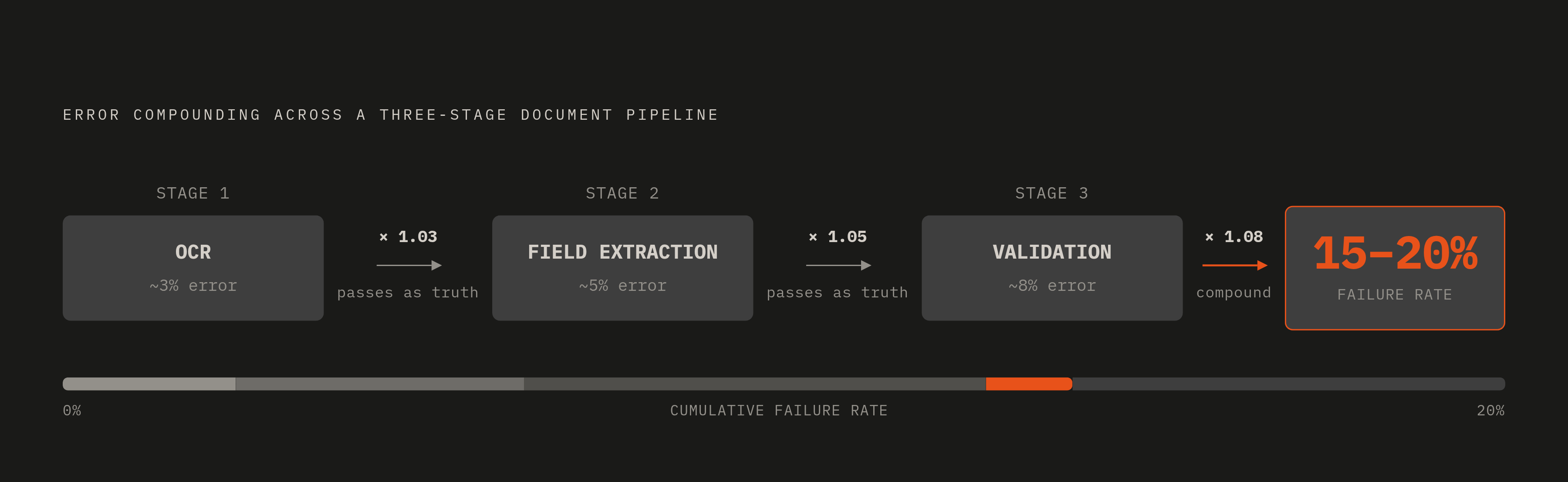
Retrieval absorbs the brunt of this, because retrieval depends on string identity more directly than almost anything else in a document pipeline. If a corpus refresh pulls documents from a different Unicode source, it can introduce NFD where an index was built expecting NFC, even when the underlying content hasn't changed at all. The miss rate that results lands on a specific user cohort, the one whose queries happen to intersect with the newly inconsistent documents, and it produces no visible error anywhere in the system. Multiply that kind of per-stage slippage across a multi-stage workflow, something like receipt processing that passes through OCR, field extraction, and validation in sequence, and a small per-stage error rate compounds into a 15 to 20 percent failure rate on the full extraction task. The compounding happens specifically because each stage treats the previous stage's output as ground truth rather than checking it, so a pipeline that works and one that quietly doesn't can look identical until that stage is checked.
One signal does cut through the silence here. A shift in prompt token counts after an upstream change to normalization logic means the tokenizer is seeing genuinely different input, even when the text looks identical on screen. Token-count drift won't tell an engineer what changed, but it tells them that something did, which is more than most monitoring setups offer for this class of problem.
What standard accuracy metrics fail to see
Most accuracy metrics used to evaluate document parsing were built to measure one thing: surface-level similarity between extracted text and a reference transcript. Encoding failures fit that blind spot almost perfectly: they preserve surface similarity while corrupting the structure or meaning underneath. ParseBench's critique of the existing benchmark landscape makes this point directly: the metrics in common use overemphasize surface text similarity, penalizing cosmetic formatting differences while missing broken table structure, wrong chart values, or content that got dropped entirely. That's the exact failure profile an encoding error produces. The text looks right. The structure is wrong.
The document types most exposed to this gap aren't the ones most benchmarks are built around. OmniDocBench and OCRBench v2 don't center high-stakes legal and regulatory documents, the category where agent workflows most need a field value or a table cell to be exactly right, though OmniDocBench does include financial reports among its nine document types. Even OmniDocBench's own evaluation code needed a patch to handle one specific encoding-class failure: its hybrid matching algorithm was updated to let formulas and plain text match against each other, specifically because models were outputting formulas as Unicode characters and getting scored as wrong for a choice that was really just an encoding preference. If the benchmark infrastructure itself required a fix for this, it's a reasonable bet that plenty of production evaluation pipelines have the same blind spot and no patch for it.
Preprocessing choices made before scoring even happens, case folding, whitespace collapsing, change Character Error Rate by a meaningful margin; an accuracy number is only ever comparable to another accuracy number computed under the same normalization spec. If a vendor normalizes more aggressively before running the comparison, they can report a better score without having improved the actual fidelity of their extraction. That's an artifact of a metric that was never designed to account for the normalization step sitting in front of it, not fraud.
Vision-language models add a failure mode that Character Error Rate cannot detect under any normalization regime, hallucinating plausible Unicode characters never present in the source document, which pass downstream normalization checks while introducing semantic errors. CER measures distance between strings. It has no mechanism for asking whether a character that matches perfectly was ever supposed to be there.
Effects of undetected encoding failures on agent decisions and regulated outputs
None of this stays abstract once a pipeline's output reaches an autonomous agent or a regulated record. A character-level corruption that no metric caught becomes a wrong decision, a compliance gap, or a record that looks fraudulent even when no one intended it to be. If a table's header shifts during parsing, an agent approving a claim can read the wrong number off it. An agent summarizing a financial report can fail outright if a chart got reduced to raw text instead of preserved as structured data. The agent doesn't know the input was corrupted; it acts on what it was given, and the corruption becomes a decision.
Healthcare is where this collides most directly with a compliance regime built around accountability. Every model inference and every data access event involving protected health information has to be logged immutably, and the HHS Office for Civil Rights has signaled that AI-driven decisions involving that data face the same scrutiny applied to traditional data handling. If an organization has no comprehensive audit trail covering its parsing pipeline, it falls into compliance debt the instant an encoding error corrupts a clinical record, because the record itself is now wrong in a way nobody logged and nobody caught.
Pharmaceutical manufacturing has its own version of this, and it now has a named precedent. FDA Warning Letter 320-26-58, issued in April 2026, established that existing cGMP quality-unit accountability rules apply in full to AI-generated documents entering a quality management system, requiring human review, documented approval, and clear quality-unit accountability for that output. So any pipeline where an encoding error silently corrupts a document before it enters a regulated record now has a direct audit surface. The letter didn't carve out an exception for AI-generated text on the theory that a machine produced it. It applied the same rule that's always applied to any document entering that system: an encoding failure buried in an AI-generated batch record is now the same kind of finding as any other undocumented change.
The security dimension: invisible Unicode characters as an active attack surface
The same stretch of Unicode code space responsible for accidental encoding failures is also being used on purpose. Characters that cause a retrieval index to miss a query by accident are the same class of character being deliberately inserted into documents to carry hidden instructions that an agent will parse and act on. Microsoft researchers documented a high-volume phishing campaign in September 2026 that used invisible Unicode tag characters, in the range U+E0000 through U+E007F, characters that render as nothing to a human reader but still get parsed as text by email filters and automated systems. The researchers called the technique ASCII Smuggling.
The same mechanism occurs in agent tooling. Malicious MCP servers have been found embedding invisible instructions directly inside tool descriptions, text that a human developer reviewing the tool would never see but that an agent reads and follows. Independent benchmarking of this technique found attack success rates against prominent LLM agents reaching 72.8 percent. That figure describes a technique that works against the majority of the agents it was tested on.
For a document pipeline, the implication is direct: a parsing system that doesn't explicitly detect and strip invisible Unicode characters is exposed not only to the data quality failures described earlier in this piece but also to prompt injection, since an attacker can plant instructions inside a document that redirect what an agent does once it reads that document. Encoding hygiene, in other words, is a security control as well as a correctness concern, and a pipeline that treats it as optional is leaving a door open that has already been shown to work.
Why "just normalize everything" is not an adequate solution
Aggressive normalization discards information that sometimes carries real meaning. In legal and medical documents, a stripped diacritic can change which name a system matches to a record. A collapsed whitespace field can merge a drug dosage number with its unit of measure. Case folding removes a distinction that an entity recognizer trained on title-cased text was relying on to tell a proper noun from an ordinary word. None of these are hypothetical edge cases. They're the direct, predictable cost of applying one normalization rule everywhere.
You have to weigh the benefit of standardizing text against the specific information that standardization step would destroy. Case, punctuation, and diacritics all carry semantic weight in some contexts and noise in others, and the correct normalization spec depends on the domain and the task, not on a single setting that works everywhere. A common operational mistake illustrates this: when a corpus is normalized one way and queries arrive normalized a different way, the index expects one spec while the queries arrive under another, and the resulting miss rate on specific character classes goes undetected until someone runs an evaluation broken out by user cohort. A text-to-speech provider that upgraded its library and silently changed its normalization defaults is a real instance of this exact failure: the change broke task completion for French-locale calls specifically, passed every surface-level test the team ran, and only showed up as a downstream behavior regression for one language.
A normalization contract fixes this: a spec that's fixed, written down, applied the same way to both the corpus and the query side, tested explicitly with regression evaluations that would catch exactly this kind of drift, and versioned so that any change to it triggers a fresh round of evaluation before it ships. Encoding should be treated not as a cleanup step but as a design decision with consequences that appear downstream, in ways that ordinary testing won't catch.
Sources
- Unicode Normalization and Grapheme Parsing of Indic Languages
- GitHub - opendatalab/OmniDocBench: [CVPR 2025] A Comprehensive Benchmark for Document Parsing and Evaluation
- Multilingual OCR: 100+ Languages (August 2026) | Extend
- ParseBench: A Document Parsing Benchmark for AI Agents
- The Character Error Vector: Decomposable errors for page-level OCR evaluation
- blog.thegenairevolution.com
- What Is Text Normalization? FutureAGI Guide (2026)