Parsing Complex Form Layouts with Field Relationship Extraction
Understanding field relationships requires parsing layout before text extraction.
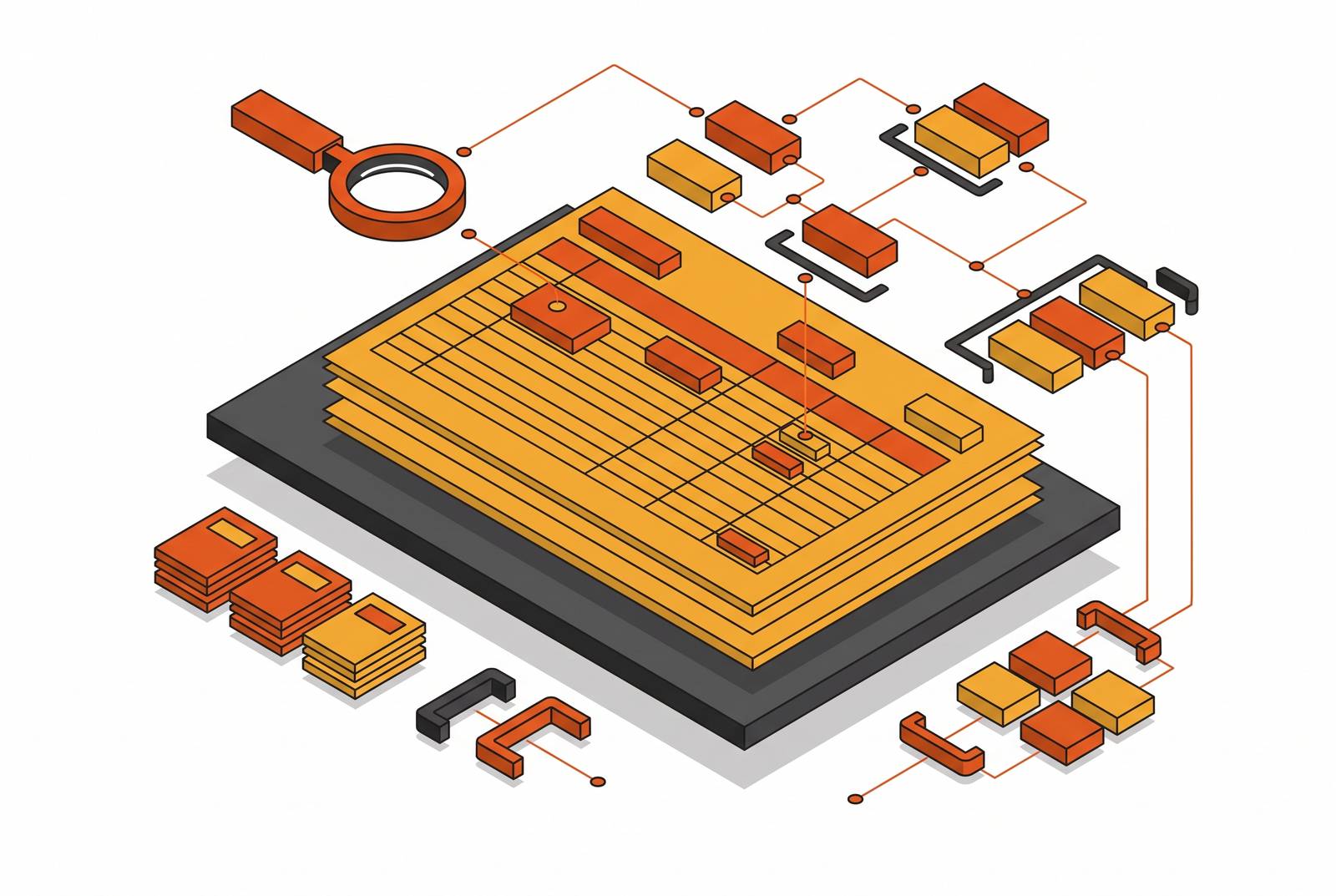
A prior authorization form asks a reviewer to check a box next to a drug name, a dosage, and a date range, but that checkbox means nothing if you don't know which label it sits beside. Parsing complex form layouts correctly requires recovering that spatial relationship before extraction runs, not after, because the identity of a field is set by where it sits relative to its neighbors, not by the characters inside it.
Why form field meaning depends on position
Picture a remittance grid with forty columns of dollar amounts. A single cell holding a number could be a quantity, a unit price, or a running balance, and nothing about the number itself resolves which. Only the column header above it carries that information, so a system that reads the number without its header has not extracted data, it has extracted a guess. The same problem appears on a prior authorization form, where a checkbox's meaning depends entirely on correctly tying it to its label, and that label might sit above the box, beside it, or printed inside it, depending on how the form was designed. Multi-line labels compound the issue further: a label that wraps across two lines in a narrow column will break any system that assigns ownership by proximity to the nearest text rather than by the boundaries of the region the label actually occupies. This is the root failure that analysis of layout-first parsing identifies directly: OCR linearizes content before any field extractor ever sees it, so a two-column insurance declaration collapses into a garbled string, and a nested table inside a financial statement breaks the row-column logic that assumed every cell would stay where it started. Position is the information, not a detail to clean up after the fact.
How traditional OCR pipelines lose spatial structure
Traditional OCR cannot preserve field relationships, because of how it is built. It produces a flat character stream and hands that stream to a field extractor, which then has to rebuild structure from heuristics, and once a layout gets complicated, that reconstruction fails in predictable ways. The mechanism is simple to describe: OCR reads pixels left to right and top to bottom, producing one long token sequence, and on a dense multi-column form, tokens from column one, column two, and column three interleave before any mapping between label and value ever runs. A 40-column remittance grid run through standard OCR produces interleaved token sequences where values systematically land under the wrong labels, a documented failure in dense form parsing. The same breakdown occurs with bank statements: once a statement is flattened by OCR, an LLM receives noise rather than structure, because the date, the description, and the amount from three separate columns merge into one sequence with no reliable boundary between them.
Template-based extractors tried to work around this by hard-coding bounding-box coordinates for each field, but that approach collapses the moment a print registration shifts or a form gets revised: the fixed coordinates no longer point at the right pixels, so accuracy resets to zero with no path back. And because this all happens upstream of every other step, one misclassification spreads through the entire chain: if a parser misreads a table header as ordinary body text, every extractor downstream inherits malformed input, and any LLM reasoning over that document is reasoning over scrambled context. In dense grids specifically, this produces two compounding failure patterns: column bleed, where a label spanning more than one line merges into the neighboring column's token sequence, and row interleaving, where uneven row heights pull values from one row into the sequence belonging to the row above it. Both pass whatever confidence threshold the system uses, so the wrong data carries straight through.
The structural detection pass: what layout-first parsing does differently
Layout-first parsing flips the order of operations. Instead of reading characters first and inferring structure second, it recovers the page's spatial structure before any text reading happens at all, so it produces a region graph that extraction walks, not a flat stream it has to reverse-engineer. A structural detection pass identifies the kinds of regions a form is actually built from: ruling-line grids, checkbox clusters, multi-column label-value pairs, and stacked fields that share a border, then builds a graph out of cell boundaries and proximity between regions. Extraction then follows the edges of that graph, so a field's association with its value survives column compression or a dense grid, instead of depending on reading order holding up.
This also changes which model handles which piece of the page. If checkboxes on a scanned document fall below a given pixel threshold, they often sit below the confidence level OCR needs to read them reliably, so a layout-first system routes that region to a vision model that classifies the fill pattern straight from pixel data, skipping OCR entirely for that field type. Within each detected cell, reading order gets assigned locally first, and only then are cells sequenced by their position in the grid, which preserves the grouping the form's designer intended rather than forcing a single left-to-right order across the whole page. Research on joint extraction frameworks, such as XFormParser, backs this structural emphasis: the model combines semantic entity recognition with relation extraction in one framework, built on vectors that carry text, visual, and spatial positional information together rather than treating them as separate passes. The output of a layout-first system is structured JSON carrying spatial metadata that an LLM or an agent can consume directly, with no intermediate cleanup or schema normalization required before it's usable.
Where field relationship extraction breaks despite layout detection
Layout detection cuts down field relationship errors substantially, but it does not remove them, and you can predict and name the failures that remain rather than treat them as random noise. Column bleed still shows up when a model lacks real cell-boundary detection: a label that spans more than one line gets merged into an adjacent column's sequence, and the error clears confidence thresholds while carrying the wrong value. Row interleaving behaves the same way: without explicit row segmentation, a grid with uneven row heights pulls a value from one row into the sequence belonging to the row above it, producing a field-value mismatch that looks perfectly clean at the document level even though it is wrong. Nested tables inside financial statements cause a related problem: if the detection model cannot tell an outer table's boundary from the inner cell grid sitting inside it, the row-column logic breaks even after a structural pass has already run.
Benchmark results confirm that this isn't evenly distributed across document types. A 2025 benchmark run by Fraunhofer IAIS and the Lamarr Institute, testing eight multimodal models across three document types, found real accuracy gaps between clean digitally generated invoices, scanned invoices, and scanned receipts, which shows that document quality and layout complexity interact to produce results that swing widely depending on the input. Even a model posting a high character-level accuracy score can still mangle roughly one field in ten, a rate that looks fine in aggregate but matters a great deal once it's multiplied across a real production batch. Existing benchmarks score either whole-document output or conventional table grids, so they leave aggregate numbers that say little about where the structure actually broke, and that gap in diagnostic insight is part of what motivated FormStruct-Bench (arXiv:2608.10396, August 2026). Its hierarchical, diagnostic design lets a given accuracy score get traced back to the specific structural failure that caused it.
Handling Cases Layout Detection Cannot Resolve
Because layout detection alone leaves gaps, production systems for dense forms are built as multi-stage pipelines, not single models. One guide to dense form parsing documents three recurring patterns: a two-stage OCR plus layout stack, a document-scoped context graph, and per-field confidence scoring that routes low-confidence regions to a human reviewer. Agentic architectures build on that pattern by adding a routing layer that directs regions to specialized models after layout detection. Layout analysis finds the structural elements on a page, tables, form fields, text blocks, handwriting, checkboxes, visual grounding ties each detected element to what it actually means, and an agent then routes different regions to specialized models: handwritten sections to a handwriting recognition model, dense tables to a table extraction model, with a semantic reconstruction step merging everything back into one coherent structured output.
The numbers from real deployments back this design choice. A multi-agent pipeline studied through January 2026 in a production deployment processed a substantial volume of documents, and the overwhelming majority were handled end-to-end by the pipeline without requiring fallback, achieving the 95-99% accuracy range documented for agentic extraction on complex documents involving handwriting and tables. The remaining documents, split between those routed to legacy OCR and those processed manually through a portal, represent cases where an unrecognized format, serious image degradation, or a deliberate operator override pulled the document out of the automated path. A logistics example makes the underlying logic concrete: when an invoice doesn't match the expected template, an agent reads the content by meaning rather than by position, pulls out the relevant fields, flags the mismatch for review, and lets the workflow continue instead of stopping cold. Financial services deployments show the same pattern at work. Agents detect signatures across multi-page FSA enrollment forms and pull line items from invoices regardless of template, and loan packets mixing state-specific Articles of Incorporation formats with inconsistent vendor invoices get processed without anyone having to reconfigure the system by hand.
None of this settles the ongoing debate between fully VLM-native pipelines and hybrid ones. The strongest case against a fully VLM-native approach to form parsing is cost and latency on edge devices or low-memory GPUs: research on XFormParser points out that multimodal large language models are hard to deploy for fast inference in those conditions. The counterargument is that open-source VLMs have closed much of the accuracy gap that used to justify a hybrid design. Both positions have real evidence behind them, and the choice between them depends on deployment constraints that vary by organization rather than on a universal answer.
Confidence scoring as the architectural hinge between demo and production
If a layout-first pipeline reports only a single confidence score per document, it ends up reproducing the exact failure it was built to fix. The small number of fields that got misextracted get averaged into the same score as the much larger number that came out correct, so the errors stay invisible until a regulator, a downstream model, or a customer runs into them directly. The pattern that governs most production routing logic works like this: a document classified with high confidence goes straight to automated processing, one below a set threshold gets routed to a human reviewer, and any extracted value that trips a business rule, say, exceeding a dollar threshold, triggers an approval gate before anything moves forward.
This averaging problem is exactly where the gap between a convincing demo and a reliable production system comes from. A vendor shows strong accuracy on a sample set, so the proof of concept passes and the system goes live, but months later a customer-facing workflow turns up a field that was simply wrong. The demo sample never contained the tail of misextracted fields that the full document archive does, and a single document-level score hides that tail completely. A July 2026 paper studying document-heavy workflows in regulated financial services put a number on this gap: across six workflows tested on four model families and three tool configurations, most configurations cleared a demonstration bar, a single correct run on a single case, but only about half cleared a production bar requiring sustained accuracy, reproducibility, verifiable attribution, and a confidence signal that actually meant something. That drop from demo-passing to production-ready is a measured result from the study.
Regulated industries raise the stakes further. If you want to survive an FDA or state-regulator audit, every extracted value has to tie back to its source span, the model version that produced it, and the reviewer who signed off on it, and a document-level confidence score simply cannot provide that lineage. Most practitioners now agree that field-level scoring with source-span lineage is where the industry needs to go, but most deployed systems still report only a document-level average, and that is the exact systemic gap the July 2026 study flagged. Infrastructure readiness tells a similar story: a 2026 survey of backend and AI engineers found that most teams are already building AI workflows into production, but only a small share feel very confident their infrastructure could handle a significant jump in scale, and that confidence drops even further inside large engineering organizations.
Field-level confidence and source-span lineage in a working system
Field-level confidence is not a dashboard feature bolted onto an extraction pipeline after the fact. You have to design the extraction architecture around it from the beginning, because a system built to produce one confidence number per document cannot be patched into producing one per field without rebuilding the extraction layer underneath it. A properly built field-level output ties each extracted value to four things at once: the exact pixel region or text span the value was drawn from, a confidence score specific to that single field rather than the document as a whole, the version of the model that produced the extraction, and a record of which reviewer, if any, confirmed or corrected it. That combination is what lets an auditor, a compliance officer, or a downstream system trace any single value back to exactly where it came from and how sure the system was when it produced it, rather than trusting a single aggregate number to speak for every field on the page.