Hybrid Computer Vision Pipelines for Document Parsing
Order matters: layout analysis, then OCR, then reasoning for accurate document parsing.
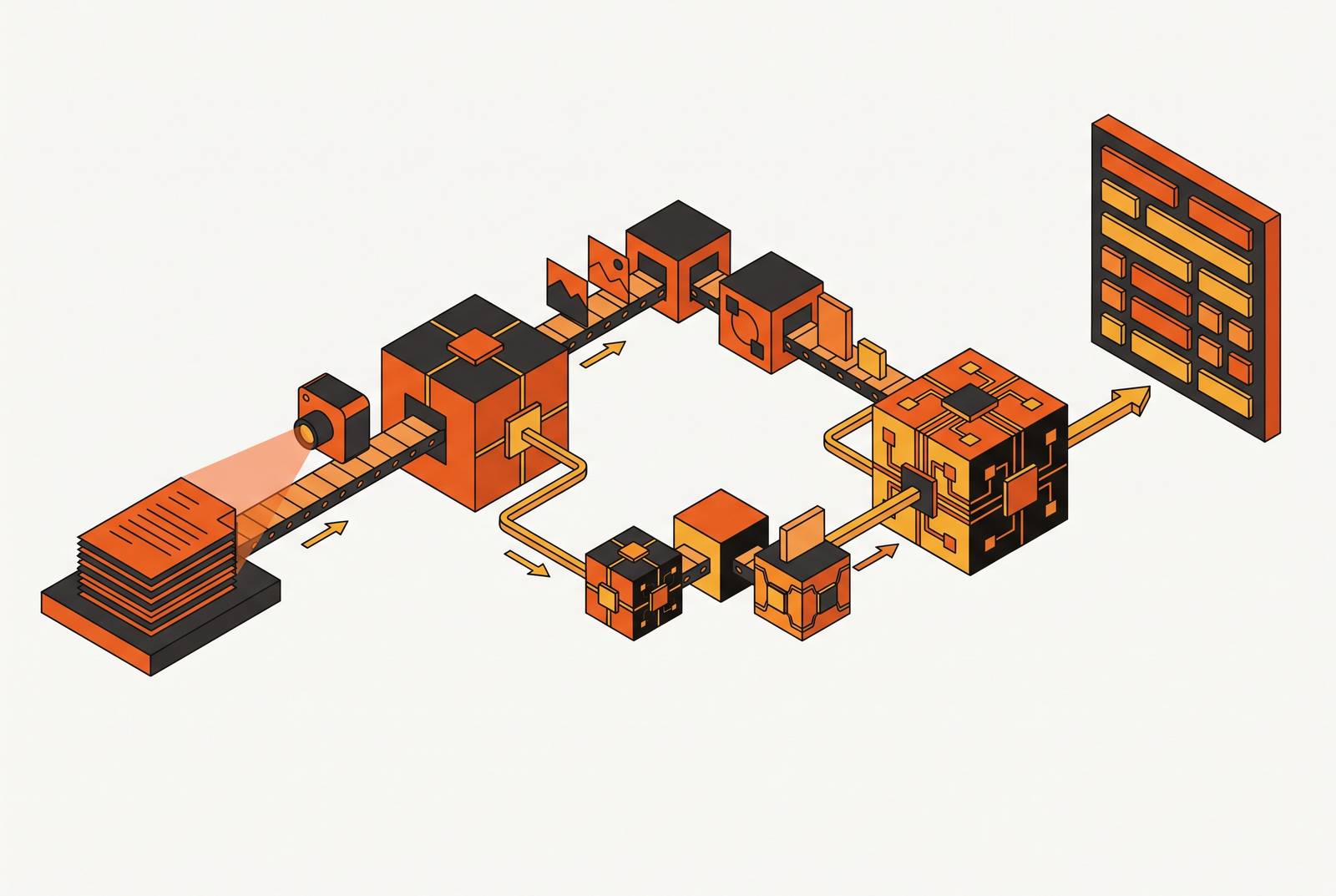
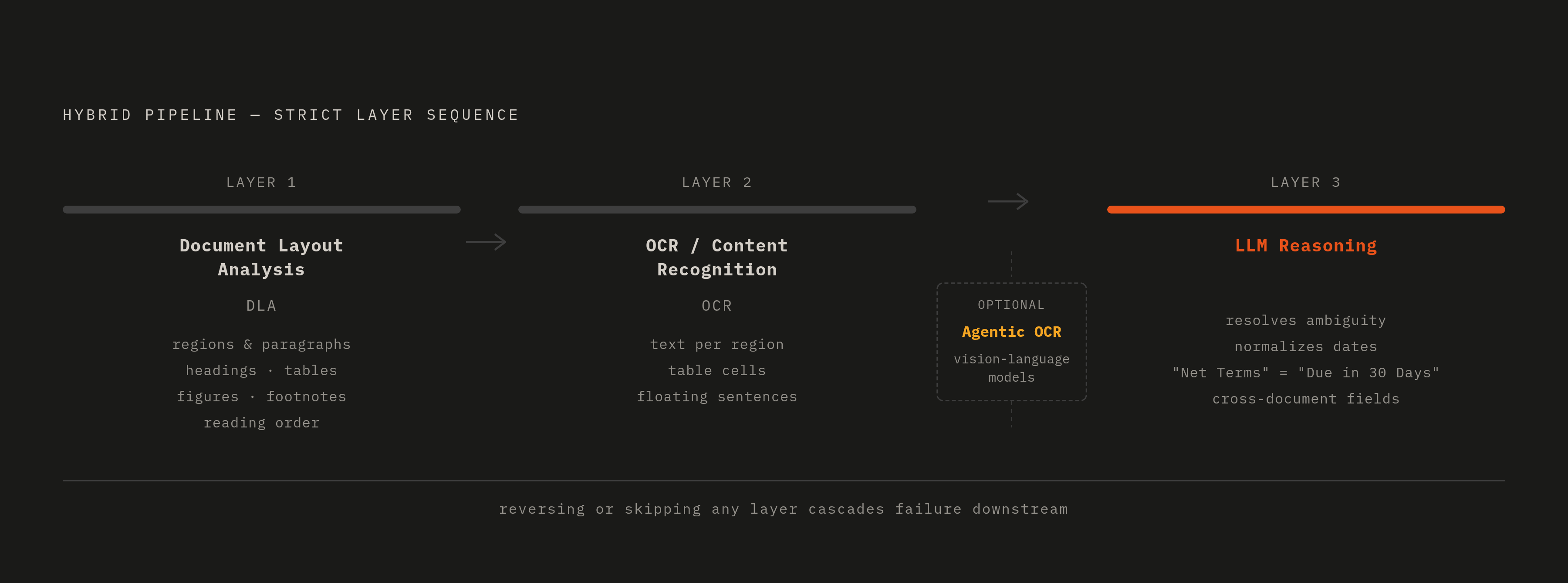
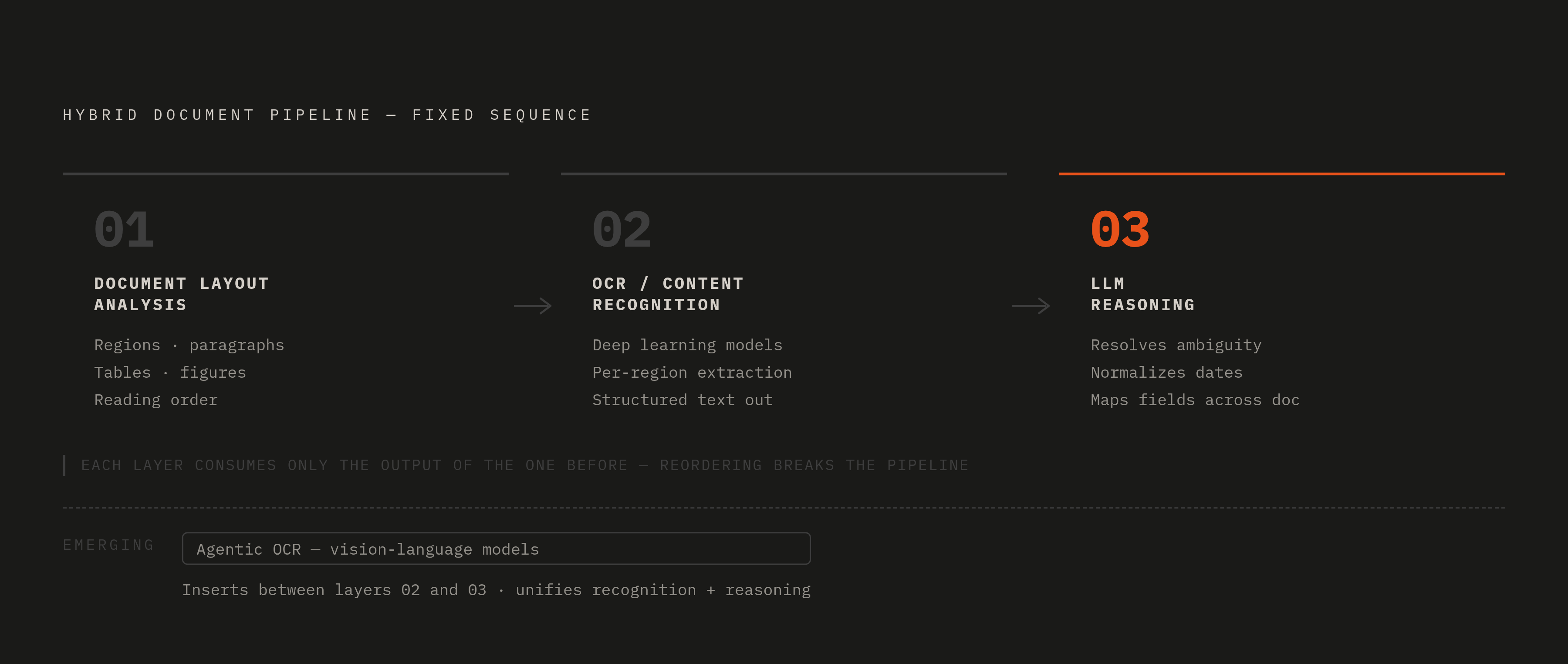
Three layers make up a hybrid pipeline, and swapping their order breaks the whole thing. Document layout analysis, or DLA, runs first: a vision system scans the page and marks out regions, paragraphs, headings, tables, figures, footnotes, and sets the reading order before a single character gets read. Only after that does OCR or content recognition run, pulling text out of each region using deep learning models that are increasingly trained to know the difference between a table cell and a floating sentence. The third layer is an LLM reasoning step, and this is where the ambiguity actually gets resolved: normalizing dates, figuring out that a field labeled "Net Terms" and one labeled "Due in 30 Days" point to the same underlying value, tying together fields that live in different parts of the document.
Calling this "hybrid" means these three layers are stitched together on purpose, with each one earning its place in the sequence. A fourth piece has shown up alongside them: agentic OCR, vision-language models that read visual and semantic structure directly instead of grinding through raw pixels, sitting somewhere between classical OCR and full LLM reasoning.
None of this happens on its own. The harness around the models does the real work: routing logic decides which component handles which page, region, or document type; bounding boxes, page-level outputs, and confidence signals get passed cleanly from one stage to the next; error recovery catches problems before they reach a user. A modular pipeline routes document regions to specialized modules in a fixed sequence. An agentic workflow adds LLM-directed decisions on top, for multi-step, multi-document cases where the right sequence isn't known ahead of time. Most teams evaluating document parsers still swap one LLM for another and measure the difference, which pulls attention away from the middle layer where the real gains tend to live.
How specialized vision models handle what general-purpose LLMs cannot
A single model, even a strong multimodal one, hits a wall once documents get messy. It has no built-in notion of a bounding box, no layout metadata, no confidence score to pass downstream. It treats a page as a picture to describe in prose rather than as a structured object with regions, hierarchy, and order. Rotated tables, multi-column academic layouts, forms nested three deep: none of this makes a general-purpose model throw an error. It fails quietly instead, handing back an answer that reads fine and is wrong.
Andrew Ng's "vision-first" framing from February 2025 nailed this: documents carry meaning through position, formatting, and spatial layout, and OCR paired with a naive vision-language call captures the characters without capturing what those characters are arranged to say. Legacy OCR pipelines, the kind built on template matching and character-level transcription, tend to plateau well short of full automation the moment layout variation shows up. That ceiling is the entire reason hybrid architectures got built in the first place.
The 2025 crop of open-source specialized models shows what happens when a system is built to solve one narrow class of these problems well, instead of trying to solve all of them at once. The 2025 crop of specialized open-source models each targets a narrow slice of the problem: some fold layout detection and content recognition into a single architecture, others optimize for structured output formats like Markdown, JSON, or LaTeX, and others prioritize compactness to cut the cost of running large multi-stage pipelines.
These are components built to hand off structured intermediate output, bounding boxes, region labels, confidence scores, to whatever runs next. Some specialized models apply the same component-focused idea to a different problem: extraction from charts, infographics, and diagrams, document types that defeat pure text models outright because there's no text there to extract. The sheer count of these specialized models says something close to consensus among the people building them: no general-purpose model covers the full range of document structure well enough to trust in production, and narrow tools built for narrow problems keep winning the comparison.
The orchestration layer as the actual determinant of production accuracy
Orchestration is the thing that decides whether a hybrid pipeline is actually hybrid or just several models bolted together and hoping. It coordinates specialized agents across the distinct steps a document needs, holds context across multi-document cases (a loan file with forty attachments of different types, say, where each one might need its own parsing path), and routes exceptions, low-confidence regions, layouts nobody has trained for, to a fallback model or a human before anything gets marked done. It also manages the handoff of intermediate artifacts so each component gets fed the input format it was actually built to read.
Ensemble coordination is one concrete pattern here: run multiple models on the same extraction task and resolve disagreement by majority vote or confidence-weighted selection. This pattern has shown up in production invoice extraction work, where combining outputs from several LLMs with matching algorithms layered on top has produced accuracy gains over individual model approaches.
The choice between OCR-first and vision-first is another orchestration call, and treating it as a permanent architectural commitment is a mistake teams keep making. OCR-first buys better cost control, cleaner auditability, page-level intermediate output, and compatibility with downstream systems that only take plain text. Vision-first holds onto layout better and survives scanned documents and complex formats where OCR alone tends to lose the structure. The right answer depends on the case at hand; production systems increasingly route this per document type, sometimes per page, rather than picking one setting globally.
Orchestration frameworks exist specifically to sit above the model stack and coordinate this, deciding what runs when across multiple agents. And here's the part that keeps getting missed: swap the underlying LLM on a poorly orchestrated pipeline and the gains are marginal and noisy, while rebuilding the orchestration layer tends to produce gains that are structural.
Why table and reading-order parsing are where hybrid pipelines earn their keep
Tables separate real systems from demos. A general-purpose model looks at a table and describes a visual pattern; a layout detector identifies cell boundaries, row spans, and header rows as structured data before any content gets read. That's why structural similarity metrics for table evaluation treat table correctness as a structural question, rather than relying on metrics built for prose that will happily reward a table that's been quietly scrambled. Large-scale table structure datasets exist because the field decided table structure deserved its own dedicated benchmark rather than riding along on text accuracy.
Reading order is the second failure mode, and it gets less attention than it deserves. Multi-column PDFs, footnotes, sidebars, mixed-direction text: any of these will scramble the reading order if a parser treats the page as one flat stream of characters, and the damage doesn't show up as missing content. Every field can extract correctly and the document still comes out wrong, because the sequence is broken even though the values themselves are right. Evaluation frameworks that treat reading order as its own evaluated module reflect exactly this reasoning, making it a distinct accuracy dimension in its own right.
The damage doesn't stop at the parsing step. Research at ICCV 2025 looked at how OCR errors compound through retrieval and generation systems, a problem researchers have started calling "OCR hinders RAG": a small extraction error early on doesn't stay small, it propagates into retrieval and then into whatever the downstream model generates from that retrieved content. Some architectures dodge the problem by design. Some architectures dodge the problem by design, searching documents visually without running OCR at all and trading fine-grained extraction detail for retrieval speed. Open-source modular tools handle complex layouts incrementally but typically leave gaps in coverage, a reminder that no single open-source component currently handles every case a real document will throw at it.
How to evaluate hybrid pipeline accuracy honestly, and what benchmark scores actually measure
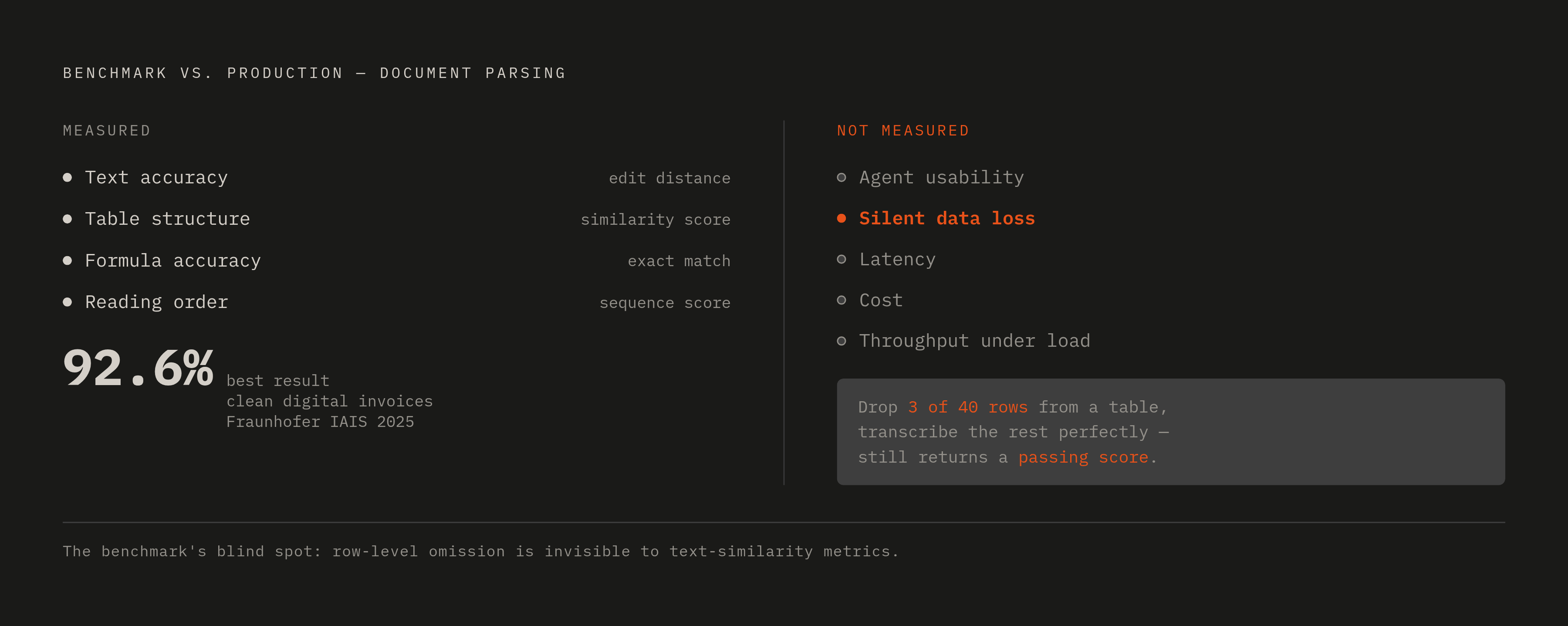
Multi-dimensional document parsing benchmarks have become the field's main open reference points, scoring text, tables, formulas, and reading order as separate modules instead of folding everything into one number. Core metrics typically include edit-distance measures for text and formulas and structural similarity scores for table layout, with reading order scored separately. Even so, continuous metrics like edit distance have a known blind spot: a model that outputs a synonym, or a Unicode variant of the same symbol, takes a penalty for a difference that carries no semantic weight at all.
The benchmark landscape goes well past one leaderboard. PureDocBench, from May 2026, offers the widest coverage available right now, roughly 4,400 pages across more than 60 document types. ParseBench, described in arXiv paper 2604.08538, was built specifically to test AI agent extraction end to end. A 2025 invoice benchmark from Fraunhofer IAIS found the best model reached 92.6 percent accuracy on clean digital invoices, with meaningfully lower scores once scanned invoices and receipts entered the mix, a clear signal that document condition is a first-order variable, not a rounding error to wave away.
What these numbers don't capture matters just as much as what they do. Text-similarity scores say nothing about whether a downstream agent can actually use the output, and they miss silent data loss entirely: drop three rows out of forty from a large table, transcribe the other thirty-seven correctly, and the text-similarity score can still come back looking fine. Latency, cost, and throughput under real production load don't show up on these leaderboards at all.
Benchmark gaming deserves to be called out directly. A recent industry comparison claiming wins over several commercial competitors used no standard OCR metrics, no character or word error rate, no public ground truth dataset, and appears to have relied on internal rather than independent evaluators. The headline figure, an overwhelming majority of comparisons won, cannot be reproduced by anyone outside the company that published it, which means it should not be treated as evidence. Credible methodology needs public datasets, standard metrics, transparent prompts, independent evaluators, and explicit penalties for silent data loss. Short of that, a number carries the weight of marketing copy rather than a result.
Confidence scoring as the mechanism that makes hybrid pipelines production-safe
A pipeline that extracts fields correctly 95 percent of the time and gives no signal about which fields fall in the remaining 5 percent carries real risk behind a good average. Confidence scoring is what turns extraction into something a business can actually build on, because it tells a downstream process which outputs to trust and which to check by hand.
Raw confidence signals don't get this done alone. Raw OCR confidence and raw LLM log probabilities are noisy enough to generate high false-positive rates, which floods the human review queue with fields that were fine to begin with and buries the ones that genuinely weren't. A single heuristic also can't tell a model that's honestly uncertain apart from a document that's genuinely ambiguous, and those two problems call for two different fixes.
The better approach combines signals rather than trusting any one number: dedicated confidence classifiers that weigh parsing confidence, citation precision, and the model's own output together. Confidence needs to live at the field level, not the document level, because a document-wide average will flag a perfectly good invoice number for review just because an unrelated date field scored low somewhere else on the same page. Two separate quantities matter here: citation coverage, meaning how many extracted fields even have a traceable source location, and citation correctness, meaning how many of those cited locations actually back up the value that got returned.
Word-level bounding box citations have become close to a production standard for exactly this reason: every extracted value gets paired with the exact spot on the page it came from. That pairing is what powers click-to-highlight review interfaces, and it's what gives compliance teams in regulated industries an audit trail that can defend an extracted value after the fact. Confidence signals can also drive routing on their own: low-confidence output gets kicked to validation or a human reviewer automatically, and a cost optimizer can use the same signal to decide when a cheaper, faster model is good enough for a given page instead of defaulting to the priciest option every time.
Where hybrid pipelines are being deployed and what the production constraints look like by industry
Financial services runs on document types that punish sloppy parsing right away: 10-K filings, invoices, multi-attachment loan packages, all dense with tables, cross-references, and figures that have to reconcile exactly. A misread decimal in an extracted balance sheet figure isn't a rounding error, it's a compliance problem waiting to surface at the worst time. Structure-preserving parsing matters here specifically because retrieval and downstream question-answering depend on tables and reading order surviving the extraction step intact, not just on the raw text showing up somewhere in the output.
Healthcare and insurance carry a different constraint: forms nested inside forms, handwritten annotations mixed in with typed fields, scanned intake documents where image quality swings wildly from one submission to the next. The Fraunhofer IAIS finding, that scanned documents score meaningfully lower than clean digital ones, describes exactly the conditions these industries deal with every day. That's why the confidence-routing layer matters so much there: it's the mechanism that keeps a bad extraction from quietly landing in a patient record or a claims file.
Legal and government document processing lean hardest on auditability. Contracts, filings, and regulatory submissions need the word-level citation trail, the thing that lets a reviewer check a claim against its source without re-reading the whole document by hand. Across every one of these industries, the real constraint is the same: building a system that knows, field by field, when to trust its own answer and when to say so instead.