Human-in-the-Loop Review Workflows for Low-Confidence Extractions
Routing low-confidence extractions prevents review queues from becoming bottlenecks.

AI document extraction on clean, machine-generated PDFs now reaches 95 to 99 percent accuracy. That number sounds like a solved problem until you run the arithmetic on volume. At 97 percent accuracy across 500 invoices a month, roughly 15 of them carry at least one wrong field, and it's rarely a typo in a description line. It's a payment total, a vendor name, a payment term, the kind of error that costs money or time to unwind after the fact. Human-in-the-loop review exists to catch that residual error rate, but most teams build it backward: as a queue bolted on after extraction, rather than a routing and confidence architecture designed alongside it.
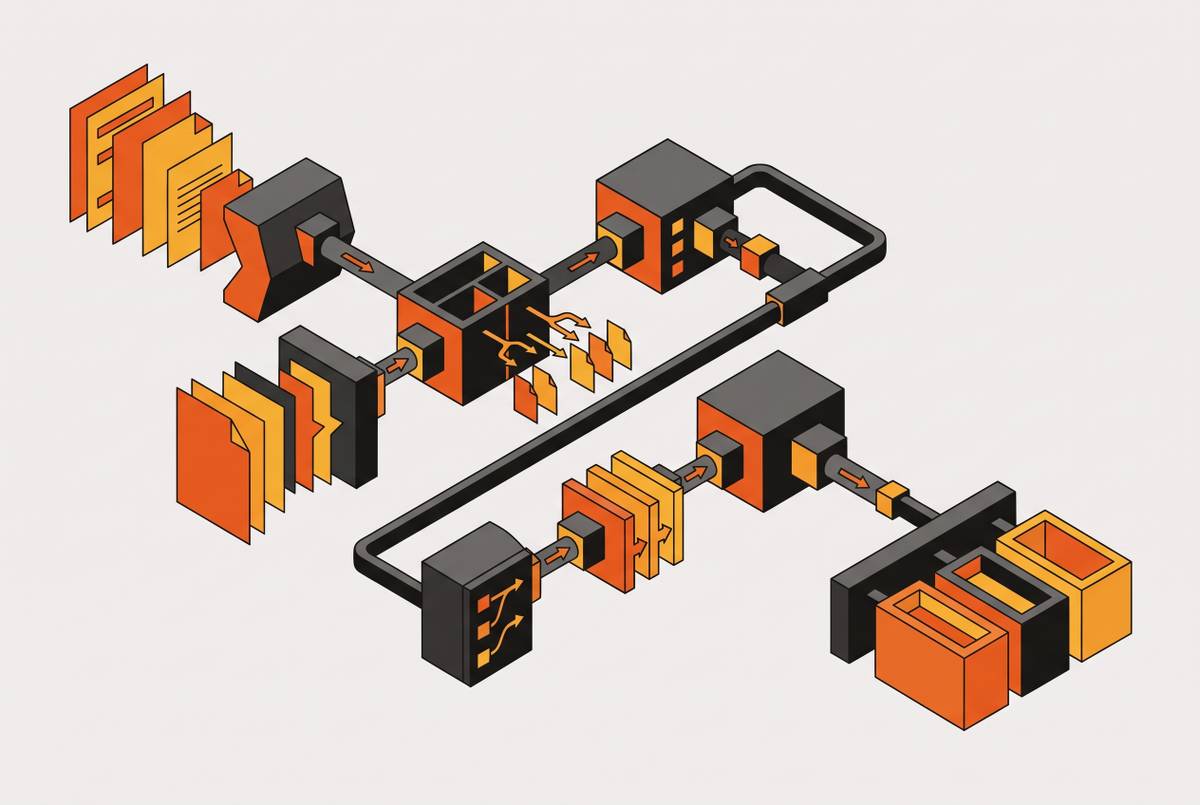
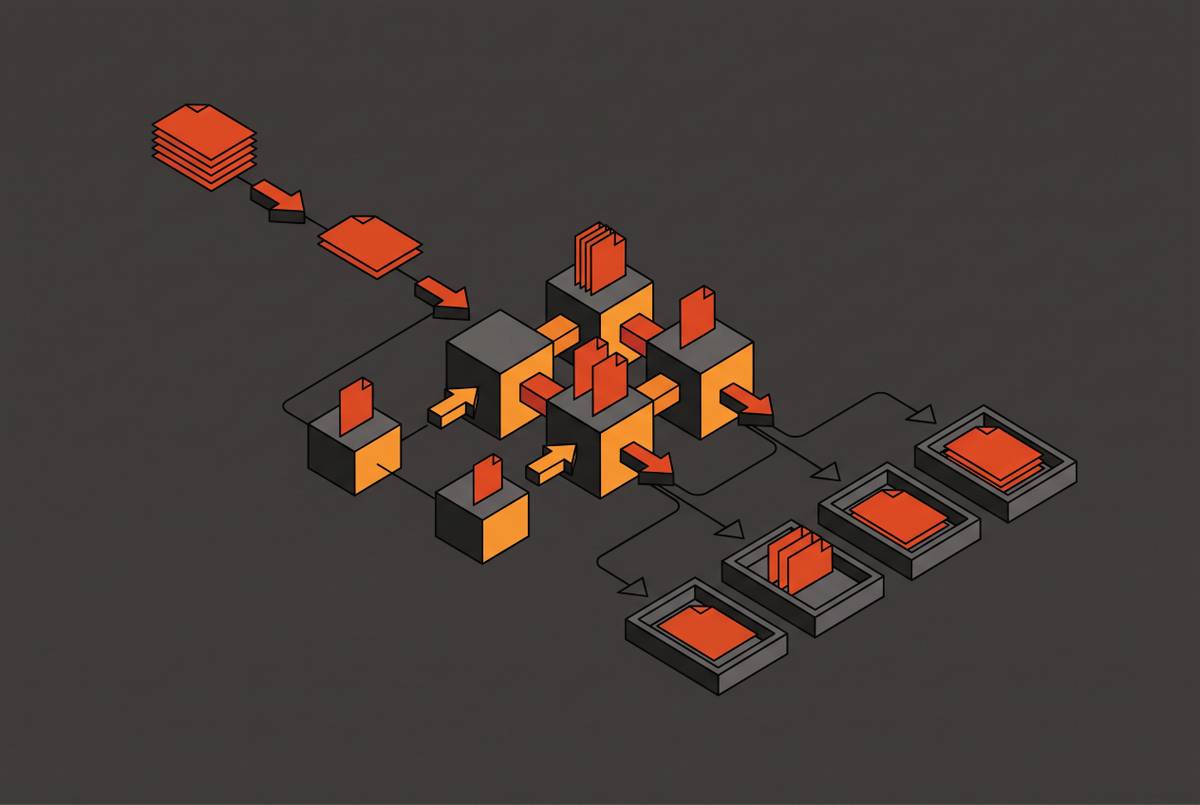
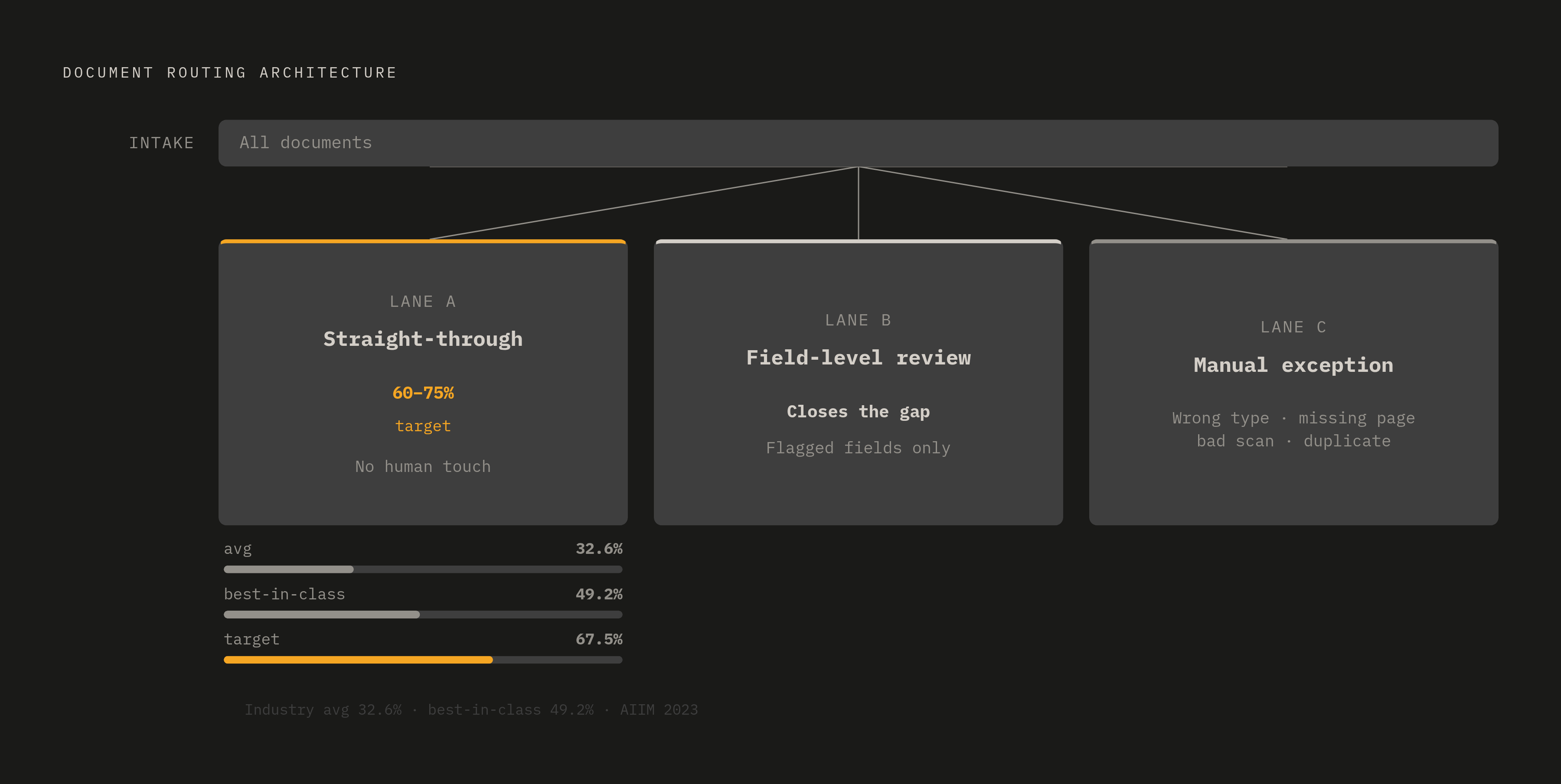
The three-lane architecture routes documents by confidence and rule state rather than forcing every document through a single queue. Lane A is straight-through processing: all required fields present, all confidence scores above their per-field thresholds, all business rules clean, no human involved. Lane B is field-level review, reached when one or a handful of fields fall below threshold or trigger a deterministic rule; a reviewer in Lane B sees only those flagged fields, not the entire document from page one, which is what keeps Lane B from collapsing into full manual work. Lane C is full manual exception handling, reserved for structurally broken documents: wrong document type, missing pages, a scan too degraded to read, or a suspected duplicate that requires judgment rather than simple field correction. The economics of the whole pipeline depend on keeping Lane B fast, and that depends entirely on a reviewer interface that surfaces flagged fields with their confidence scores and source document context inline, without requiring navigation across multiple screens to fix a single value.
How do you design a three-lane human-in-the-loop workflow so reviewers only see flagged fields?
Most implementations treat HITL as a coin flip. A document either auto-approves or lands in a review queue, and that binary makes the queue unmanageable within a few months of production volume. A working document pipeline needs three exits, not two.
Lane A is straight-through processing: every required field is present, every confidence score clears its threshold, business rules pass clean, and no exception trigger fires. The document posts with no human touching it. Lane B is field-level review, reserved for documents that are mostly right but carry one or a handful of uncertain fields. A reviewer here should see only the flagged fields, not the entire document from page one. Lane C is full manual exception handling, for documents that are structurally broken: wrong document type, a missing page, a scan too degraded to read, a suspected duplicate, or a case that needs judgment rather than correction.
Lane A determines how many documents a person has to open. Lane B determines how long each of those openings takes. Most engineering teams build Lane A first and treat Lane B as an afterthought, which inverts the actual cost structure: a document that requires opening five screens to fix one field is functionally no different from a full manual review, just with extra steps.
Inside Lane B and Lane C, "did the AI read this field correctly" is a data question with one right answer, while "should this invoice actually be paid" is a judgment call. Those two questions deserve different reviewers, different time budgets, and arguably different queues altogether, because conflating them means your fastest reviewers get stuck making decisions they're not positioned to make.
Aim for 60 to 75 percent straight-through processing after roughly three months of tuning. For context, Ardent Partners reports that the accounts payable industry's average touchless processing rate is 32.6 percent, with best-in-class organizations at 49.2 percent. That gap between average and best-in-class is almost entirely a threshold and rule-engineering problem, not a model quality problem, which is the argument the rest of this piece exists to support.
Confidence scoring: what the scores represent and why calibration is the real problem
A confidence score is the model's own estimate of certainty, scaled 0 to 1. A 0.95 means the system believes it extracted that field correctly 95 percent of the time; a 0.60 is the model telling you it isn't sure. Calibration is the property that makes that number mean anything: a properly calibrated 90 percent confidence score should be correct 90 percent of the time when you check it against ground truth, not some noticeably lower share, not 99 percent.
That property doesn't hold reliably across platforms. A 2026 arXiv paper, ConfBench (arXiv:2608.01792), benchmarking confidence calibration in vision-language models on document extraction, found calibration quality ranging from near-perfect to severely overconfident depending on the platform tested, and noted that no systematic benchmark for calibration in key information extraction previously existed. Part of the root cause is that most document benchmarks are trained and tested on clean, high-quality samples, while real production documents carry scanning artifacts and physical degradation that distort accuracy and confidence estimation simultaneously.
Two families of methods try to produce that confidence number. Verbalized confidence has the model self-report a score directly, which is convenient to implement but the least reliable of the two. Token-level log-probability methods draw on the model's internal probability distribution and sit on firmer ground, though a separate paper (arXiv:2606.24420, accepted as an Oral at the RobustifAI Workshop, IJCAI-ECAI 2026 in Bremen) notes that which method actually performs better for structured document extraction remains largely unresolved.
Production data from one extraction run illustrates the shape of the problem in practice: model-assigned high-confidence rows made up 81.57 percent of output, medium-confidence made up 18.43 percent, and low-confidence candidates were filtered out at extraction time and never persisted. That confidence label is a self-report from the model, not a substitute for a human checking the work. The same arXiv:2606.24420 paper found that single-signal approaches, whether log-probabilities, verbalized confidence, or self-consistency checks, each carry limitations at practical operating thresholds. Multi-signal approaches that combine several of these methods are gaining ground for this reason.
Track the distribution of confidence scores over time, by document type. A sudden drop across a specific vendor or form isn't noise; it's usually the first sign of a new template, a scan quality shift, or a format change, and it appears in the score distribution well before it appears as a wave of downstream errors. The practical instruction is simple: measure calibration against your own document population before trusting a vendor's published confidence behavior. A score calibrated on a vendor's benchmark set says nothing about how it behaves on your scanned receipts from three different regional offices.
Setting thresholds per field: the table and the logic behind it
There is no single correct confidence threshold, and any vendor that hands you one universal number to apply across every field is making a guess on your behalf, not a measurement. The right approach prices each field's threshold according to what a wrong value there actually costs the workflow downstream.
The public anchor for the sane range comes from AWS's own guidance: something like 50 percent confidence is tolerable for archival text you're never going to act on, while financial decisions may call for thresholds of 90 percent or higher. That's a wide range, deliberately, because the fields inside a single document don't carry equal risk.
A starting-point table, adapted from Parseur's published HITL guidance, breaks it down by field category:
Low-risk metadata, things like page count or a free-text description line, can run at 0.85 to 0.90 confidence. Identity fields, vendor name, claimant name, invoice number, want something tighter, in the 0.90 to 0.95 range. Financial fields, subtotal, tax, total, reimbursable amount, deserve 0.95 to 0.98, given that these are the numbers that actually move money. Payment-critical fields, bank account number, routing number, remit-to address, should be set at 0.98 or, more conservatively, trigger review on any change from the value on file, regardless of score. Compliance fields, tax ID, diagnosis or procedure codes, denial reasons, want 0.97 to 0.99 or mandatory review. Decision fields, approve or deny, pay or hold, a fraud flag, shouldn't be auto-decided by confidence score at all without explicit sign-off from whoever owns the risk.
These numbers are starting points, not settings to leave alone once configured. Calibrate them against the actual documents flowing through the specific pipeline, not against a generic industry benchmark. The tuning cadence that tends to work: start conservative, meaning higher thresholds and more human review than feels necessary, measure both the straight-through rate and the error rate over the first month, and only then loosen thresholds upward as the model's performance on that specific document population gets confirmed with real data. That 60 to 75 percent straight-through target from the previous section isn't an arbitrary round number, it's the outcome that correctly calibrated per-field thresholds should produce after that tuning period.
Deterministic rule overrides: what confidence scoring cannot catch
Confidence scoring has a blind spot, and it's not a small one: it catches the model's uncertainty, but it says nothing about the model's confident errors. A model can assign 0.97 confidence to a bank account number it has never seen before, extracted cleanly and completely wrong, because nothing about the extraction process itself was uncertain. The number on the page was legible. The problem is that the number shouldn't be trusted regardless of how legible it was.
Deterministic business rules exist to cover exactly that gap. They fire independent of confidence score and route to a human unconditionally, because the trigger condition is not about model certainty. A handful of rule categories belong in every production pipeline that touches money or compliance obligations. Duplicate detection flags a repeated invoice or claim number automatically, no matter how confidently the extraction read it. Three-way match failures, where purchase order quantity, receipt quantity, and invoice quantity don't line up, route to review before any payment action clears. Changed payment-critical fields, specifically a bank account or routing number that differs from what's on file for that vendor, go to a person every time, because altered bank details are one of the most common vectors for payment fraud and no confidence score is designed to catch social engineering. Out-of-range values, an amount that exceeds historical norms by some defined multiple, or a date sitting outside a plausible window for that document type, get flagged the same way. And regulatory mandatory-review fields, diagnosis codes, policy exclusions, denial reasons, get routed to a human because the law requires it, not because the model seemed unsure.
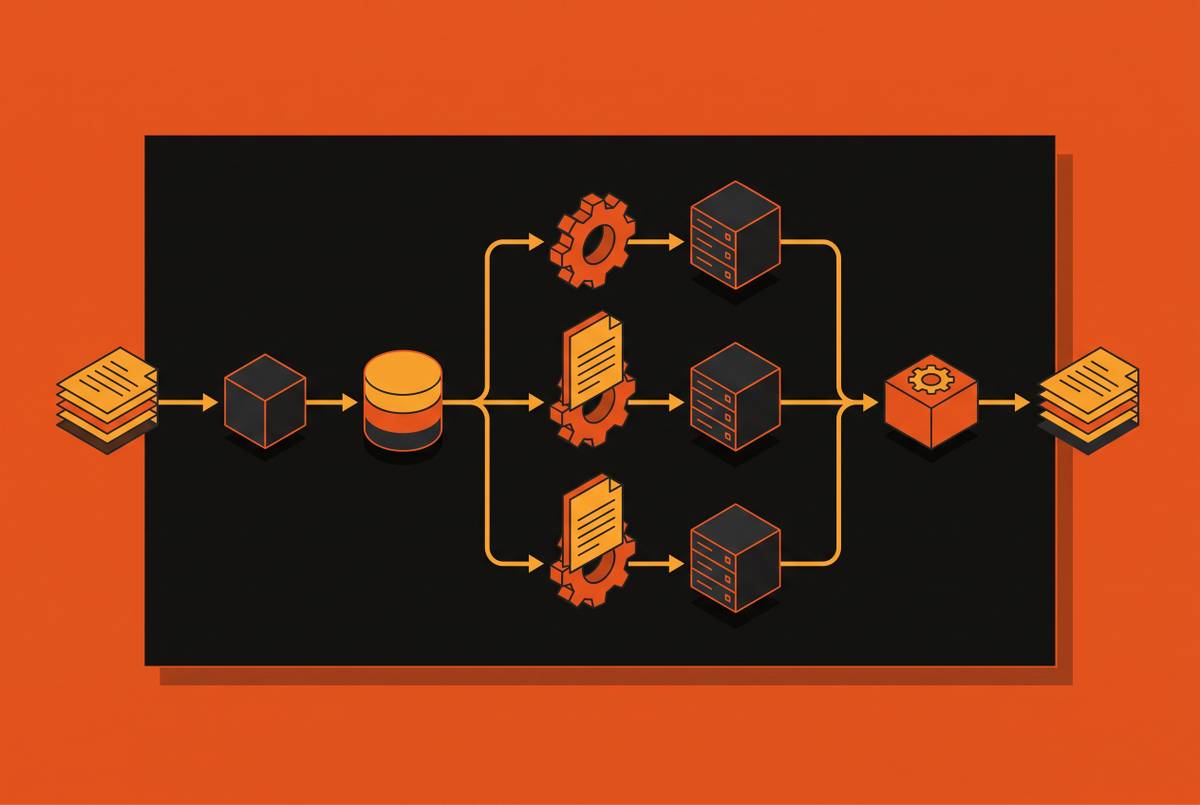
These rules should run as a separate validation layer that sits after extraction, not as a replacement for confidence thresholds. Both layers run in parallel. Neither substitutes for the other, and treating deterministic rules as redundant with confidence scoring is how a changed bank account slips through on a high-confidence extraction.
This isn't just good engineering practice anymore, either. The EU AI Act, under Article 14, requires human oversight for high-risk AI systems, including credit scoring, employment screening, and medical devices, with obligations taking effect in 2026. A deterministic mandatory-review rule for a compliance-sensitive field is the direct engineering implementation of that legal requirement, not a nice-to-have layered on top of it.
The reviewer interface: what reviewers must see to make fast, accurate decisions
An interface that forces a reviewer to re-read an entire multi-page document to verify a single flagged field defeats the purpose of building a Lane B. This is an engineering deliverable with specific requirements, not a screen that gets designed as an afterthought once the extraction pipeline is working.
At minimum, a reviewer needs the original document rendered visually, as a PDF or image, positioned next to the extracted values, not dumped as flat text stripped of its layout. Each extracted field needs its confidence score visible alongside it. Fields that triggered a threshold or a deterministic rule need to be highlighted immediately, so the reviewer isn't hunting for what needs attention. Editing needs to happen inline, a click on the value and a correction typed in place, without navigating away from the review screen. And every approve or reject action needs an audit trail captured automatically: who reviewed it, what they saw, what they changed, when.
The economics of Lane B live or die on this interface. If correcting one uncertain field requires clicking through several screens, Lane B stops functioning as a fast lane and starts behaving like Lane C in practice, even though it's categorized differently in the architecture. The audit trail is required under frameworks like the EU AI Act, and it's also the raw material that feeds the feedback loop described next. It's required under frameworks like the EU AI Act, and it's also the raw material that feeds the feedback loop described next. For regulated workflows specifically, lending decisions, clinical documentation, insurance claims, the interface needs to support explainability directly: a reviewer needs to see why a field got flagged, not just that it was flagged, because a reviewer who can't see the reason behind the flag can't make a fast, defensible decision about it.
There's evidence this design choice matters at scale. One case study involving a Tier-1 bank processing 200 to 300 page multilingual KYC packages found that reviewer interfaces surfacing only uncertain spans, rather than requiring full document re-reads, cut manual review time by 40 to 60 percent. Separately, MIT Sloan research on human-AI collaboration found a case where human-AI teams reached 90 percent accuracy against 73 percent for AI acting alone, on a task where humans alone had already been performing at 81 percent. The interface is the variable that decides which outcome you get: a well-built one is the mechanism through which the collaborative gain occurs, rather than a built-in guarantee.
Closing the feedback loop: how reviewer corrections become model improvement, not just one-time fixes
Every correction a reviewer makes is a labeled data point. The original document, the AI's extraction, and the human's correction together form ground truth for exactly the field the model got wrong, and that's valuable in a way that gets thrown away if nobody captures it systematically.
Without a structured loop closing that gap, the same category of error keeps recurring indefinitely. The review queue doesn't shrink over time, because the model behind it never actually learns from the corrections being made against it, month after month, on the same field types. Building the loop means capturing corrections from Lane B and Lane C with full document context and storing them rather than discarding them once the immediate fix is made. It means watching for recurring error patterns, the same field type, the same document format, the same failure mode, occurring repeatedly in the queue, because that's a systematic model gap rather than random noise. And it means those corrections actually feed back into fine-tuning cycles or prompt refinement, on some defined cadence tied to how much feedback volume accumulates.
Systems that close this loop report straight-through processing rates climbing over time, not staying flat. That 60 to 75 percent figure from earlier is a three-month milestone, not a ceiling to settle at permanently. According to VentureBeat, 96 percent of AI and machine learning practitioners consider human labeling important, and 86 percent call it essential, which lines up with the argument here: reviewer corrections aren't overhead sitting on top of the real work, they're the primary source of high-quality, production-grade labeled data available to a team running this pipeline.
The volume argument matters too. Adoption of generative AI in production workflows has been climbing sharply, with one report from Netsol Tech, cited via Parseur, putting the share of organizations routinely deploying generative AI at 65 percent, nearly double the prior year's figure. As that volume of AI-touched decisions scales, the infrastructure for closing the feedback loop grows proportionally more load-bearing to the whole system's reliability, because at higher volume small gaps in feedback handling compound into system-wide reliability problems.
Reviewer corrections are customer data, generated inside a customer's own review process, and whoever is selecting a platform should flag this directly. A vendor's no-training-on-your-data policy needs to explicitly cover that feedback data, not just the model's inference outputs, and that's worth confirming in writing before a platform gets chosen, not after.
Audit sampling of auto-approved documents: the check that catches thresholds set too low before downstream does
Confidence thresholds decide what gets sent to review. They say nothing at all about whether the documents that skipped review were actually correct, and that distinction is where a quiet failure mode lives.
A threshold set too low creates a specific kind of silent breakage: the model is confidently wrong on some slice of documents, those documents clear Lane A without anyone looking at them, and the error only surfaces downstream, in a payment that goes to the wrong account, a clinical record with a transposed code, or a compliance filing built on a bad number. Nobody catches it at the point where it would have been cheap to fix.
Audit sampling is the mechanism that catches this before it becomes someone else's problem. It works by pulling a random percentage of Lane A documents, the ones that went straight through with no review at all, on a regular cadence, weekly at minimum during the first three months a workflow is live. A reviewer checks that sample against the source document without knowing in advance which ones were auto-approved versus flagged, to keep the check honest. The error rate found in that sample gets tracked over time, and if it climbs past whatever tolerance the workflow has set, that's the signal to tighten thresholds on the specific fields where errors are clustering.
Stratifying the sample matters as much as running it. Scan quality varies by source, and a threshold calibrated against clean digital PDFs from one supplier can be far too permissive applied to faxed documents from a different one, even though both are nominally the same document type flowing through the same pipeline. Sampling across document type and input channel, rather than treating the auto-approved pile as one uniform population, is what actually reveals that gap before it costs something downstream.