Idempotent Document Processing in Distributed Pipeline Architectures
Document pipelines need idempotency engineered separately at each processing stage.
Idempotent Document Processing in Distributed Pipeline Architectures.
Idempotency in document pipelines versus generic data pipelines
Idempotent document processing is not a switch someone flips at the ingestion layer and forgets about. It has to be built, deliberately, into every stage of the pipeline: ingestion, parsing, extraction, and delivery each carry a different contract, and none of them inherit safety automatically from the one before. That distinction matters because the generic version of this problem has been solved for years.
Documents break that comfort. The input format itself behaves adversarially, not merely messily: PDFs arriving into a real pipeline span cleanly generated text, scanned images of wildly varying quality, and files that are malformed or deliberately obfuscated. A generic data pipeline assumes rows and schemas. A document pipeline has to assume that some fraction of its inputs are actively hostile to parsing.
Three failure modes appear at this stage that the standard idempotency playbook never anticipated. A parser can complete cleanly for the first two-thirds of a document and then crash, leaving a partial result that a naive retry will simply redo from scratch. A low-confidence extraction might get routed to human review or a more expensive model path, and retrying that same document later could send it down an entirely different branch depending on what changed in between. And a document that legitimately splits into multiple logical units, a multi-policy PDF being the clean example, has to produce the exact same set of splits every single time it runs, or downstream systems end up with duplicate records, missing records, or both.
The consequence looks identical to any pipeline failure on the surface: duplicate rows, aggregations that get double-counted, state that goes inconsistent after a partial crash. What's different is the root cause, and in a document pipeline that cause is frequently silent: a dropped page, a missing line item in a table. Nothing throws an error; the pipeline just quietly produces a wrong answer. That's the argument this piece makes: idempotency in document processing is a layered property, engineered separately at ingestion, parsing, extraction, and output, and each layer's boundary contract has to be understood on its own terms before the whole system can be trusted. Generic pipeline idempotency is well-understood, relying on replace over append, partition overwrite, MERGE/upsert, and idempotency keys, with tools like Apache Kafka, Apache Spark, Delta Lake, and Apache Hudi providing built-in mechanisms, as Airbyte's guide describes.
Content hashing and job-keying as a safe ingestion boundary
Everything downstream depends on getting one principle right at the front door: ingestion accepts and records, and processing executes. So the first move in any well-built document pipeline is to separate those responsibilities cleanly.
That separation starts with a hash. Every file gets a hash computed on arrival, and that hash gets stored in a documents table with a status of PENDING. A duplicate upload of the same file gets caught before a single worker ever touches it. The documents table itself becomes the ingestion contract, an immutable record of the blob pointer, the hash, and the arrival timestamp, with the status field as the only thing allowed to change at this stage, moving from PENDING to IN_PROGRESS to COMPLETE or FAILED. Retries don't overwrite that history, either. A separate pipeline_runs table logs each orchestration attempt as its own row, so the system retains a full record of every attempt rather than clobbering the last one.
The hash matters for reasons well beyond catching duplicate uploads, though. It becomes the deterministic key that every later stage keys off of: same hash, same job_id, same expected set of outputs. That's the root of the whole idempotency tree the rest of the pipeline hangs from. It mirrors a pattern familiar from cloud data engineering more broadly, where tying a pipeline run to a specific file or batch, and preferring replace over append, is the standard way to guarantee that the same input always yields the same output.
What this stage does not do is a common source of false confidence. Content hashing guarantees a document enters the pipeline exactly once. It says absolutely nothing about whether parsing that document twice produces the same result, a separate problem that is harder to solve. Separation of concerns is the load-bearing principle: ingestion accepts and records while processing executes, and mixing them makes retry logic collapse, as the PyImageSearch Airflow tutorial describes.
Making the parsing stage deterministic and resumable
Parsing is where the assumption of determinism starts to strain. PDFs from different producers behave differently from one another, and scanned pages require OCR, whose output can shift from run to run depending on model version or even runtime conditions. A parser behaves as a context-sensitive process, unlike the pure determinism of a hash. That's the uncomfortable fact underneath this whole stage.
Consider the mechanics of a partial parse. Without page-level checkpointing, a retry starts over from page 1, producing duplicate page records downstream. With page-level checkpointing done right, the retry instead picks up at page 148, but only if the checkpoint for each page gets written atomically before that page's result is handed off to the next stage. The ordering there is not a minor implementation detail; it's the entire guarantee. Write the checkpoint after handoff, and a crash between those two steps recreates the exact duplicate-record problem checkpointing was supposed to solve.
This is essentially a write-ahead log pattern, borrowed from database design: record the state for a processing window before acknowledging that the window completed. Operators writing into a message queue can achieve exactly-once guarantees this same way. Applied to parsing, it means every parse output gets keyed by a composite of (job_id, stage, page_number), with a uniqueness constraint enforced at the database level, so a retried parse cannot insert a duplicate page result even if the retry logic itself has a bug. The database, not the application code, becomes the last line of defense.
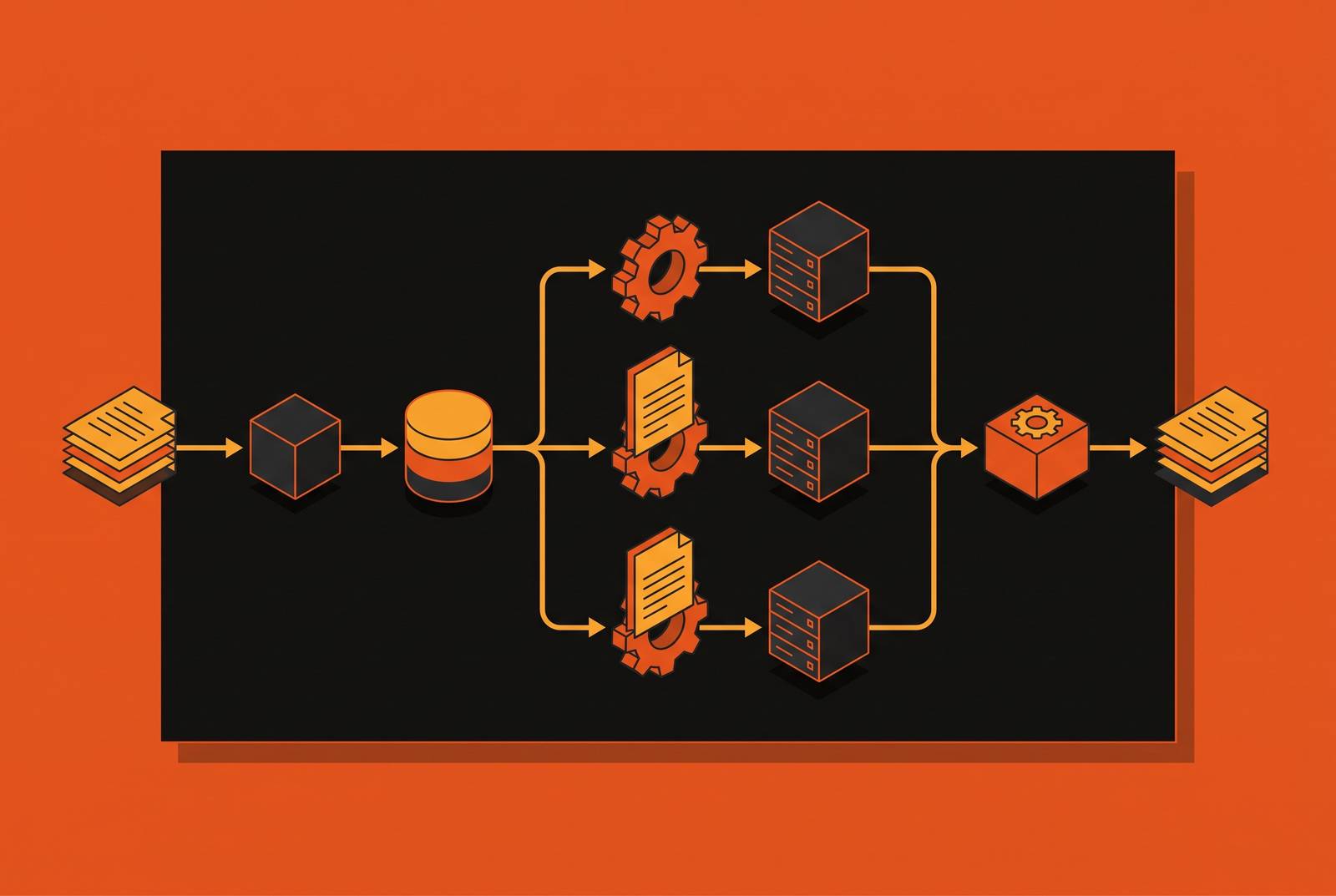
Orchestration carries a lot of this weight in practice. A DAG structure, fetch pending, parse, chunk, validate, mark complete, records what happened at each station, and if a step fails, the retry happens automatically while the operator's dashboard shows which document failed and at which step.
Text similarity isn't the bar for what "same output" means for a parser. Same page sequence, same reading order, and same table structure form the determinism guarantee that actually matters, because everything extraction does downstream depends on layout fidelity, not just on the words being present somewhere in the output. The classify stage offers a useful comparison here: classifying the same document twice yields the same label, and it's safe to simply overwrite the old result with the new one. Parsing should aspire to that same property. Getting there just takes considerably more engineering, because unlike classification, a parser's output has internal structure that has to match exactly, not just a single label that has to match. A 200-page document may parse pages 1–147 before a worker crash.
The extraction stage's idempotency contract, separate from parsing
Extraction looks like it should inherit parsing's guarantees for free. It doesn't. Extraction writes need their own keying scheme, (job_id, stage, page_number) with a uniqueness constraint, so a retried extraction can't produce duplicate page results. The key structure mirrors parsing's, but it's a genuinely separate constraint, because extraction is retried independently of parsing and can fail for entirely different reasons.
The sharpest of those reasons is confidence gating. Low-confidence extractions often get routed to human review or to a more expensive model. On retry, the same document can score differently and get routed down a different branch entirely, if the confidence threshold has moved or the underlying model has been updated in the meantime. That means the idempotency contract at this stage can't just cover what got extracted. It has to cover which routing branch the document took, because that decision is itself part of the state that has to be reproducible or at least auditable. The practical fix is to store the confidence score and the routing decision alongside the extracted fields, keyed to the specific job run, so that a retry producing a different score reads as a new decision rather than a silent correction of the old one.
The scale of that variance is not theoretical. A benchmark from the Fraunhofer IAIS and Lamarr Institute found the same top-performing model scoring 96.50% on clean digital invoices, 92.71% on scanned invoices, and 87.46% on scanned receipts, the same model, the same prompt, a nine-point spread driven entirely by document condition. A retry on a scanned receipt is operating against a meaningfully different expected accuracy than a retry on a clean digital invoice, and any idempotency contract that treats those two cases identically is going to be wrong about one of them.
There's a subtler failure mode buried in large-array extraction, the kind that pulls line items out of a multi-page invoice. A partial completion there can silently drop rows, and a retry that re-extracts the whole array afterward may come back with a different row count than the first attempt. That's not idempotent, and worse, it's not detectable at all without an explicit row-count validation step built into the extraction stage itself. Nothing about the pipeline's normal error handling will catch a quietly shortened array; it takes a check designed specifically to catch it.
Extraction idempotency needs deterministic field keys, stored confidence scores, recorded routing branches, and explicit completeness checks on any extracted array.
Multi-document splits and classification routing breaking naive idempotency assumptions
A single uploaded file is frequently a packet of multiple documents: a cover letter, a contract, three exhibits, all inside one PDF. The split step that breaks that packet into its logical pieces has to produce the identical set of child documents every time it runs, and that's a much harder property to guarantee than it sounds.
The naive approach fails in a specific and instructive way. If split boundaries get determined by a model, a classifier trained to detect transitions between document types, then a retry running against a newer version of that model can produce different boundaries than the original run did.
The split manifest itself needs to be written as an immutable record before any child document extraction starts, so that the boundaries are locked in before anything downstream depends on them.
Classification sits inside this same problem in a way that's easy to underestimate. Running a classifier on the same document twice is idempotent in isolation; the label comes back the same both times. But classification feeds routing, and if the routing decision itself isn't recorded, a retry can send a child document down a different extraction template than the first attempt used, even though the classifier's raw output looked identical. The mature version of this architecture routes the predictable majority of documents down a cheap, deterministic path and reserves a more expensive, agentic path for genuine edge cases. Idempotency at the routing layer, in that design, means recording which path got chosen, not merely what the classifier said. The split manifest, the classification result, and the routing decision all count as pipeline state that has to be persisted before downstream work begins; none of it can be safely reconstructed after the fact by inspecting outputs on a replay. Child document IDs derived from position, such as "pages 1–12," become stale if the split changes, leaving downstream records keyed to those IDs orphaned or duplicated. The safe pattern derives child document IDs from a hash of (parent_job_id, split_index, page_range) rather than from content alone, since content can be identical across splits, and stores the split manifest as an immutable record before any child extraction begins.
Designing idempotent output delivery so downstream consumers don't see duplicates
Idempotency has to hold at every hop in the chain. A pipeline that deduplicates flawlessly internally but publishes its result twice to a downstream message queue has still failed, in every way that matters to the system consuming it. That's an easy principle to state and a surprisingly easy one to violate in practice, because the internal guarantees can feel complete right up until the publish step.
Consumers on the other end of that queue have to assume duplicate delivery is possible, because most message queues default to at-least-once delivery rather than exactly-once, even though certain configurations, Kafka with transactions or SQS FIFO queues among them, can provide exactly-once semantics under the right setup. The idempotency key handed to those consumers should be the same triple used for internal writes, (job_id, document_id, stage), so a consumer receiving a replayed message can detect it and discard it rather than processing it twice.
The publish step itself needs to be atomic with the state transition that precedes it. Marking a job COMPLETE and publishing to downstream should happen inside the same transaction, or through a transactional outbox pattern, publishing only once the state change has actually committed, never before. Getting that ordering backward is how a crash between "mark complete" and "publish" turns into either a lost message or a duplicate one.
For the output store itself, the MERGE or upsert pattern does the heavy lifting: writing extracted fields into a target table by inserting new rows and updating existing ones to the same values is idempotent by construction, running it twice against the same source data leaves the target table in an identical state either way. Event-driven consumers need a parallel mechanism, a deduplication table tracking processed event IDs, checked before processing and marked after a successful write. The one adjustment specific to document pipelines: that event ID needs to encode the document's job_id, not merely a message broker's own ID, or the deduplication table loses the thread the moment a message gets redelivered under a new broker-assigned identifier.
None of this extends past the pipeline's own boundary, and that boundary needs to be explicit. Downstream agents that act on extracted data, triggering a payment, updating a record somewhere, are frequently not idempotent themselves. The pipeline's guarantee stops where its output lands; documenting that stopping point clearly is part of the design, not an afterthought.
Orchestration tooling and state machine design that hold the layers together
A state machine acts as the single source of truth, and all of the stage-level contracts described so far only hold together because of it. A reasonable version of that machine runs through PENDING, INGESTED, PARSED, SPLIT, CLASSIFIED, EXTRACTED, REVIEWED for documents that need human eyes, PUBLISHED, and finally COMPLETE or FAILED. Each transition is gated on the previous stage's output being committed as an immutable record; nothing moves forward without that. A retry, critically, re-enters at whatever state failed, not back at PENDING, and that single design choice is what makes stage-level resumability possible at all rather than theoretical.
Apache Airflow's DAG model is a common way to implement this in practice. Fetch pending, parse, chunk, validate, mark complete, structured as a DAG, gives visibility into every single stage, retries happen automatically and get logged, and the operator dashboard shows exactly which document failed and why, something a raw cron job or bare Celery setup doesn't offer.
Failure handling needs to go further than automatic retries, though. A structured self-healing pattern has an agent identify the failure, generate a fix, and then run that fix through compile checks, lineage verification, and a sandbox replay before anything actually changes, with agents never directly mutating files or executing shell commands. That layer of caution matters specifically in document pipelines, where a single malformed PDF can crash a worker in ways a generic data pipeline rarely encounters. And some documents simply won't process no matter how many times they're retried, malformed, adversarial, or deliberately obfuscated files fall into this bucket, and they need a QUARANTINED terminal state with a human review path rather than an infinite retry loop burning compute for no return.
The stakes for getting this orchestration layer right are rising. Gartner projects that 35% of enterprise AI workloads will run through agent pipelines by 2028, up from roughly 5% in early 2026. The orchestration layer built today to manage document idempotency is the same layer that becomes the control plane for agentic workloads at that scale, which is a strong argument for building it to be extensible from the start rather than as a piece of scaffolding meant to be torn out later.
Benchmarking and evaluation infrastructure for verifying idempotency-relevant accuracy
Most public benchmarks test accuracy against clean documents, and clean documents are exactly the case where idempotency is easiest to get right. They rarely evaluate the failure modes that actually break it: partial parses, dropped rows in large arrays, confidence scores that collapse once the input degrades even slightly.
OmniDocBench, accepted at CVPR 2025 and still actively maintained through 2026, covers 1,403 PDF files across 9 document sources, 19 layout categories, and 15 attribute labels, with Kimi K3 scoring 91.1% as of July 2026, a result that suggests genuinely production-grade parsing across most document types. But only 6% of its pages come from enterprise content, so the benchmark likely understates failure rates on financial filings, contracts, and regulatory submissions, paperwork that arrives scanned, stapled, and inconsistently formatted.
ParseBench, published in April 2026, was built specifically to close that gap. It draws on roughly 2,000 human-verified pages pulled from real enterprise documents across insurance, finance, and government, and it explicitly tests the failure modes that break production agent workflows. That distinction, testing for messy real-world failure rather than for accuracy on tidy samples, is exactly the evaluation posture a pipeline needs if its idempotency claims are going to hold up outside a demo. Trust the pipelines built and measured against that harder case, not the easier one.