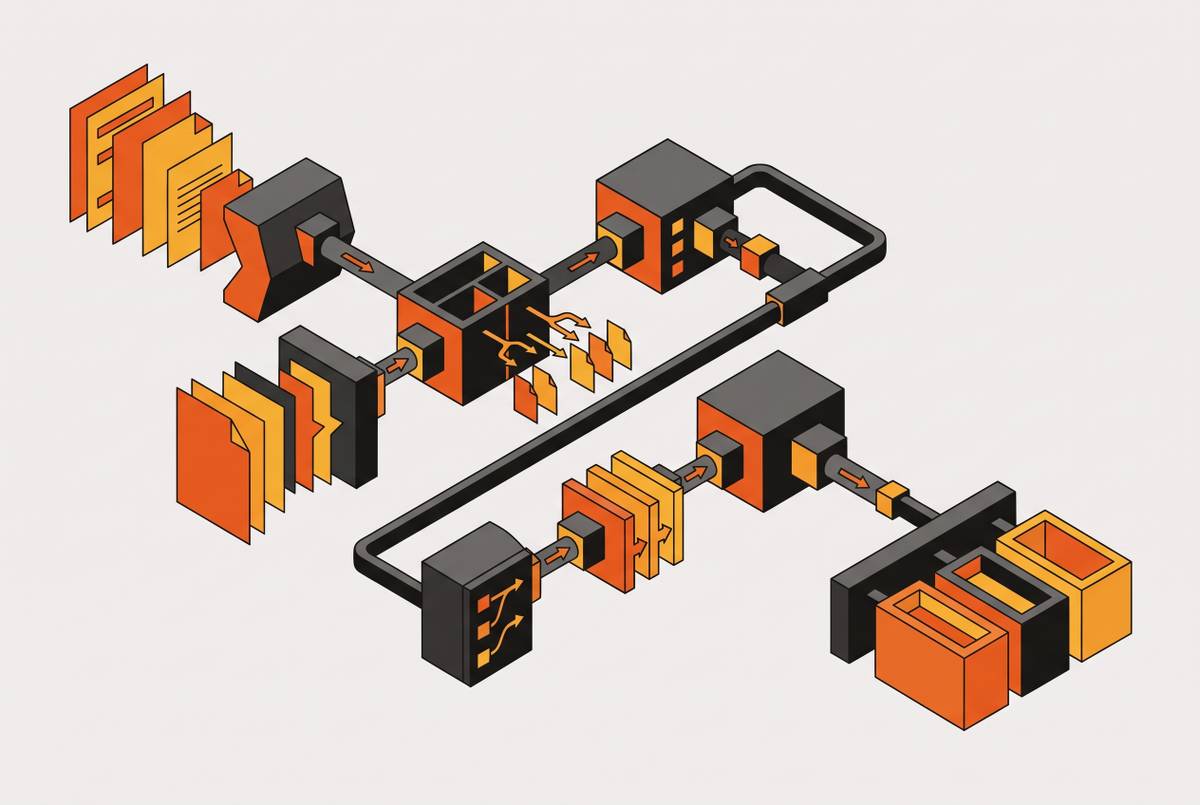
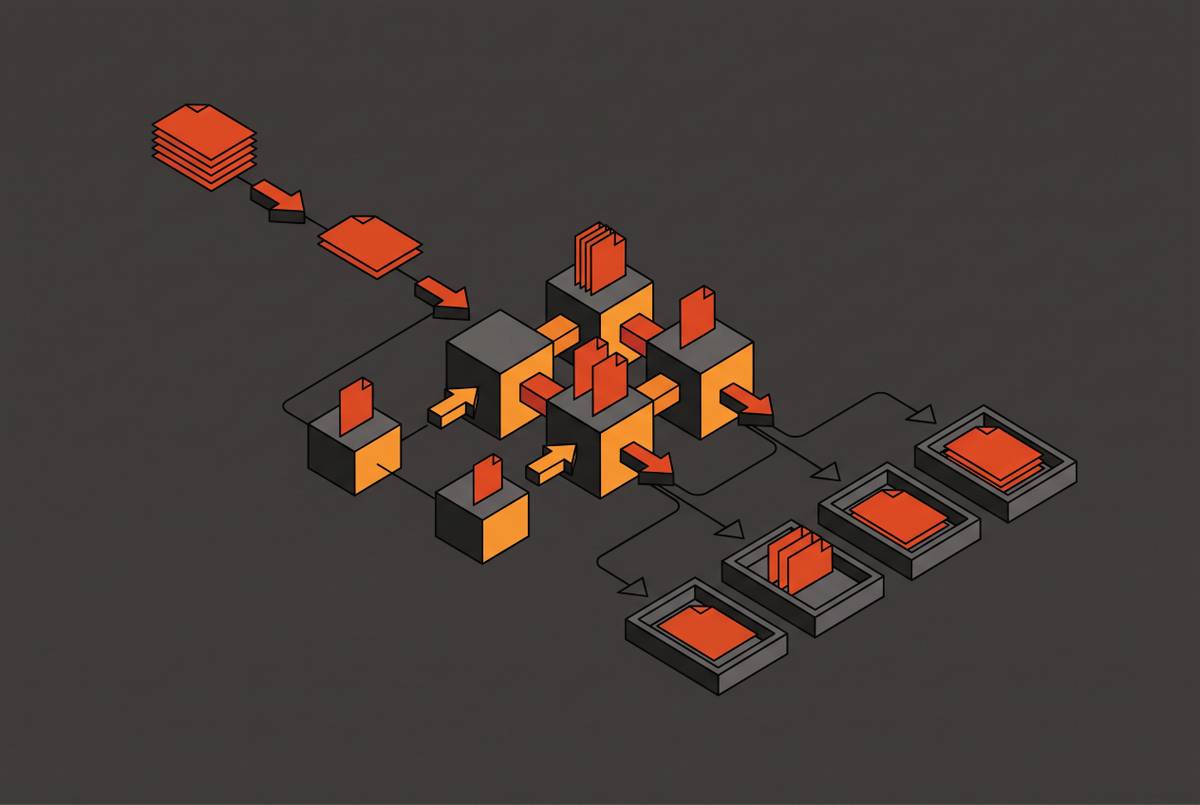
Async Document Processing APIs and Webhook Reliability Patterns
Document extraction needs different reliability patterns than payment webhooks.
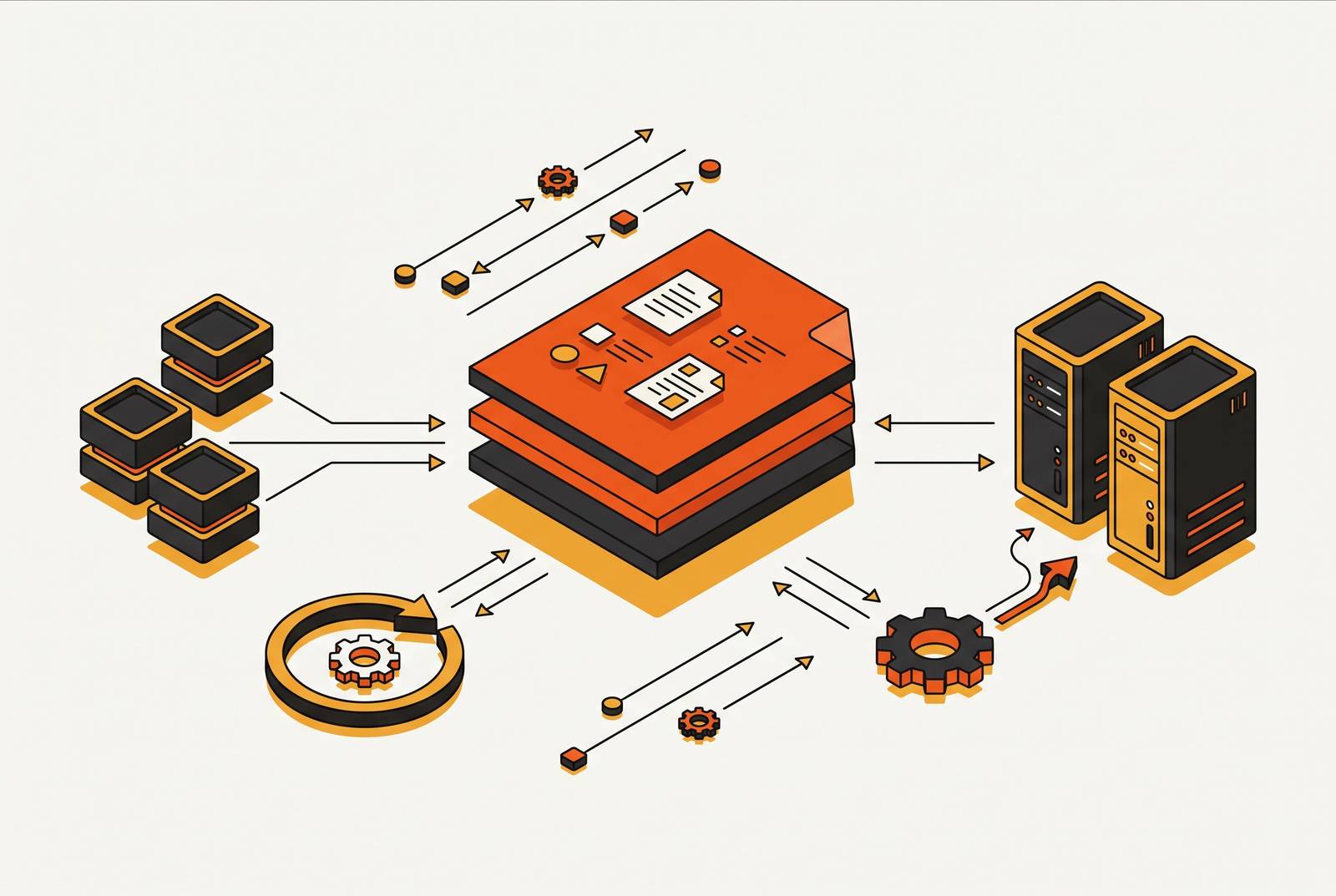
Async document processing breaks in ways payment webhooks don't, and most teams building document pipelines are still reaching for payments-integration advice that was never built for the job. A payment charge is a clean binary: it succeeds or it fails. A document extraction job produces a result and a confidence score, and that difference changes almost everything about how the pipeline should be built. This piece walks through why that gap matters and what to build instead of borrowing payment patterns wholesale. Async Document Processing APIs and Webhook Reliability Patterns.
Why Async Document Processing Creates a Different Class of Reliability Problem
Whether a document job should run synchronously or async comes down to what the document actually is. A single-page invoice processed while a user waits inside an app is a fine synchronous call. Past a certain volume or complexity, though, the job has to move async, and that move brings a failure surface that has nothing to do with how the sync version behaved.
The comparison to payment webhooks is instructive precisely because it breaks down. A payment charge either clears or it doesn't, and that binary makes payment webhook design forgiving in ways document pipelines never are. Document extraction produces a confidence score alongside its output, and unless a team specifically instruments for that score, a low-confidence result moves downstream looking exactly like a high-confidence one. Systems on the receiving end, AI agents making decisions off extracted fields, loan origination systems, accounts payable pipelines, often can't absorb a duplicated or missing record without real downstream cost.
The gap between a pipeline that works in a demo and one that survives production is wider than most engineers budget for, and the numbers back that up. A preprint titled "The Checking Problem" tested 72 configurations of document-heavy workflows and found that 57 cleared a demonstration bar by producing one correct run. Only 32 cleared a production bar requiring sustained accuracy, reproducibility, and a real confidence signal, a survival rate of 56.1 percent. The webhook layer is one of the places a configuration that looks solid in a demo quietly fails that bar, because demos don't surface burst traffic, retry storms, or the slow decay of a dead-letter queue nobody's watching. This guide frames the discussion around four concrete failure modes (slow acknowledgement, burst delivery, idempotency gaps, and silent failures), each addressed with its own pattern.
The four failure modes that break async document pipelines in production
Slow acknowledgement is the most common failure. Teams underestimate it first. If a webhook handler does any real work before it returns, writing to a database, calling a downstream API, checking a business rule, it risks blowing past the provider's timeout window. Missing that window causes the provider to mark the delivery failed and retry it, so the retry lands while the original delivery is still running. That's the standard shape of a duplicate-execution bug, and it's rarely rare in practice.
Burst delivery is the second failure mode, and it comes directly from how document jobs actually get submitted. Documents rarely trickle in one at a time. They arrive in clusters, including an end-of-month accounts payable run, an overnight batch of contract scans, and a bulk KYC upload ahead of a compliance deadline. A webhook endpoint without a queue in front of it can see 500 near-simultaneous deliveries when a batch of 500 invoices submitted together all complete inside the same narrow window. It drops events under that load, and a dropped completion event for a document job usually means re-running the whole job to recover the result.
Idempotency gaps are the third, and they follow from how providers deliver events in the first place: at-least-once, never exactly-once. Any transient failure, a timeout, a dropped connection, a slow database write, triggers a retry whether or not the first delivery actually succeeded. Without a way to recognize "seen this already," that retry runs the same business logic twice, so a duplicate record lands in the ERP, a duplicate set of extracted fields gets pushed to an AI agent, and a downstream workflow fires a second time. The bug is subtle precisely because nothing actually failed. The first delivery just answered slowly enough that the provider assumed it hadn't gone through.
Silent failures are the fourth, and they're the hardest to catch. A handler can return a 200 and never actually enqueue the payload. A worker can crash midway through a document and leave it in limbo. A dead-letter queue can sit filling up for weeks with nobody checking it. None of this trips a default monitoring alert, and document extraction adds its own version of the problem: a result that falls below a confidence threshold but gets passed downstream anyway, with no flag attached. That kind of data loss can take days to appear in monitoring, and by the time it does, fixing it means re-running the original ingestion job from scratch. Provider timeouts range from 10 seconds (GitHub) to 20 seconds (Stripe) before they mark delivery failed and retry.
Fast acknowledgement: separating receipt from processing
The fix for slow acknowledgement is simple to describe and easy to botch in the details: pull the HTTP handler completely apart from the worker that does the real processing. The handler's job stays narrow. It checks the signature, pushes the raw payload onto a queue, and returns a 202 Accepted. Nothing else happens inside that request. Parsing the payload, writing to a database, and calling a downstream system all move to a background worker pulling from the queue on its own schedule, off the provider's clock.
Signature verification has to happen inside the handler, before the payload ever touches the queue. Stripe, GitHub, and Shopify each sign deliveries differently, and pushing verification downstream means a team can end up queuing and processing unsigned or tampered payloads before anyone checks whether they should be trusted. That's a security hole dressed up as a reliability fix. Reducing latency does not solve this issue, and treating them as the same fix is a mistake.
The handler's response time should sit well inside whatever window the provider gives. The worker, meanwhile, gets the raw payload rather than a parsed or cleaned-up version, and runs its own validation and business logic from there. If the worker fails partway through, the message stays on the queue for retry. The provider already got its 200 by this point and won't resend the original delivery, so that retry becomes a purely internal matter, handled on the pipeline's own schedule rather than the provider's.
Document processing makes this split more urgent, not less, than it would be for a plainer webhook. A finished extraction result can carry a large structured JSON body, per-field confidence scores, and extracted tables running to hundreds of rows, and parsing and storing all of that takes real, measurable time. Bolt any synchronous downstream step onto the handler, updating a loan file, kicking off the next step in an agent's workflow, and that latency stacks directly inside the same window the provider is timing. Aim for 3 to 5 seconds as the practical response target, even though provider windows run from 10 to 20 seconds.
Queue architecture for burst-tolerant webhook ingestion
A queue is what absorbs burst traffic. The application server was never built to. Apache Kafka, RabbitMQ, and AWS SQS all buffer events between producers and consumers, but they don't behave identically: Kafka and SQS store events durably by default, while RabbitMQ needs its queues and messages explicitly configured for durability and persistence, which matters the moment a broker restarts mid-backlog. The payoff is load balancing and horizontal scaling on the consumer side, plus temporary storage that keeps events safe while the consumer service itself is down.
Picture the burst directly. Five hundred invoices submitted together tend to finish processing in the same narrow window, precisely because they were submitted together. Without a queue in front of the webhook endpoint, that's five hundred near-simultaneous deliveries hitting one handler at once. With a queue in place, the handler still takes all five hundred, but it runs the same three-step job for each one, verify, enqueue, return 202, and lets the worker pool drain the backlog at whatever pace it can actually sustain.
A dependable webhook setup has a few distinct pieces doing separate jobs, and none of them should be doing another's work. The HTTP handler verifies signatures, enqueues, and returns 202. The queue holds messages durably and in order. A pool of workers, built to be idempotent, pulls from that queue and does the real processing. A dead-letter queue catches anything that runs out of retries, governed by a redrive policy defining how those events get revisited. An append-only event log records every delivery that came through, and that log becomes the audit trail when something needs reconstructing after the fact.
Architecturally, this is a publish/subscribe pattern: the application publishes, the queue brokers, workers subscribe and pull. That structure lets one document completion event fan out to several independent consumers, storage, an agent pipeline, an audit log, without wiring those consumers to each other directly. None of this comes free, and teams that skip the cost accounting regret it later. A queue layer is more infrastructure to run and more surface to watch: message backlogs need their own monitoring and autoscaling policy, and retries carry a real risk of out-of-order delivery, a much bigger deal for data-sync workloads than for simple notifications.
Idempotency and deduplication in document extraction workflows
Idempotency here means processing the same webhook delivery five times produces the exact same end state as processing it once https://docs.benchling.com/changelog/webhook-ack-timeout-changes. That guarantee can't live in the HTTP handler alone. The worker code doing the actual database writes and downstream calls has to be idempotent end to end, or all the handler's discipline gets thrown away downstream.
The standard fix stores the provider's unique event ID, whatever it's called, delivery ID or job ID, the first time it comes in. Before any processing logic runs, check whether that ID has already been seen. If it has, return early and skip the business logic entirely.
Document workflows raise the cost of getting this wrong, and the cost isn't abstract. A duplicate extraction result written into a loan file isn't a cosmetic glitch, it's a corrupted record somebody downstream has to catch and manually fix. A duplicate confidence-score event can trigger a second human review request for a field a reviewer already cleared, burning review capacity on a problem that doesn't exist. Large-array extraction is the sharpest version of this risk: tables running dozens or hundreds of rows, where a silently duplicated set of rows in the structured output often stays invisible until someone runs a downstream reconciliation days later, and tracing it back to its source by then takes real digging.
Idempotency has to be enforced at the level of individual steps inside the worker, and not only at the top of the job. If a worker crashes after writing to the database but before the downstream API call, then restarts and retries from the top, it must not redo the database write it already finished. Step-level idempotency solves this by having each discrete action, a database write, an API call, a notification, check its own completion state before it runs, so a retry picks up where it actually left off instead of replaying the whole job. Where that state gets stored, a database row, a Redis key with a TTL, a dedicated idempotency table, changes the consistency guarantees a team actually gets.
Retry strategies and exponential backoff for document job completions
An async document pipeline has two separate retry surfaces, and conflating them is one of the more common design mistakes in this space. Provider-side retries happen when the document API retries delivery because it never got a 2xx response back. Worker-side retries are internal, involving the pipeline's own worker retrying a processing step, a database write, an API call, or a confidence-score check that failed on its own terms. These two need deliberate, separate design, because getting either one wrong produces a distinct failure mode. Misconfigure provider-side retries and events go missing without a trace. Misconfigure worker-side retries and the same job gets processed over and over without anyone meaning it to.
Exponential backoff with jitter is the standard fix for both, and skipping the jitter half of that phrase is a common shortcut that undoes the whole point. Start with a short initial delay, double it with each attempt, and add randomized jitter on top, whether that's a flat window like zero to one second or an amount scaled to the current backoff length. When a burst of documents fails at the same moment, which happens precisely because they were submitted together in the first place, backoff without jitter means every retry lands at the same instant again, recreating the exact burst the backoff was supposed to smooth out.
A dead-letter queue captures events that exhaust retries, with a redrive policy for later replay. It should only catch events that have already burned through every retry attempt, governed by a redrive policy specifying how many attempts happen before an event lands there, plus monitoring that flags someone the moment the DLQ's depth starts climbing. For document pipelines, an event landing in the DLQ almost never means a transient hiccup. It usually means the document itself has a real problem, such as a corrupt file, an unsupported format, or a confidence score that never cleared the threshold. That's a different signal entirely from a dropped network packet, and it calls for a person to look at the document rather than a system to retry it again.
Retry logic needs its own rate limiting too, separate from backoff timing. Document processing APIs commonly publish rate limits by account tier, and a retry storm triggered by a burst of failures hitting at once can blow through those limits and get the whole pipeline throttled or blocked, turning one localized failure into a system-wide outage.
Silent failure detection: confidence scoring, event logging, and replay
A 200 response proves exactly one thing: the payload arrived. It says nothing about whether it got processed correctly, and that gap is where the hardest failures in a document pipeline tend to live. A worker can crash after partial processing and leave a document in a state that's neither finished nor flagged for retry. A low-confidence extraction result can pass downstream with no flag on it at all, and when that happens, the error appears not in the pipeline but several steps later, as a wrong call made by whatever AI agent or downstream system consumed the unflagged result.
The defense against this starts with treating event logging as core infrastructure, not something bolted on after launch. Every webhook delivery should get an append-only record containing a timestamp, event ID, provider, a hash of the payload, processing status, and the worker's eventual outcome. That log turns a question like whether the completion event for job X actually got received and processed into something answerable, instead of something someone has to guess at.
Replay capability follows directly from that log, and it belongs in the build from day one, not on a backlog labeled "nice to have." When a bug ships and a batch of events fails silently under it, replay means running those failed events back through the fixed worker, without needing anyone to resubmit the original documents. Without a durable event layer, replay means someone manually querying logs and re-publishing events by hand, which is the real cost of skipping this piece early. For document pipelines specifically, replay has to pull from the original stored payload rather than re-fetching the result from the document API, since that API's result may have changed, expired, or stopped existing entirely by the time the replay happens.
Confidence scoring closes the loop on all of it, and it deserves equal billing with event logging and replay. A threshold that routes low-confidence extractions to human review, instead of letting them slide downstream unflagged, turns an invisible data quality problem into a visible, actionable one. Provider timeouts anchor the whole design: Stripe sets its webhook delivery timeout at 20 seconds, GitHub sets its at 10 seconds https://invokebot.com/research/webhook-reliability-patterns.html.