Orchestration Patterns for Document Ingestion Pipelines
System design, not model quality, determines whether document pipelines hold up in production.
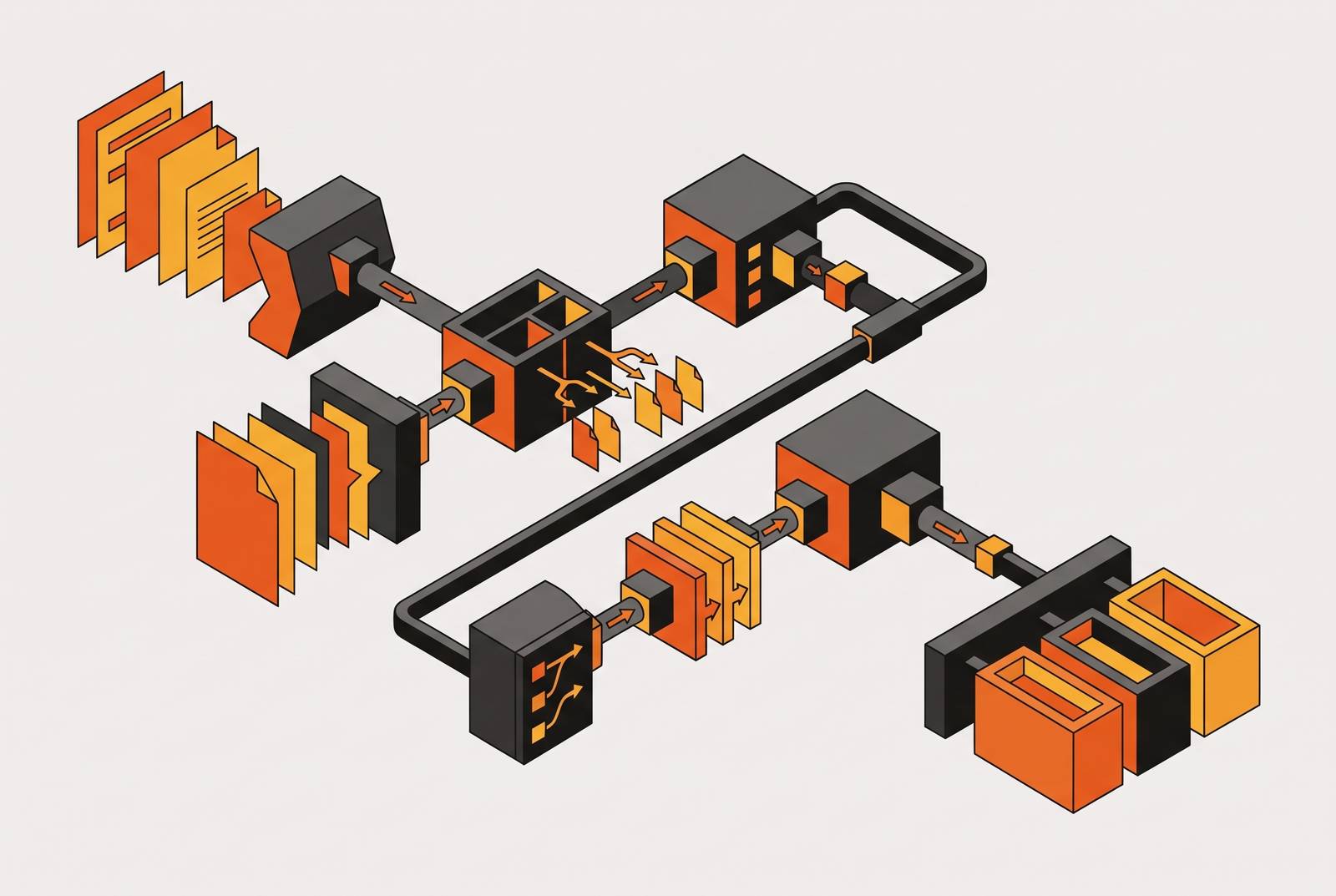
Document ingestion pipelines fail for reasons that have nothing to do with model quality. A parsing step drops a footnote reference, an extraction step reads a merged table cell as blank, and three stages later an agent hands a customer the wrong interest rate with total confidence. The orchestration decisions governing how stages connect, how failures move through the system, and how documents get routed between parse, extract, validate, and handoff determine whether a pipeline holds up in production, not the individual models sitting at each stage.
Engineers building these systems tend to treat ingestion as plumbing, a preprocessing chore that happens before the "real" work of retrieval and generation starts. That assumption doesn't survive contact with a dense table buried deep in a scanned financial report. It doesn't survive vendor invoices arriving in six different layouts from six different accounting systems. Kudra.ai's 2026 pattern guide documents exactly this failure mode: an agent encountering a dense table hallucinates numbers instead of reading them, cross-references between clauses go unresolved, and layout variance across vendor documents produces wrong answers with no error thrown anywhere in the chain.
At meaningful volume and document variety, a fragile ingestion layer doesn't fail occasionally. It fails systematically, and each downstream stage compounds the damage rather than catching it. ParseBench, a 2026 benchmark from Zhang et al. testing 14 parsing methods across five capability dimensions, found no single model dominant across all five. That result points away from compute and toward system design as the actual constraint. Better models help. They do not substitute for a pipeline architecture that knows what to do when something upstream goes wrong.
The five-stage pipeline model and coupling between stages as the core engineering problem
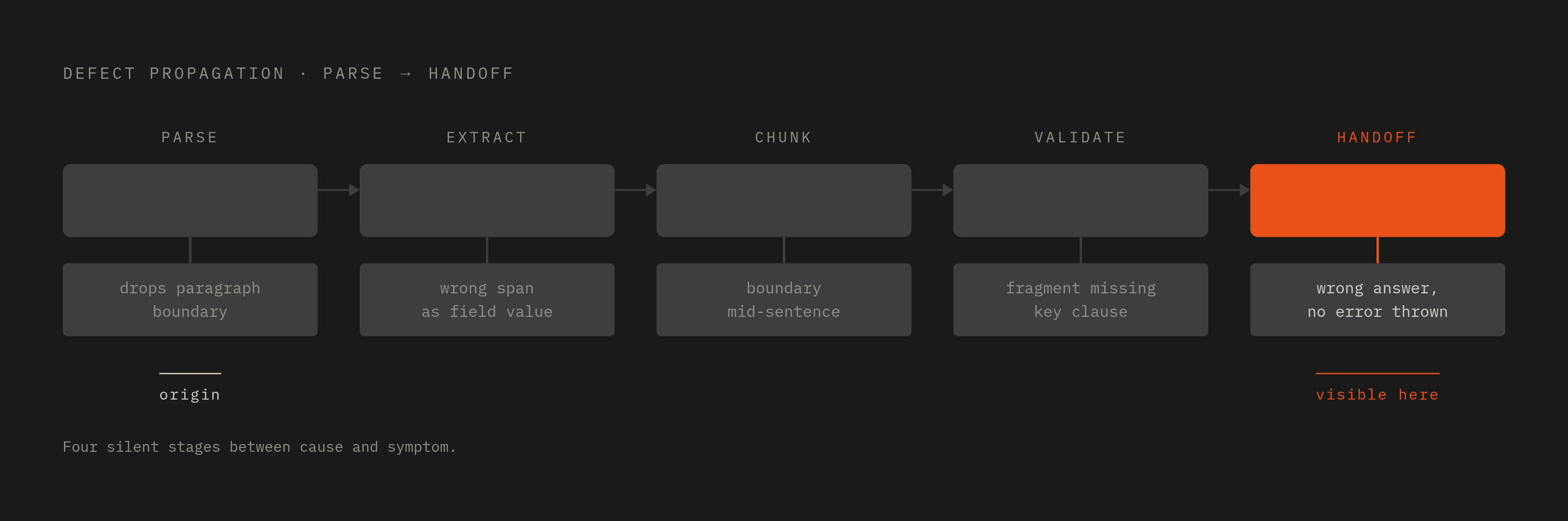
A document ingestion pipeline typically runs through five stages: parse, extract, chunk, validate, and hand off to whatever consumes the result, usually an embedding step or an agent-facing retrieval layer. On paper, these look like independent modules. In practice, they're tightly coupled, and that coupling is the entire engineering problem.
A parsing failure never stays contained to parsing. Missing a paragraph boundary during parse causes extraction to read the wrong span of text as a field value. Get the extraction wrong, and chunk boundaries end up in the middle of a sentence that mattered. Corrupt the chunking, and retrieval returns a fragment missing the clause that would have answered the question correctly. By the time this is visible, it looks like an agent error, some hallucination or reasoning failure, when the actual defect happened four stages upstream and left no trace pointing back to its source.
Treating any one of these stages as optional is how gaps get built into a pipeline before anyone notices. The gaps stay invisible during testing, because test documents tend to be clean and well-behaved. They appear at runtime, the moment a real document arrives with a layout nobody accounted for.
Two failure patterns recur often enough to name directly. The first is multi-page context loss: an extractor that processes pages in isolation has no way to resolve a field reference on page 9 that points back to a definition on page 2. The second is format fragmentation. A single ingestion queue might receive a digitally-generated PDF with a clean text layer, a Word document with heading styles, and a scanned image with no text layer. Run all three through the same uniform extraction logic and at least one of them returns garbage, quietly, formatted just cleanly enough to look correct.
A six-stage variant of this model, described by decryptcode.com, adds Source Monitoring and Metadata Enrichment to the core five stages. That extension matters for pipelines that need freshness tracking, knowing when a source document changed, and permissioned retrieval, knowing who is allowed to see what came out of it. Every orchestration pattern described below is an answer to one question: how do you stop a failure at one stage from moving silently into the next?
Batch, real-time, and hybrid ingestion: choosing the trigger model before choosing anything else
Before picking a chunking strategy or an orchestration framework, a pipeline needs a trigger model, and that choice constrains almost everything downstream of it.
Real-time ingestion fires on document arrival. It costs the most per document, because there's no opportunity to batch overhead across multiple files, but it's required wherever a delay carries a direct financial or safety consequence: loan decisioning, fraud detection, customer-facing intake where a stuck document means a stuck customer.
Hybrid or micro-batch ingestion works on short windows, seconds to a few minutes, and runs near real-time performance at a moderate cost. This is the right fit for high-volume queues where processing documents one at a time would rack up per-document overhead that a small batching window mostly eliminates.
Freshness gives this choice a concrete benchmark rather than a vague one. Decryptcode.com's pipeline guide sets the production target for critical sources at under 15 minutes from a document change to an index update, with an alert threshold once lag passes one hour. That's a number to design against directly, not an abstraction.
The trigger model isn't just about latency and cost, though. It decides what kind of validation and retry architecture is even available downstream. Batch pipelines can afford a synchronous validation pass, checking every field before anything moves forward, because there's already a processing window built in. Real-time pipelines can't wait on that. They need asynchronous confidence routing: let the document through, but flag anything below a confidence threshold for review while the rest of the system keeps moving.
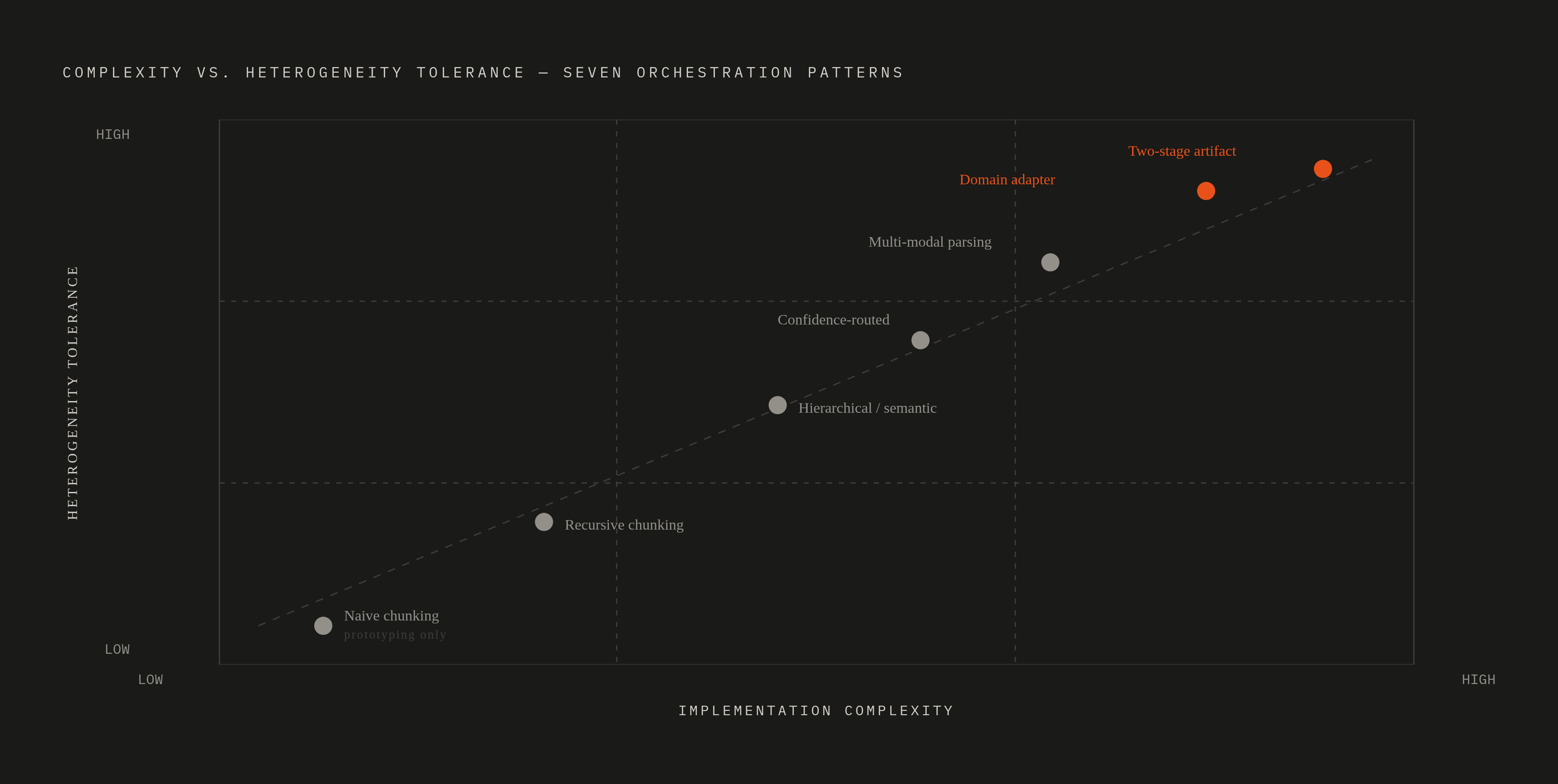
Seven ingestion orchestration patterns: architectures, tradeoffs, and applicability
None of the patterns below is universally correct. Each solves a specific coupling or routing problem, and picking the wrong one for a given document type is how a well-intentioned pipeline turns brittle.
Pattern 1: Naive fixed-size chunking. Split text at a fixed token count, with an optional overlap window, and pay no attention to sentence, paragraph, or section boundaries. A February 2026 benchmark run across 50 academic papers, cited in Kudra.ai's 2026 guide, found recursive 512-token splitting hit 69% accuracy, while naive fixed-size splitting performed markedly worse on documents with real semantic complexity. Naive chunking has exactly one legitimate use: prototyping, where the goal is isolating retrieval latency or embedding quality as variables. Once answer quality is on the line, it's not a suitable production pattern.
Pattern 2: Recursive, structure-aware chunking. This splits using a hierarchy of separators, paragraphs first, then sentences, then raw tokens, only descending to a smaller separator once a chunk exceeds the size limit. It respects document structure where structure exists and falls back to sentence boundaries when it doesn't, and per Kudra.ai it outperforms naive chunking with almost no added computational overhead. LangChain's RecursiveCharacterTextSplitter is the standard implementation, and it's a reasonable default baseline for prose-heavy documents.
Pattern 3: Hierarchical or semantic chunking. Split at structural boundaries first, headings and sections, falling back to paragraph and then token splitting only when a section runs oversized. Ibrahim Fadhili's March 2026 piece describes attaching a section_hint metadata tag to each chunk, so even a small fragment carries knowledge of which section it came from. This pattern earns its complexity on multi-page contracts, regulatory filings, and technical specifications, anywhere section identity is doing real work in determining what counts as a correct retrieval.
Pattern 4: Domain adapter, or pluggable analyzer. A DocumentAnalyzer interface routes each incoming document to a specialized analyzer, legal, financial, medical, before chunking ever happens. Fadhili's architecture keeps the core pipeline engine agnostic to document type; domain-specific logic lives entirely in the adapter. This lets one shared pipeline infrastructure serve a genuinely heterogeneous document corpus without rebuilding extraction logic every time a new document type appears.
Pattern 5: Multi-modal parsing with format detection. Before touching content, detect what kind of document is actually in hand: a digital PDF with a searchable text layer, versus a scanned image that needs OCR first. Fadhili's orchestrator routes accordingly, python-docx with heading preservation for Word files, pdfplumber for digital PDFs, and an OCR-based approach for scans that lack a searchable text layer. This pattern is the direct fix for the format fragmentation failure named earlier, and it matters most for any pipeline pulling documents in from multiple vendor sources with no shared file convention.
Pattern 6: Confidence-routed sequential validation. Confidence thresholds route low-scoring fields into a human review lane before those fields ever reach a downstream system. Fields that skip this check propagate silently, and that silence is the actual production failure, not the low confidence score itself. ParseBench found traditional layout-detection parsers scoring between 55% and 80% on its benchmark, so a real fraction of output from even a decent parser needs a second look. One well-documented sequential approach lays out a four-step version of this: extract fields, check completeness and flag anything missing, draft a summary for human review, then create the record, with a validation failure at any point routing into the review lane instead of continuing forward.
Pattern 7: Two-stage artifact layer with separated processing and indexing. Stage one produces a processed artifact, an extracted, structured representation of the document, stored in object storage. Stage two embeds and indexes from that artifact rather than from the raw file. shuvro.io's analysis of this pattern identifies the operational payoff as occurring the moment the embedding model changes: only stage two needs to re-run. No re-parsing, no re-extraction, no re-downloading of source files. It also opens the door to multi-domain indexing, the same underlying artifact feeding several different vector stores, each with its own embedding model and its own metadata schema. This is the pattern that makes model upgrades affordable and multi-tenant retrieval architecture workable at all, rather than a rebuild-from-scratch event every time.
How Failures Propagate and How to Contain Them
Every handoff between stages is a failure boundary, full stop. Design each one as though the next stage is going to fail, because eventually it will.
Idempotency is the discipline that keeps a retry from turning into a duplicate. A document delivered twice, or a message replayed after a timeout, must not cause double processing anywhere downstream. Scality's May 2026 enterprise orchestration guide flags this as especially critical in event-driven handoffs between teams, where nobody on the receiving end has visibility into whether an event already fired once.
Dead-letter queues handle the documents that fail parsing or validation after a set number of retries. Rather than blocking the main pipeline or, worse, dropping the document with no record, it moves to a holding queue for manual inspection. Silent dropping is the worst outcome available here, and it deserves to be named as such: for large-array extraction in particular, quietly dropping rows out of a table is a critical failure mode precisely because the output still looks valid. Nothing errors. Nothing logs. The row is just gone, and any accuracy benchmark that doesn't explicitly penalize this is measuring the wrong thing.
Decryptcode.com's guide sets concrete alert thresholds as a baseline: a failure rate above 5%, a queue depth above 1,000 documents, or a freshness lag above one hour, any of which should trigger active alerting rather than sitting quietly in a log file waiting for someone to read it.
Event-driven handoffs between stages decouple execution from scheduling. Each stage runs on its own clock and fires the moment the upstream stage commits, rather than waiting on a fixed schedule that assumes upstream is always ready on time. Scality's multi-pipeline coordination patterns identify this as specifically what prevents head-of-line blocking, one slow document holding up every document behind it in the queue.
Instrumentation and observability: why per-stage metrics are the only metrics that diagnose problems
Decryptcode.com's guide groups the useful metrics into three categories, and all three need to be instrumented at every stage, not just at the pipeline's exit. Throughput metrics cover documents processed per hour and current queue depth. Quality metrics cover parsing accuracy, sampled and reviewed, chunk quality scores, and embedding coverage. Freshness metrics track the time from a document change to the corresponding index update.
Domo's data integration guide describes a pattern for 2026 pipelines as a single orchestration framework managing both real-time and batch workloads under one visibility layer, so freshness metrics from the real-time side and throughput metrics from the batch side aren't sitting in two disconnected dashboards nobody cross-references. On the observability tooling side, Bitontree's agentic AI workflow guide names LangSmith and Arize Phoenix as example options for the observability layer in a minimal agentic stack.
The operational consequence of skipping per-stage instrumentation is specific: a parsing model that degrades slightly, producing output that's structurally valid but semantically wrong, can run for days without anyone noticing. Document-level validation catches outright failures. It does not catch a slow, systematic drift where every document still passes its checks but the numbers inside them are quietly off. Only per-stage metrics, tracked over time, catch that kind of drift.
Multi-team orchestration: when one pipeline grows into many
A mature AI program rarely runs one ingestion pipeline. It runs several, spread across product, research, platform, and security teams, all of them drawing from shared upstream documents and feeding shared downstream indexes. Scality's May 2026 enterprise orchestration guide treats this as the point where single-pipeline thinking stops working and a coordination layer becomes necessary.
Scality identifies four patterns that hold up at that scale. Asset-graph coordination has each team declare the assets it produces and what those assets depend on, with an enterprise orchestration layer reconciling the resulting graph so that an upstream update automatically notifies every downstream consumer. This maps naturally onto asset-centric orchestrators like Dagster, which builds in native asset lineage, or onto a task-centric orchestrator like Airflow paired with catalog tooling built on an open-source lineage framework.
Event-driven handoffs extend the same idea across teams rather than just across stages: team A's ingestion pipeline fires an event on completion, team B's training pipeline subscribes to that event and runs when it arrives, and every one of these cross-team events has to be idempotent for the same reason idempotency matters at the single-pipeline level, just with higher stakes and less shared context between the teams involved.
Shared infrastructure with per-team workspaces keeps the platform layer singular: one Kubernetes cluster, one object-storage endpoint, one identity provider, with each team scoped to its own namespace and IAM permissions. The platform team runs one platform, not a different platform for each consumer.
Governance sits above all of it. Lineage, data residency, and retention policy live one layer above any individual team's orchestrator, because that's the only place they can be enforced uniformly rather than reimplemented, inconsistently, inside every team's own pipeline.
The urgency behind building this coordination layer isn't theoretical. Gartner figures cited in Paperwise's document management guide put 67% of enterprise document processing initiatives now evaluating agentic AI approaches, up from 23% two years prior. That's a lot of organizations moving from one pipeline to many at roughly the same time, which is exactly the transition that makes multi-team coordination an urgent problem rather than a someday problem.
Orchestration tooling choices: DAG schedulers, event buses, and MCP servers
For pipelines with genuinely complex stage dependencies and retry logic, DAG-based orchestrators, Airflow and Prefect among the common choices, along with the durable-execution orchestrator Temporal, give dependency tracking, scheduling, and monitoring out of the box. Decryptcode.com identifies this as the right layer to reach for once a pipeline's dependency graph gets complicated enough that hand-rolled retry logic stops being manageable.
Dagster represents a different philosophy: an asset-centric orchestrator that models the pipeline as a graph of data assets rather than a graph of tasks. That framing lines up directly with the asset-graph coordination pattern described above, and per Scality's guide, it's a strong fit for teams that want lineage built into the orchestration model itself rather than bolted on afterward.
The newer layer worth watching is the Model Context Protocol, released by Anthropic in late 2024 as a way to expose tools, resources, and prompts to a model in a standardized format. By 2026 it has become the de facto method for that kind of exposure, with the surrounding ecosystem passing a substantial volume of monthly downloads according to arXiv:2606.20570. In a modern agentic ingestion pipeline, the orchestrator commonly sits on top of a set of MCP servers, each one exposing an internal system, a document store, a validation service, a metadata registry, to the agent in a consistent, addressable way. That doesn't replace the DAG scheduler or the event bus underneath it. It sits above them, giving the agent a stable interface to the same infrastructure the orchestration layer is already coordinating.
Sources
- Enterprise AI Orchestration: Multi-Pipeline Patterns
- Data Integration Best Practices: 15 Rules for 2026
- Build Document Ingestion Pipeline for AI (July 2026) | Extend
- Building a Resilient, AI-Powered Document Ingestion Pipeline for Smarter Search | by Ibrahim Fadhili | Medium
- 7 Document Ingestion Patterns Every AI Agent Developer Must Know in 2026 (Visually Explained)
- Building a Two-Stage Document Ingestion Pipeline for AI Agents at Scale
- AI Document Ingestion Pipeline | DecryptCode
- arxiv.org