Vision-Language Models vs Traditional OCR Engines
Each tool excels on different document types; choosing between them is about matching the problem.

Vision-language models and traditional OCR engines solve document extraction through fundamentally different mechanics, and each carries a distinct profile of strengths tied to specific document conditions. This is a matter of tradeoffs. The intelligent document processing market is a useful proxy for how much this decision now matters: Grand View Research puts it at $3.0 billion in 2025, growing to $29.7 billion by 2033 at a 33.8% compound annual growth rate, and other research firms land anywhere from $2.86 billion to $10.57 billion depending on how they scope the category. The spread comes down to definitions, but the direction isn't in dispute: enterprise document automation is scaling fast, and BFSI alone holds 25.0% of end-use share in 2025, with large enterprises accounting for 71.6% of revenue. Those are high-volume, high-stakes shops, and the growth means more engineering teams are inheriting document pipelines at production scale and hitting the real limits of whatever tool they started with.
The mechanical split comes down to pipeline architecture. Traditional OCR engines run as staged, deterministic chains: preprocessing feeds layout analysis, layout analysis feeds character recognition, and no stage can see the whole page at once or revisit a decision made upstream. A layout error in stage two corrupts everything character recognition produces afterward, with no way to recover. Vision-language models take the document image and generate structured output in a single forward pass, reading spatial relationships, table structure, and reading order directly from the visual field rather than from a rule-based segmentation step. That difference in architecture is what drives each tool's failure profile: OCR holds up on clean, uniform, printed documents where its assumptions match reality, and its throughput advantage is real, with classical engines running on ordinary CPUs at close to zero marginal cost per page; once complex tables, handwriting, non-linear layouts, or cross-page entity relationships enter the pipeline, those same assumptions become the ceiling, because no amount of preprocessing tuning touches a limitation that sits upstream of preprocessing entirely. VLMs pay for their flexibility in vision tokens, where rendering a page at native resolution generates thousands of tokens per pass, meaning more compute and slower inference, and compressing those tokens aggressively to cut cost risks losing exactly the fine-grained detail, superscripts, faint table borders, small text in degraded scans, that makes them accurate in the first place.
Many teams pick one tool and force every document through it. A blanket "use OCR" or "use a VLM" rule rarely survives contact with a real document mix; the right call depends on what the documents actually look like and what the pipeline needs the output to do.
How traditional OCR engines actually work and where their assumptions live
Traditional OCR runs as a deterministic pipeline: preprocess the image, binarize it, segment it into regions, match character patterns, output text. Each stage is its own model or rule set, handing off to the next in sequence. Text detection feeds layout analysis, layout analysis feeds character recognition, and nothing downstream can see the whole page at once the way a person reading it would.
That works fine when its assumptions hold: a clean scan, a printed font, a layout that looks like a standard form or a simple receipt. OCR got here through three rough eras. The classical era, roughly the 1960s through the 2010s, relied on image binarization, rule-based segmentation, and hand-built feature engineering, the approach behind Tesseract v3 and early ABBYY tools. The deep learning era, from about 2012 to 2022, swapped in CNN-to-LSTM pipelines with CTC decoders (EasyOCR, PaddleOCR, Tesseract v5) and later transformer-based recognition models like TrOCR and Surya. Since 2023, most new development in the field has moved to the VLM era, which is the shift this piece is really about.
The pipeline structure is also where mistakes spread. A layout analysis error in stage two doesn't stay contained; it corrupts everything the character recognition stage produces afterward, because that stage has no way to go back and recheck its assumptions. Tesseract, still the most widely deployed open-source classical engine, lands in the 70 to 90% accuracy range on clean printed text, and it gets worse on non-Latin scripts or scans that aren't pristine. That's a structural property of how the pipeline was built, stage by stage, each one trusting the stage before it. No amount of tuning fixes that.
The three specific document conditions where OCR breaks first
One production study found an OCR pipeline landing at just 64% accuracy across 200 annotated pages. Sit with that number for a second: it shows the gap between OCR's lab-clean reputation and what happens once real paperwork enters the pipeline, and the failure rate only climbs as document complexity does.
Complex layouts are the first failure point. Multi-column text, nested tables, and pages that mix body text with figures confuse the layout analysis stage, because that stage reads the page in a fixed scan order rather than a genuine reading order. Columns bleed into each other, and table rows flatten into single lines of run-on text.
Handwriting and non-standard fonts are the second failure point. Character recognition models train overwhelmingly on printed fonts, so handwritten notes or unusual typefaces come out garbled, and whatever system sits downstream can't make sense of the result. That's a mismatch between what the model learned and what the document actually contains, and no OCR vendor has solved it at scale.
Cross-page field relationships are the third, and probably the worst one for regulated workflows. OCR resets its context at every page boundary, so it can't hold a borrower's name on page one and match it against a reference to that same borrower on page six. Loan files, medical records, and legal contracts routinely need exactly that kind of cross-section entity tracking, and template matchers built on a page-by-page pipeline cannot resolve it, full stop. All three failure modes trace back to the same root cause: the pipeline's architecture. Preprocessing tweaks don't touch it, because the limitation sits upstream of preprocessing entirely.
How do VLMs process documents differently from OCR engines, and why does that change what's possible?
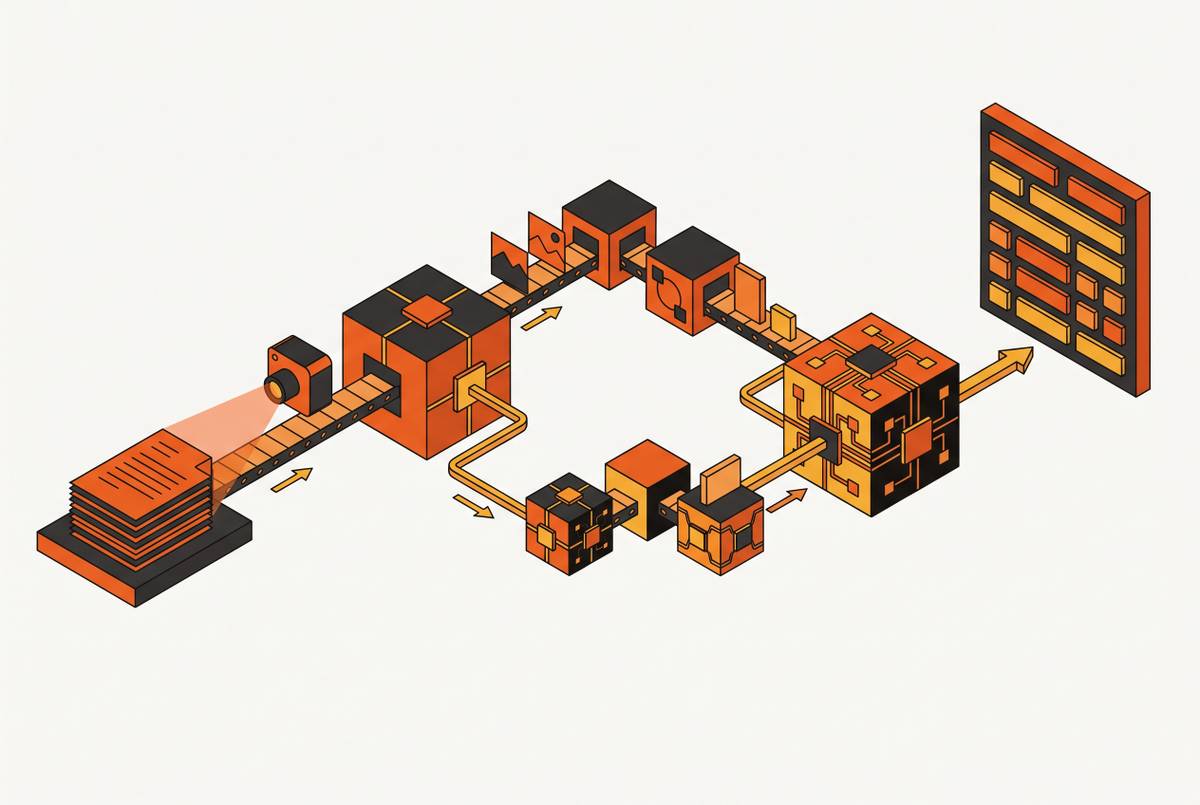
A vision-language model takes the document image and generates structured output (markdown, HTML, or JSON) in a single forward pass. There's no staged handoff between detection and recognition, and no context reset between one element on the page and the next. The model looks at the entire page at once and figures out spatial relationships, reading order, which cells belong to which table, how headings nest, straight from the visual field rather than from a rule-based segmentation step.
Two architectural approaches have emerged within this VLM era. Pure end-to-end models process the full page in one pass; olmOCR and GOT-OCR 2.0 fall into this camp. Hybrid systems pair a dedicated layout-detection model with a VLM that handles recognition per detected region, an approach used by MinerU2.5, PaddleOCR-VL, and dots.ocr. The hybrids cut down on system complexity compared to a classical multi-stage pipeline, but they still carry some risk of error propagation from that initial layout-detection step, and they give up some of the benefit that comes from optimizing the whole process end to end.
The real engineering tension sits in vision tokens. A typical document page runs around hundreds to thousands of words, and rendering that page at native resolution generates thousands of vision tokens for the model to chew through, which means more compute, more memory, slower inference. Compress those tokens too aggressively to save on cost, and the model starts losing exactly the detail that matters: superscripts, faint table borders, small text in a degraded scan. Different model builders are placing different bets on where to sit on that tradeoff, and those bets explain why one VLM handles dense tables well while another runs faster but blurs on fine print. This is the fault line where VLM capability diverges from OCR's, and where VLMs start diverging meaningfully from each other, too.
Where VLMs demonstrably outperform OCR engines in production
Tables are the clearest case, and it isn't close. dots.ocr, a 1.7-billion-parameter model released under an MIT license, scores 88.6 and 89.0 on the TableTEDS metric for English and Chinese respectively on OmniDocBench. Classical OCR struggles badly on this task, since character-matching pipelines have no built-in concept of table cell membership to begin with.
Mathematical formulas show a similar gap. Chandra, a 9-billion-parameter model, scores 80.3 on formula recognition, and dots.ocr achieves strong formula-detection performance despite its compact 1.7-billion-parameter footprint, well past anything a character-matching engine can produce on its own. Handwriting tells the same story: Mistral OCR v3 reaches 88.9% on handwriting recognition, a category that's close to a hard wall for classical OCR. Fine-grained detail matters too. Chandra scores 92.3 on tiny text recognition, and Mistral OCR v3 hits 96.6% specifically on complex tables.
Two other capabilities deserve mention even without a benchmark score attached. VLMs hold context across the full document, so they can track an entity mentioned on one page and match it against a reference several pages later, a capacity that OCR's page-reset architecture struggles to support. And in multi-column or non-linear layouts, VLMs work out reading order visually instead of forcing a fixed scan order onto the page.
One caveat matters here. OmniDocBench's best-in-class scores, around 92.6, don't always carry over to production. Models that top that leaderboard have sometimes lost in head-to-head human preference testing on OCR Arena. Treat these benchmark numbers as directional signals about capability, not a guarantee of how a model behaves on a specific enterprise document set.
Where traditional OCR engines still hold their ground
Clean, high-volume, uniform documents are still OCR's home turf: standard printed forms, invoices with fixed fields, simple receipts. The deterministic pipeline is fast and cheap precisely because the document matches its baked-in assumptions, and there's no reason to pay for a VLM's extra compute on a task this pipeline already handles well. This is where teams overcorrect after reading VLM benchmarks: they rip out working OCR pipelines for document types OCR was never going to fail on, and that's a mistake worth naming plainly.
Throughput at scale still favors OCR in most deployments. DeepSeek-OCR, a 3-billion-parameter model, can process over 200,000 pages a day on a single A100 by cutting vision tokens by a factor of 7 to 20, a genuinely impressive result. Even so, that still requires GPU infrastructure, while a classical OCR engine running on ordinary CPUs can chew through enormous volumes at close to zero marginal cost per page. Latency matters here too: VLMs generating thousands of vision tokens per page run slower than classical engines, and GPT-4o achieves strong accuracy on legal and educational content but carries higher compute overhead than classical engines.
Auditability is another point in OCR's favor. A classical engine produces the same output for the same input every time, which matters in regulated workflows where variable output creates compliance exposure that's hard to explain to an auditor. For offline or air-gapped environments, smaller CPU-runnable OCR engines can run without GPU infrastructure or an API call out to a third party, which matters directly for sensitive data environments with strict data-residency rules.
OCR's limitation shows up as a ceiling on what kinds of documents it can handle, within a range where its quality remains strong. For documents that fit its assumptions, it stays fast, cheap, and predictable, and those aren't small virtues.
What accuracy numbers from vendor benchmarks actually measure — and what they don't
OmniDocBench v1.5 is the community's main reference point, with best-in-class aggregate scores reaching around 92.6. But the benchmark runs on a curated document set, and curated sets tend not to capture the degraded scans, mixed-language pages, and odd layouts that show up in a real enterprise pipeline on a Tuesday afternoon.
Here's the part vendors leave out of the deck: the same model, evaluated within the same benchmark family, can post wildly different scores depending on document type, tables versus handwriting versus clean printed text. That variance is the real production risk, and it's exactly what a single aggregate score hides from view. Worse, benchmark rankings and human preference rankings don't always agree. OCR Arena has shown models that top an automated leaderboard losing in side-by-side human preference comparisons, which should give anyone pause about treating a benchmark score as a purchase decision.
So what's actually worth checking? Run the benchmark on documents that match the target workflow in type, quality, and language mix, not a vendor's polished showcase set. Look for scores broken out by document category, tables, formulas, handwriting, clean text, rather than one blended number, and look for confidence scoring that flags low-certainty extractions before they reach a downstream agent or database. Then run the eval on the production document set itself, not a demo corpus. Specialized models trained on the kind of documents a workflow actually produces consistently close the gap between what a benchmark promises and what a pipeline delivers.
A practical decision framework for choosing between VLMs and OCR on a given workflow
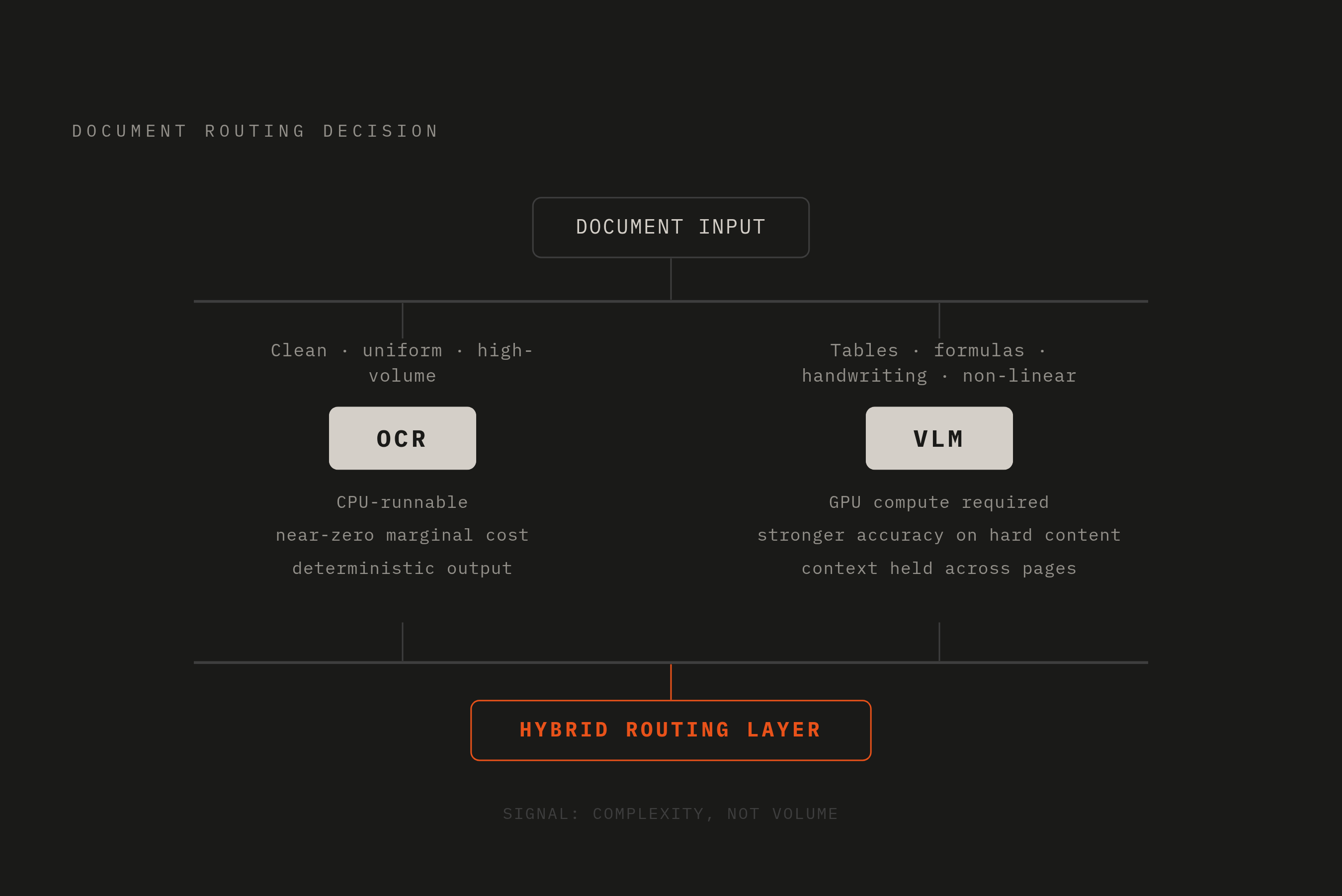
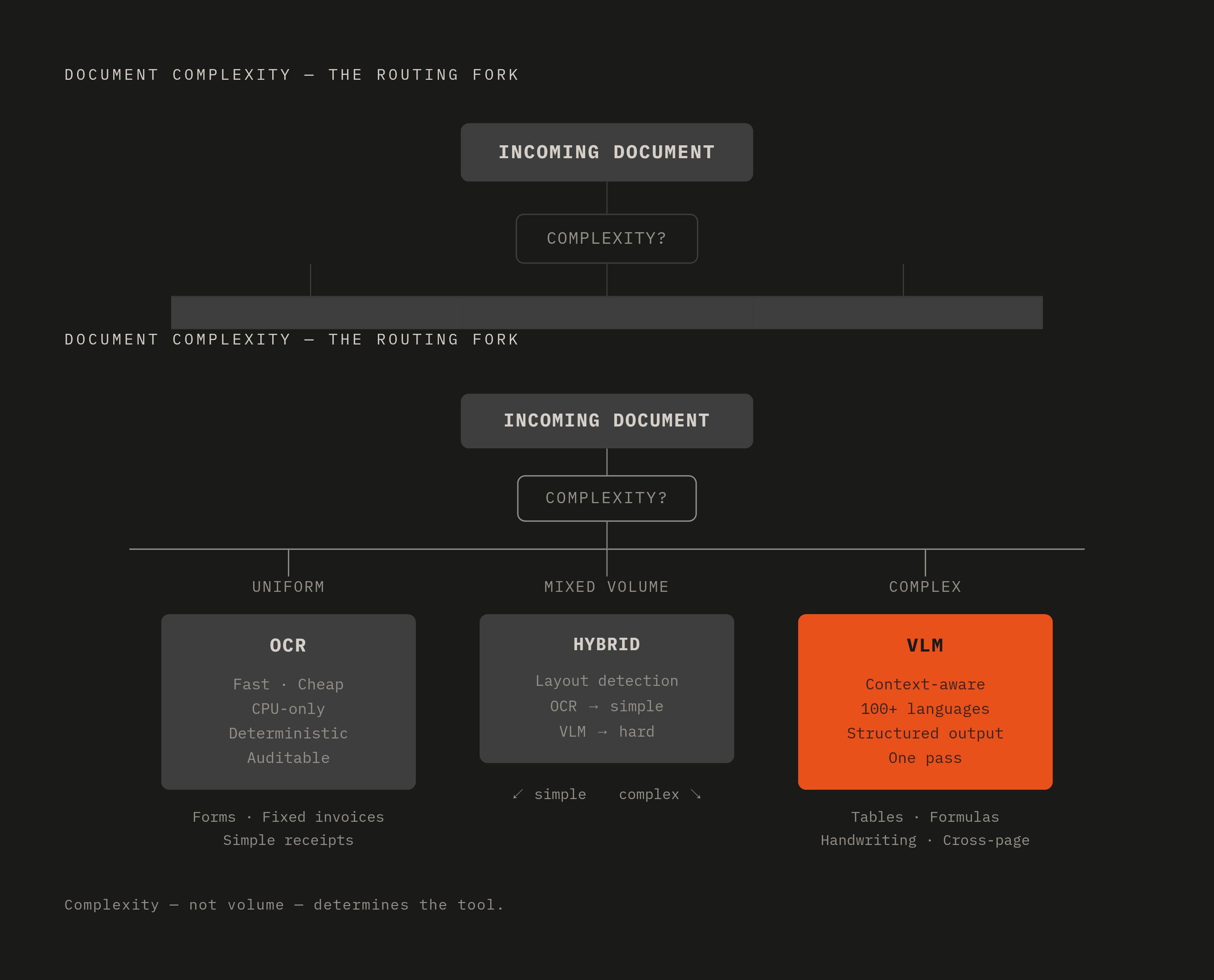
Document complexity, more than document volume, is the signal that matters most, and teams that anchor on volume alone tend to pick wrong. If the pipeline handles uniform, clean, predictable structure, standard forms and fixed-field invoices, OCR stays fast and cost-effective, and there's little reason to reach for anything heavier. Once tables, formulas, handwriting, non-linear layouts, or cross-page relationships enter the mix, a VLM becomes the stronger starting point.
A handful of secondary signals tip the decision one way or another. Throughput ceiling matters: a pipeline moving hundreds of thousands of pages a day at low latency needs careful thought about VLM token costs, and a hybrid setup, layout detection paired with targeted VLM recognition only where needed, can bring per-page compute down without giving up accuracy on the hard documents. Output type matters just as much: if the consumer downstream is a structured database expecting fixed fields, OCR plus template matching is often enough, but if an AI agent has to reason over the extracted content, the quality of the VLM's output directly sets a ceiling on how good that agent's reasoning can be. Language and script matter too, since OCR accuracy tends to drop on non-Latin scripts while newer VLMs like dots.ocr claim consistent accuracy across over 100 languages. Data sensitivity is its own axis: self-hosted, open-weight VLMs can meet data-residency requirements, but licensing terms vary and are worth reading closely. dots.ocr ships under a permissive MIT license, and licensing terms for any self-hosted model are worth reading closely before deployment.
For large enterprises running a genuinely mixed document diet, the honest answer usually involves both technologies working together. A routing layer that sends simple, high-volume documents to OCR and reserves complex or high-value documents for a specialized VLM cuts cost and lifts accuracy at the same time, matching each tool to the job it's actually built for.
The choice of parsing technology shapes what everything downstream, especially an AI agent, is capable of doing with the output. Reading order errors, missed table structure, and dropped cross-page references degrade downstream reasoning in ways that are genuinely hard to catch in testing and expensive to fix once shipped. Purpose-built document processing infrastructure, the kind that pairs hybrid computer vision with vision-language models and bakes in confidence scoring and evals, is what closes the gap between picking the right model on paper and actually running a reliable pipeline in production. Tools built this way let a team check extraction quality against its own real documents before an error ever reaches a user. That's the whole point.