Handwritten Text Recognition in Production Document Pipelines
Handwritten text recognition fails silently in ways printed OCR never anticipated.
Handwritten text recognition is not a slightly noisier version of printed OCR. It fails in ways printed-text pipelines were never built to catch, and treating HTR as a drop-in swap for standard OCR is how production systems quietly lose data, until a customer, an auditor, or a doctor catches the mistake. Printed-text OCR now runs at 98 to 99 percent accuracy on standard documents. Handwriting lives in a different world entirely, and the gap is structural. More training data doesn't close it.
Off-the-shelf OCR tools score around 60 percent on handwritten content. AI-powered systems push that closer to 95 percent under good conditions, but even the honest benchmark for a well-tuned HTR system, 3 to 5 percent character error rate, sounds small until it compounds across a ten-page intake form or feeds a downstream agent that treats every character it receives as ground truth. Four percent CER on a 2,000-character document means roughly 80 characters land wrong. Put those characters in a date field or a drug name, and the error stops being cosmetic.
The specific failure modes HTR introduces that printed-text pipelines never had to handle
Style variance is the first one, and it's the sneakiest. A model trained on one distribution of handwriting degrades on writers outside it, silently, with no error raised and no flag tripped. Accuracy just drops. A 2025 AIMultiple benchmark tested 100 cursive samples across 10 writers and found DeepSeek OCR scoring 79 percent, a 21-point gap from the top performer on the identical task. That's not a hard document. That's ten people writing normally, and one model falling apart on a chunk of them. The failure runs per-writer, not per-document-type, so a pipeline that works fine on one department's intake forms can fail quietly on another's without any change to the document template.
Layout ambiguity is the second, and it's the one most teams underestimate. Handwritten forms routinely mix printed labels with handwritten responses in the same visual region, and a parser that can't cleanly separate the two produces garbled structured output instead of clean field values. Crosilla, Klic, and Colavizza (2025, in the Journal of Documentation) found that traditional supervised HTR models make errors specifically because layout detection and text recognition run as two separate stages: a mistake in the first cascades straight into the second. Mixed print-and-cursive documents aren't just harder OCR. They're a distinct failure category, and they need to be engineered for as one.
Confidence collapse deserves more attention than it gets, because it's the failure that disables every other safeguard. Printed-text OCR confidence scores are a reasonably trustworthy signal: low confidence usually means the model is actually unsure. HTR breaks that assumption. A model can produce a high-confidence output on a badly misread character simply because it has no ground truth to check itself against. It isn't hedging. It's confidently wrong. That matters most for any downstream agent using confidence scores to decide whether something needs a human's eyes, because a collapsed confidence signal means the safety valve never fires. The system believes it did its job.
Ambiguous strokes invite a related problem: hallucination. When a character is genuinely unreadable, LLM-based HTR systems "complete" it based on surrounding context rather than what's actually on the page. Crosilla et al. found that LLMs show limited ability to self-correct these zero-shot transcription errors on their own, so the model's best guess and a plausible-sounding wrong answer look identical from the outside.
Reading order breaks down too. Handwritten margin notes, insertions, and arrows violate the left-to-right, top-to-bottom assumption baked into most document parsers. METATR, the multilingual benchmark covering documents in 29 languages, flags reading-order errors as critical failures under real-world conditions, not edge cases.
And then there's the failure mode that standard metrics don't even measure: silent row dropping. When a handwritten table or multi-row form is partially illegible, some pipelines quietly lose data from unreadable rows rather than flagging them for review. CER and WER only score what got extracted and say nothing about what got left out, so a pipeline can post a strong accuracy number while failing the actual task.
Why current benchmarks underreport how bad these failures get in production
Most published HTR benchmarks run on datasets like IAM, RIMES, and similar standard datasets: clean, single-language, well-segmented samples that look nothing like what shows up in a real intake pipeline. This critique applies directly to how HTR benchmarks are constructed. Benchmarks built by model developers tend to highlight whatever their own architecture handles well. Benchmarks built by end users tend to focus on one narrow document type. Neither tells a team processing large, messy, heterogeneous document collections what it actually needs to know.
Real-world results look worse. Pather et al. (2026) benchmarked frontier models against a real mixed medical form combining dates, printed text, and handwritten responses. The best models reached around 85 percent accuracy, with weighted F1 scores near 90 percent on discrete or predefined fields. That's from one relatively controlled real-world form, not a general pipeline swallowing whatever comes through intake. If the best-performing model still misses 15 percent on a single well-understood form, the number only worsens as document variety grows.
The metrics compound the problem, because CER and WER measure characters and words that got recognized and say nothing about rows or fields that got silently dropped. A pipeline that omits a quarter of the handwritten fields and transcribes the rest perfectly can post a strong CER score while failing the actual task completely. Teams grade the wrong thing, then wonder why the score doesn't match the complaints coming in from the field.
Here is the position worth taking plainly: benchmark numbers from published datasets are not a substitute for running evals on a team's own document population, full stop. Anyone who ships an HTR pipeline on the strength of an IAM or RIMES leaderboard score is shipping blind. Those evals need to measure field-level recall and row completeness, not character accuracy against a clean reference dataset. A model that looks state-of-the-art on IAM can still miss a quarter of a hospital intake form, and the published number will never tell anyone that.
How the model landscape actually breaks down for HTR, and what it implies for picking infrastructure
Two approaches dominate right now, and neither wins outright, though teams keep treating this as a horse race with a single champion at the end. Supervised specialized models, the Transkribus category, need manually annotated ground truth, though as few as 25 to 50 pages can be enough when a base model bootstraps the annotation process. They treat layout and recognition as separate stages, but they can be fine-tuned tightly to a specific handwriting style or language given enough labeled data. Multimodal LLMs take a different path: they accept raw, unannotated images, process layout and text together, and need no model-specific training at all. The tradeoff is that their performance swings unevenly across languages and document types.
Crosilla, Klic, and Colavizza (2025) found no consistent winner between the two. Proprietary MLLMs lead on modern English handwriting. On historical documents, Transkribus-class supervised models show no clear edge over MLLMs, and MLLMs specifically weaken on non-English text. Post-processing doesn't rescue either approach: the same study found LLM-based correction of zero-shot transcriptions doesn't meaningfully improve results and can't substitute for a person doing manual correction.
"Pick the best model" is the wrong question, and teams that ask it lose time chasing a leaderboard that won't hold up on their own documents. ParseBench's 2026 findings reinforce the pattern from the printed-document side: no single method stays consistently strong across every capability dimension, even before handwriting enters the picture. Handwriting just adds another axis on which methods fail inconsistently.
Routing, not selection, is the practical answer, and it's the piece most teams skip because it's less glamorous than picking a model off a leaderboard. Classify document type and handwriting characteristics first, then send each class to the model best suited for it. Routing to specialized models by document type consistently outperforms running everything through a single general-purpose model, across multiple benchmarks. General-purpose foundation models, applied without specialization or routing, aren't enough on their own, and that conclusion holds consistently across the 2025 and 2026 benchmarks.
The architectural decisions that actually contain HTR failure modes in production
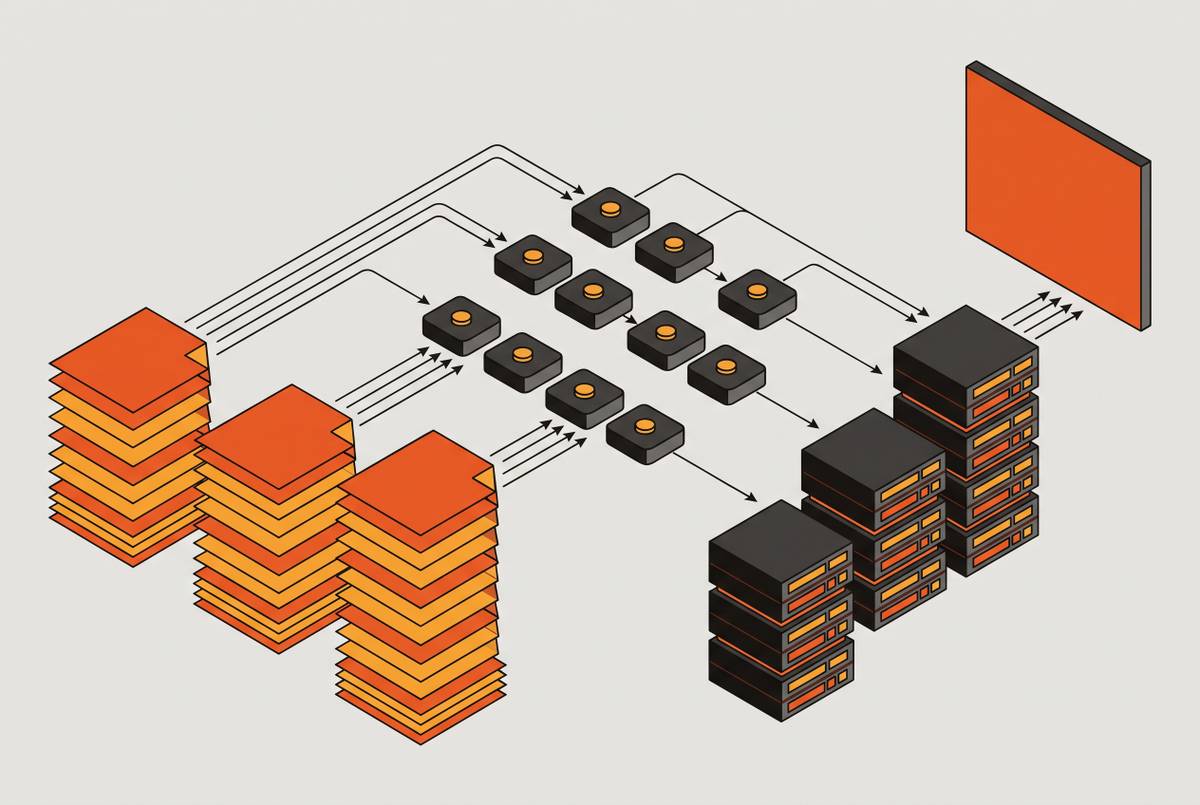
Handwritten and printed content need to be classified and routed before recognition happens, not after. A 2026 microservice architecture preprint (arXiv:2605.18818) treats hybrid classification as a first-stage design decision, separating GPU-bound inference from CPU-bound orchestration. The same logic applies directly to splitting HTR from printed-text OCR: decide the path early, and build separate handling for each.
Fallback paths are what make high completion rates possible in the first place, and skipping this step is the single most common mistake teams make when they scale an HTR pipeline past a pilot. A 2026 multi-agent pipeline (MADP), running on production data through January 2026, processed 955 documents and completed 926 of them, 97.0 percent, end-to-end without any fallback. The remaining 29, 3.0 percent, triggered a fallback to legacy OCR or manual review. That 97 percent figure only holds up because a fallback path existed for the cases the AI path couldn't handle alone. Without it, those 29 documents would have failed outright instead of routing somewhere useful.
Confidence scoring needs its own calibration for HTR rather than inheriting vendor defaults built for printed text. Since confidence collapse is the specific failure mode at play, the fix is per-field thresholds derived from evals on real document samples, and confidence scores below that threshold should route to a human review queue rather than pass silently downstream. Catching an error before it reaches a user is a product decision, not something bolted on after the fact.
Evals need to measure field-level recall, not character accuracy, because CER and WER miss silent row and field omissions entirely, which is exactly the failure that matters most for structured handwritten forms. Evals should run against a representative sample of a team's actual documents, not against IAM or RIMES, because METATR's 29-language benchmark shows how far confidence built on standard datasets can drop once real, messy collections enter the picture.
Latency is easy to underestimate, and most teams get it backwards. Teams often assume the LLM call is where pipeline time goes, but in hybrid architectures the recognition stage can dominate end-to-end latency. HTR typically runs slower than printed-text OCR for equivalent output quality, so pipeline SLAs need to plan around that, especially for high-volume intake. Asynchronous processing for IO-bound steps and independent horizontal scaling of the recognition stage are the mitigations the same paper points to.
Fallback needs to be an explicit, designed path, not a catch-all error handler bolted on afterward. Unrecognized formats, badly degraded scans, and low-confidence outputs should route somewhere defined: a human reviewer, legacy OCR for the structured parts of a page, or a second pass through a slower but more careful model. MADP's 3.0 percent fallback rate isn't a failure statistic. It's a design target, proof that the system knows what it can't handle and routes accordingly instead of guessing.
Image preprocessing carries real weight here, not the cosmetic role it plays in printed-text pipelines. Resolution, lighting, skew, and background noise directly affect HTR accuracy in ways they simply don't for clean printed scans. Skew correction, background denoising, and resolution standardization belong in the pipeline as a required stage, not an optional cleanup step tacked on when time allows.
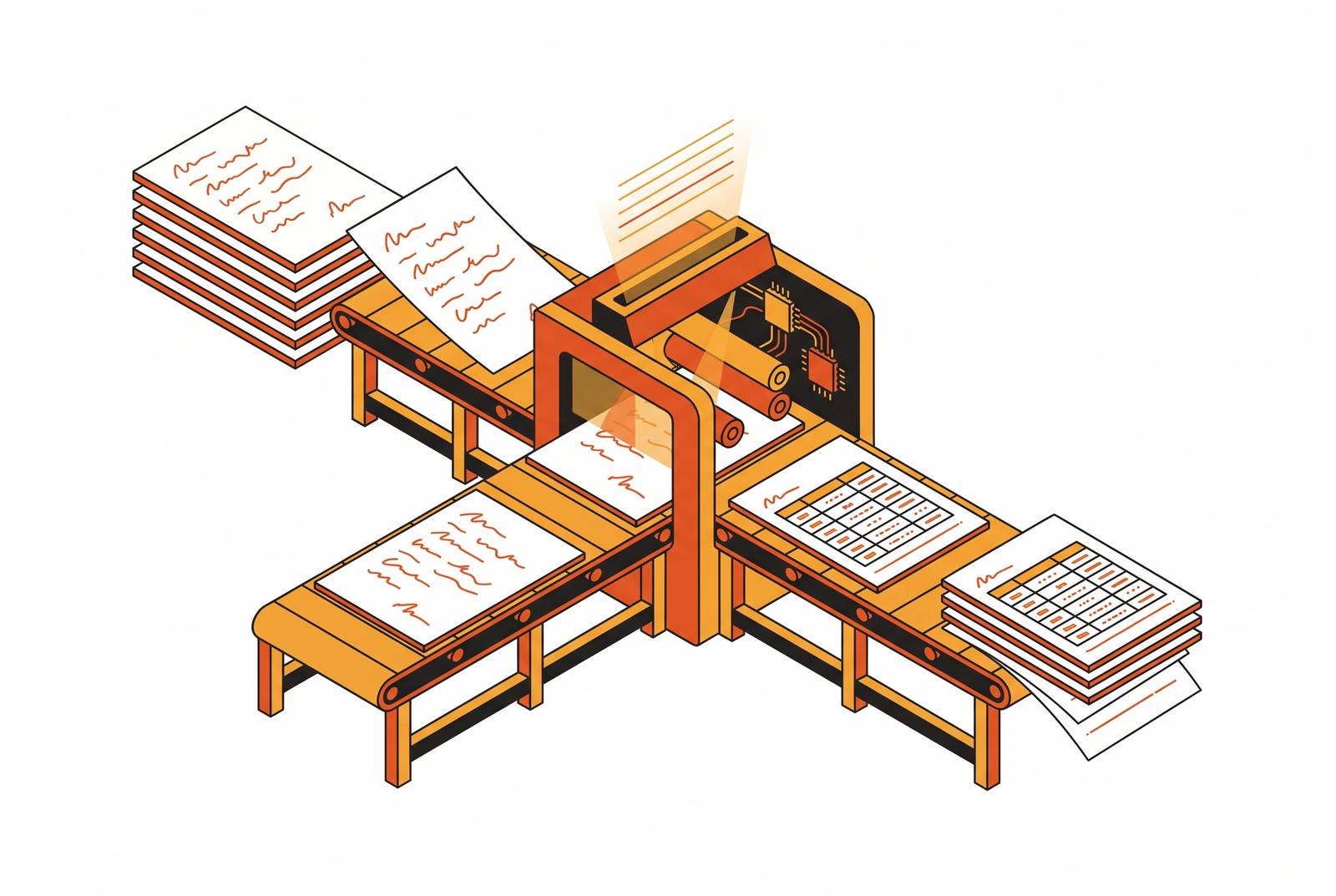
Structured field extraction and free-text transcription need to be handled as separate problems. Forms combining printed labels with handwritten answers require layout-aware parsing that can attribute each value to the field it belongs to; treating the whole page as one undifferentiated block of text produces garbled output. Mixed-format documents (dates, checkboxes, free text, and numeric fields together) benefit from field-type-aware extraction, and the Pather et al. medical form results back this up directly: no single model dominated across every field type.
Where HTR failure modes hit hardest: healthcare, financial services, and logistics intake
Healthcare stacks every hard problem on top of each other at once, and it's the domain where getting this wrong costs the most. Intake forms, clinical notes, and prescription pads combine non-standard symbols, drug names, mixed print-and-cursive handwriting, and field values where an error carries real clinical weight. Pather et al. (2026) ran their benchmark on a real medical form precisely because unconstrained handwriting shows up nowhere more starkly than in healthcare documents. AI-powered contextual understanding can pick out notoriously difficult drug names from messy handwriting, but only when the pipeline is built around the healthcare document distribution specifically, not treated as a generic handwriting task. Compliance isn't a separate conversation from architecture, either: HIPAA constrains where inference can run and how long data can be retained, so pipeline design and compliance are the same decision, not two.
Financial services carry a narrower but no less serious risk surface: handwritten signatures, dates, and annotations layered onto contracts and forms. The failure mode that matters most here isn't a garbled word. It's a confidently wrong reading of a date or a numerical value, the kind of error that looks clean and passes right through unquestioned. Mixed-format documents, a printed form with handwritten fields filled in, are the dominant pattern, so layout-aware extraction matters just as much as raw recognition accuracy. Audit trails and field-level provenance aren't optional either: a pipeline that hands back a single extracted string with no record of which field it came from or how confident the model was isn't ready for a financial workflow, whatever its accuracy score claims.
Sources
- Benchmarking large language models for handwritten text recognition | Journal of Documentation | Emerald Publishing
- Handwriting Recognition Benchmark with 14 LLMs & OCRs
- METATR: A Multilingual, Evolving Benchmark for Automatic Text Recognition
- OCR Accuracy Comparison 2025: Benchmark Analysis
- From Handwriting to Structured Data: Benchmarking AI Digitisation of Handwritten Forms