Production Monitoring for Document Extraction Pipeline Drift
Calibrated confidence scores and per-stage monitoring catch silent extraction failures.
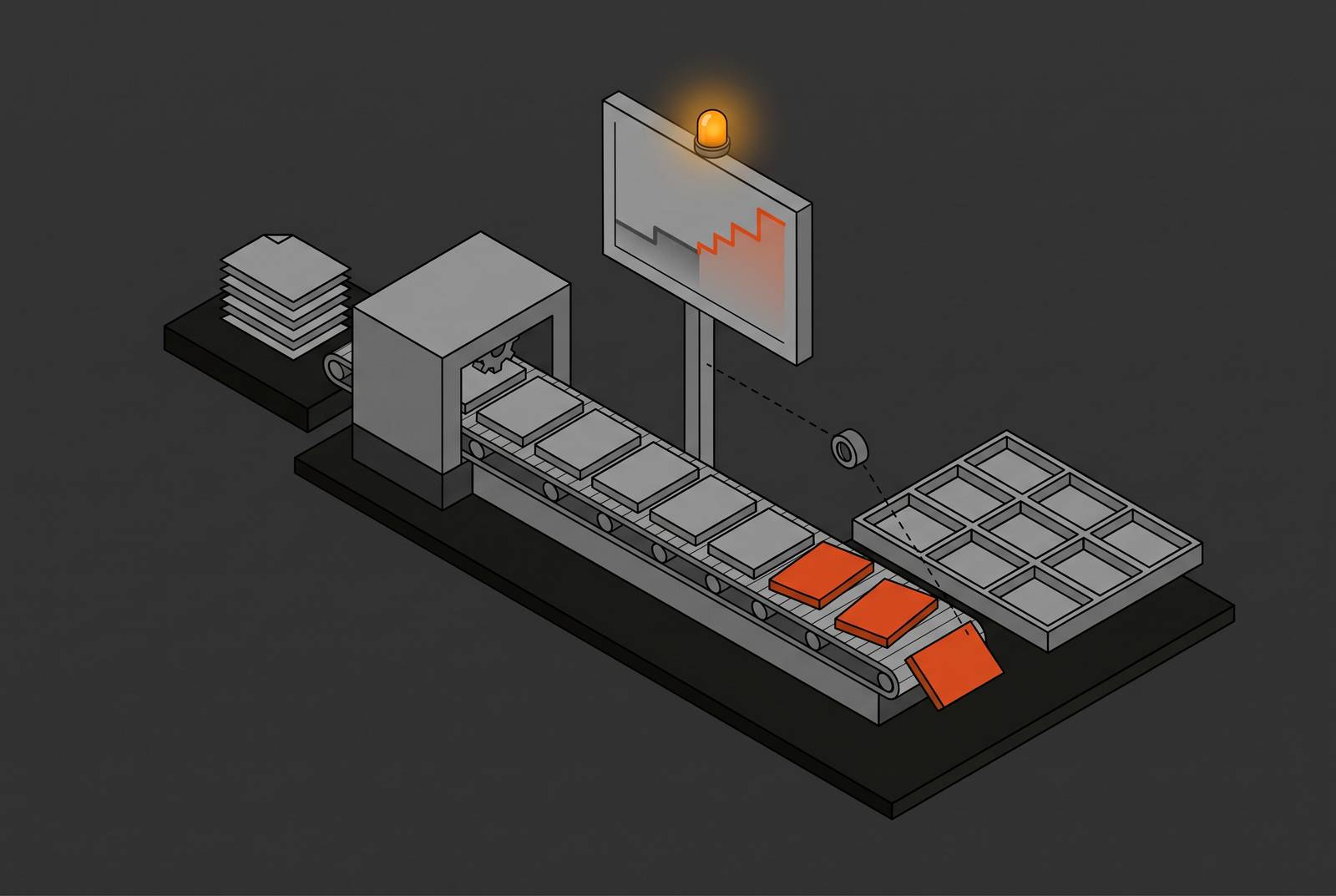
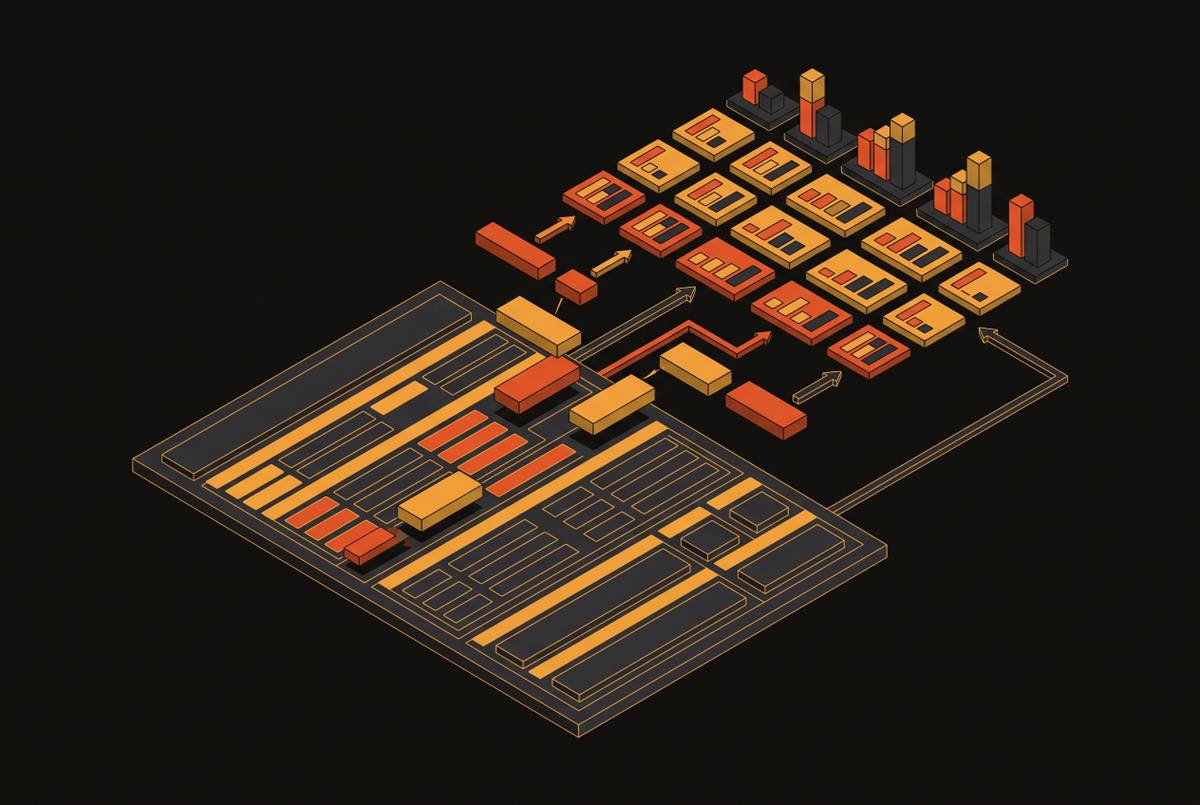
Production monitoring for document extraction pipeline drift helps keep an API that handles complex layouts reliable as the documents it processes change. High accuracy on clean PDFs is not enough for scanned invoices, multi-column documents, tables, and mixed formats. Production reliability requires per-stage instrumentation, calibrated field-level confidence, schema contracts, and defined response runbooks alongside aggregate metrics.
Why production document extraction pipelines degrade silently
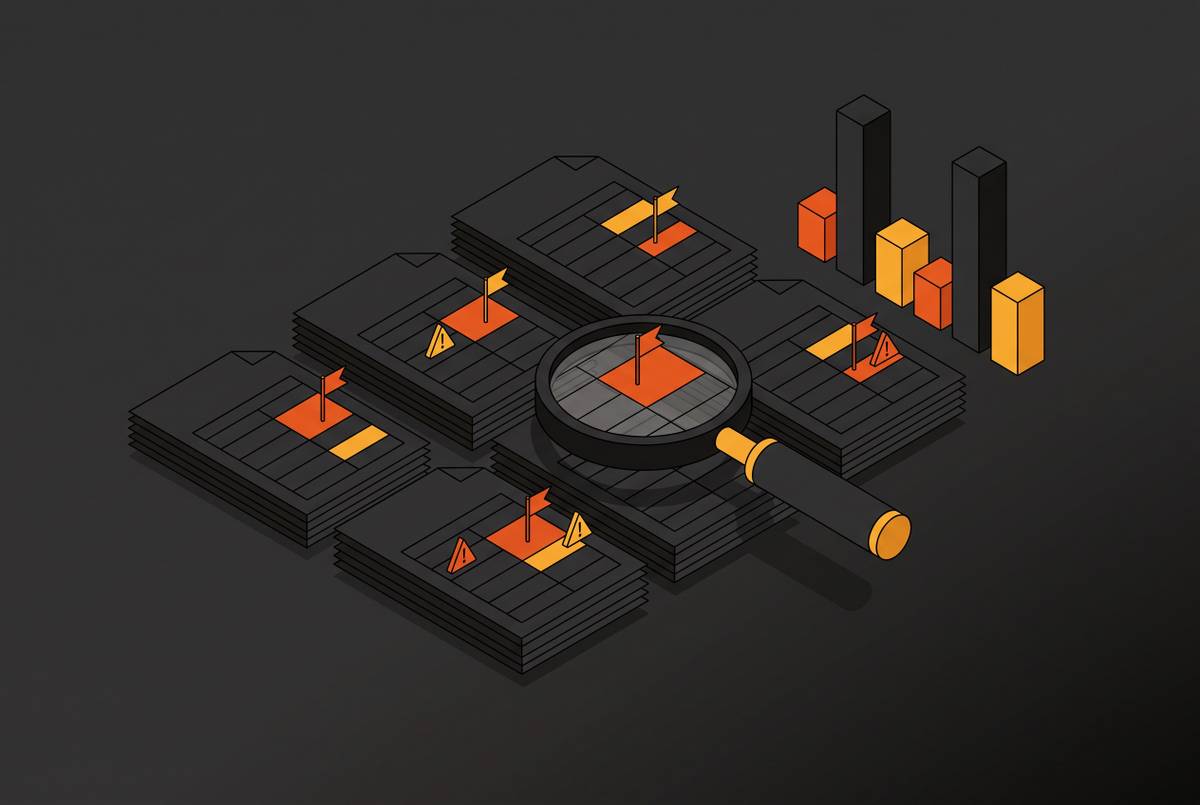
An engineer sees a pipeline that is running, while extraction quality is deteriorating beneath its success responses. Documents come in, jobs finish, and structured data flows to downstream systems. Nothing appears to have stopped working at all. Yet wrong fields can go unnoticed until reconciliation weeks later, because a job that finishes without errors can still have the wrong extracted values.
Three mechanisms explain this gap. Schema drift changes the structure that field mappings rely on, input distribution shift changes the mix of documents, and silent field-level failure lets values that are missing or misclassified pass as successful output. A supplier’s revised invoice layout can trigger the first, while growing volumes of an unfamiliar document type trigger the second. Either can cause the third without raising a pipeline error.
Without pre-processing, poor scans reach extraction directly, and without validation, incorrect fields leave it unchecked. Without an exception path, there is no audit trail for documents that are dropped. A missing correction feedback loop then turns a temporary accuracy dip into lasting degradation, because reviewer edits never improve the template or model responsible.
Why aggregate pipeline metrics cannot catch field-level drift
Overall throughput, total error rate, and end-to-end latency measure execution. An invoice pipeline can maintain all three while extracting incorrect line-item totals from a subset of vendor formats. The dashboard remains green throughout the resulting degradation. A small document slice can therefore accumulate errors without moving the overall error rate enough to attract attention.
The stages also conceal one another’s failures. A slow VLM call can disappear inside average pipeline duration, while a parsing error propagates through extraction, chunking, and embedding/indexing before weak validation passes it to an agent. A drop in throughput when input volume stays the same points to a stage bottleneck, but aggregate timing cannot show which stage it is in. Field-level accuracy against held-out ground truth shows whether the values in completed extractions are still correct.
Per-stage instrumentation as the foundation of drift visibility
To close this gap, each processing stage should emit its own signals rather than rely on a monitoring layer to reconstruct hidden operations. Ingestion records the source channel, arrival timestamp, original filename, and format. This is where the audit trail begins. It is also where duplicate arrivals must be visible, such as the same invoice generating two jobs.
Pre-processing should record DPI, blur detection, and any orientation correction it makes. Documents below the quality threshold should go into an exception queue before extraction to avoid an API call whose output cannot be trusted. Classification then records the assigned document type, classification confidence, and routing decision. That routing decision has consequences for every page. Misclassification causes the wrong extraction model and template to be used even when the later stages work as they should.
Extraction should show per-field confidence, which fields are missing or present, and accuracy against a held-out ground truth set. Validation should show which results are schema failures, which are cross-field business-rule failures, and which go through human-review routing. A layer that passes everything provides no protection. Each stage should also emit a trace span containing its timing, document identifier, stage name, and outcome, with OpenTelemetry providing cross-service tracing. Pydantic models, custom validation functions, structured central logging, and Prometheus stage metrics support this pattern, but clean stage boundaries are essential because a combined pre-processing and extraction function needs refactoring before the two can be instrumented independently.
Confidence scores as the primary early-warning signal for extraction drift
Confidence scores give the earliest available warning of extraction drift, but automation thresholds need to be calibrated against how often the model is right. A model can report high confidence while being correct far less often. The number alone is not a reliable probability. Practitioners should compare scores with a sample of human-reviewed outputs and establish an adjustment factor before using them to approve or reject fields.
Some LLM-generated scores systematically overscore ambiguous fields. For closed frontier models that do not expose token-level probabilities, verbalized confidence offers a viable production signal by asking the model to state its uncertainty. That signal still needs to be checked against reviewed outputs. Once calibrated, confidence can be used to approve high-confidence extractions automatically and send low-confidence fields for review before they reach downstream systems.
The useful trend is confidence by document type. A supplier’s layout change can lower scores for its invoices and enlarge the review queue while other document types remain stable. The same pattern can isolate one carrier’s bills of lading. Monitoring those slices links an early warning to the template or document source that needs investigation.
Statistical methods for detecting distribution shift in extracted fields
Confidence monitoring becomes more informative when paired with tests of extracted-value distributions. Numeric fields such as invoice amounts, quantities, and dates represented as numbers can be monitored with Population Stability Index, the KS statistic, Wasserstein distance, or JS/KL divergence on binned distributions. The choice depends on the field being compared. For skewed invoice amounts, these methods examine distribution changes rather than treating a stable average as evidence of stability.
Categorical fields require a different set of signals. A chi-square test detects changes in vendor-name or status-code distributions, while top-k tracking exposes newly appearing categories. A rising “unknown/other” rate can warn that unfamiliar documents are entering the pipeline. For free text such as clauses, addresses, and descriptions, embedding centroid shift and cosine distance compare current content with a baseline, while out-of-vocabulary rate and length statistics provide cheaper proxies.
A short window covering the last hour or day catches sudden batches or pipeline changes, a medium window smooths daily variation, and a long window exposes gradual drift. A known-good production baseline is more useful than a training baseline that does not reflect the live document mix. Seasonal pipelines also benefit from a same-period baseline from the prior year. Each comparison should retain document-type, vendor, region, or acquisition-channel slices so that stable aggregate distributions do not hide localized degradation.
Schema drift as a distinct failure mode with its own detection pattern
Schema drift is a structural break. An invoice’s line-items table moves from the first page to the last, or a supplier adds a column that invalidates positional mappings. A moved checkbox can leave an extractor reading the old location without an error. Statistical tests cannot make sure that fields are mapped as intended. Schema contracts and versioning address that separate failure mode.
Contracts at the extraction output boundary should flag required fields that become null and outputs whose types or values fall outside what is allowed. Per-field null-rate monitoring exposes sudden gaps in historically populated fields, while new fields or enum values can indicate an unsupported document variant. A new template version should run beside the existing version until validation establishes that it handles the changed format, preserving the old template for in-flight documents.
Industry-specific consequences of undetected drift
In healthcare, extraction failures in prior authorization documents can turn a flaw in the data into a delay in a decision. The operational consequence extends beyond the incorrect field. Required decision timeframes make delayed processing consequential even when the extraction service itself remains available. This is why successful job completion is an inadequate measure of reliability for documents involved in regulated workflows.
Logistics exposes the same gap through carrier-specific formats. Wrong port codes, missing quantities, or misread delivery confirmations can propagate from bills of lading and proof-of-delivery documents into customs paperwork and delivery reconciliation. Finance presents a different concentration of exposure. Vendor invoice fields flow directly into ERP systems, so a changed template can corrupt records before a reviewer sees them. A single high-volume vendor can account for disproportionate financial exposure even when its documents represent a small share of total count.
Compliance logging requirements that drift monitoring must satisfy
Compliance logging and drift monitoring should share an instrumentation layer because both depend on tracing a document through processing and review. Designing them separately creates an attribution gap. A service account or API key identifies the mechanism accessing regulated data, but it does not identify the individual who directed that access. HIPAA’s unique user identification rule, GDPR’s accountability principle, and SOX’s audit trail requirements make individual attribution necessary.
Stage records should connect the document identifier, stage name, and outcome with the identity of any human reviewer who touched the document, while access records identify the individual directing access. Retention must be designed into that same architecture. HIPAA requires required documentation to be kept for six years, so how long monitoring data used as compliance documentation is kept must take more than short-term operational needs into account. This makes the audit trail a product of the processing architecture rather than a separate reconstruction after an incident.
Defining drift budgets and alert thresholds before incidents occur
Detection becomes operationally useful only when teams define acceptable degradation before an alert fires. Business tolerance should specify minimum field-level precision for each document type as an absolute threshold. Operational tolerance should set the highest manual-review rate the team can accept. These limits address different forms of pipeline degradation. A system can preserve accuracy through review while becoming operationally unacceptable because its queue keeps growing.
Response SLAs should distinguish warnings from critical incidents in advance. A confidence decline confined to one vendor’s invoices may warrant investigation within a business day, while a null-rate spike in a field feeding a regulatory filing warrants immediate escalation. Statistical sensitivity alone should not determine urgency. Otherwise, every minor distribution change becomes a page, and the monitoring layer trains operators to ignore it.
A drift budget gives these tolerances an operating model analogous to an SRE error budget. Acceptable drift consumes the budget rather than remaining an unclassified dashboard trend. Meaningful consumption initiates investigation before tolerance is exhausted. When the budget reaches zero, escalation becomes automatic and documented, with the runbook specifying ownership and the appropriate response.
A response runbook structure for the four categories of extraction drift
The runbook should separate four incident categories because problems that look alike downstream can need different fixes. A sudden pipeline break appears through a short-window alert, reduced throughput, or an error spike. Pipeline integrity is the first investigation priority here. Upstream schema or encoding changes, new defaults, logging truncation, and outages activating fallback logic can resemble model degradation. The response should compare the current schema with the last-known-good version and roll back to the previous template when a schema change is confirmed.
Gradual confidence degradation instead calls for investigation of the document slice consuming the drift budget. Growing volumes of a new variant or seasonal changes in document mix can produce this pattern. Human review provides the evidence needed for remediation. The response should sample low-confidence documents, update an existing template or create a new one, and feed reviewer corrections into template or model improvement.
A schema contract violation requires a versioned structural repair. Null-rate spikes and new enum values can indicate a changed form, invoice layout, or carrier document variant. The existing template should not be overwritten during remediation. A new version should be deployed beside it and validated on a held-out set before live documents are routed through it.
An out-of-distribution document type requires containment before template reuse. Rising unknown rates, embedding centroid shifts, or unmatched document classes should route affected documents directly to an exception queue. Template creation and held-out validation precede production routing. Queue growth is an early signal to begin that work. Across all four categories, the runbook must name the response owner, escalation path, and remediation so that each detected failure has an accountable path to resolution.