Data Residency Requirements for Cross-Border Document Processing
Every hop in a document pipeline can silently move regulated data across borders.

Cross-border document processing requires a full-stack residency architecture. An enterprise document parsing platform must account for where source files, extracted text, embeddings, logs, and evaluation samples are processed, retained, and accessed. The right deployment depends on the document’s legal and contractual constraints, with controls that cover every copy and every operator.
Why "where the data is stored" is the wrong question for document pipelines
Data residency is where data is stored and processed, while sovereignty is which government’s laws control access to it. Localization imposes a legal requirement to keep data inside a country. These terms require different controls. Operational sovereignty adds another dimension by asking who administers the systems day to day.
A document pipeline makes those distinctions concrete because it copies content before the original reaches persistent storage. A hosted parsing service can tokenize, embed, cache, log, and retain document content for abuse monitoring in different jurisdictions. Prompts are part of that data path too. Sending a customer record to a parsing API can be a cross-border transfer even when the source file stays local. Assessing the selected region therefore requires tracing where data goes between ingestion and storage and who can reach it at every hop.
The six surfaces in a document pipeline where data crosses borders silently
Model inference is the first surface. A prompt sent to a hosted OCR or extraction API enters the region where that service runs, and its output logs contain data too. Telemetry and observability form the second surface. Traces, latency metrics, and error payloads can include document fragments that reach a centralized observability platform outside the approved region. An extraction endpoint can therefore be local while its diagnostic path is not.
Prompt caching is the third surface because intermediate results may be retained somewhere other than the inference endpoint’s region. Evaluation and quality sampling form the fourth. A central quality team can move full prompt-completion records from production into its working environment, then send them to a grading model in another jurisdiction. This creates a separate processing path beyond production inference. Auditing the customer-facing API alone leaves that path unexamined.
Fine-tuning feedback is the fifth surface because corrections and annotations to documents may reach the infrastructure the provider uses for training. Subprocessor chains are the sixth and can include transcription, safety filtering, evaluation, and support services in other countries. Each dependency widens the boundary under review. Primary storage restrictions do not constrain search indexes or backups automatically, and a global control plane may let foreign operators view metadata or escalate privileges. A local retrieval index does not make a global parsing API local processing.
The regulatory patchwork engineers actually have to satisfy in 2026
The following constraints serve as an engineering reference. In the EU and EEA, GDPR does not impose a blanket requirement to store EU data in the EU. Transfers nevertheless require a valid mechanism, including an adequacy decision, the EU-US Data Privacy Framework for certified US recipients, or Standard Contractual Clauses with a Transfer Impact Assessment. Inference location belongs in that assessment. A US-hosted parsing API creates a cross-border processing path even when primary storage remains in the EU.
Contractual requirements can be stricter than that legal baseline. Public-sector, healthcare, and financial buyers in Germany and other strict member states may require in-country or in-EU inference. The EU AI Act requires documentation, traceability, and post-market monitoring for high-risk systems as well as the transfers that must meet GDPR requirements. In the United Kingdom, UK GDPR and the Data Protection Act 2018 apply. UK adequacy regulations, the International Data Transfer Agreement, or the UK Addendum to the EU SCCs offer separate routes for transfers that must be assessed even when EU SCCs are already in place.
The United States has no federal blanket residency mandate. Procurement contexts including FedRAMP, ITAR, and CJIS can nevertheless impose US-only processing requirements. HIPAA and GLBA require sector-specific security safeguards but do not explicitly require US-only processing. State rules on AI and disclosure also apply. Geography alone therefore cannot establish whether a US healthcare or financial workflow meets its obligations.
China’s PIPL, Data Security Law, and Cybersecurity Law impose transfer requirements involving security assessment, certification, or standard contract filing for personal or “important” data. Saudi Arabia’s PDPL permits transfers only under specific conditions, rather than imposing a universal requirement for domestic processing. India’s DPDP Act permits transfers by default except to countries on a government-notified restricted list, which had not been issued as of early 2026. A shared pipeline must accommodate their overlap, so local operation, customer-held keys, or self-hosting may be needed depending on the combined requirements.
How healthcare and financial services document workflows are most exposed
PHI can appear in OCR output, extracted fields, retrieval index entries, and inference prompts. HIPAA obligations apply to those processing activities, while the GDPR and regional health data rules that apply set the residency requirements. Keeping the original clinical document local does not resolve the status of fields returned through a foreign endpoint.
The cloud Business Associate Agreements already in place may not fully cover those AI-specific routes. Model training, prompt retention, inference telemetry, and evaluation sampling all need to be covered as well as the original storage arrangement. A BAA is not a substitute for that review. If production extraction records become evaluation samples, the quality workflow needs its own controls on where processing takes place and who has access. Otherwise, the agreement and the deployed architecture describe different boundaries.
Financial document pipelines face a similar gap when records go into central systems for evaluation or logging. A compliant pattern begins with an in-country landing zone and keeps extraction and embedding in the same region. Feature stores and logs use customer-held encryption keys. Any cross-border movement requires a documented transfer mechanism. This ties the treatment of derived data to the controls around the core financial documents rather than treating evaluation records as exempt operational material.
Four deployment patterns that actually satisfy residency requirements, and what each costs
The architecture choice should follow the applicable rules, document sensitivity, and operational capacity. Region-pinned endpoints are the lightest pattern, placing inference, storage, the vector database, and metadata stores in one cloud region. Network egress policies deny public routing outside that region. Operational lift is comparatively low, but the scope is limited. An EEA location or applicable adequacy decision can address transfer requirements without resolving sovereignty exposure associated with a US-headquartered provider.
When regulated fields can be removed before remote processing, edge redaction offers a different trade-off. A CDN worker or regional API gateway strips PII and sensitive fields before routing anonymized content to a model, then reconstructs the response locally. Its attraction is low-cost coverage at the extraction boundary. Its weakness is completeness, because a missed field reintroduces exposure. Format-preserving encryption with keys in customer HSMs strengthens this pattern, although the redaction or tokenization must remain verifiable.
Federated observability addresses a different branch of the decision. It keeps logs, evaluation samples, and audit trails in regional sinks that can be queried without moving the data to a central environment. Quality evaluation must also run locally. This requires per-region log destinations and excludes a grading model that receives regulated samples in another jurisdiction. Running quality and audit workflows separately in each region adds cost compared with using one central pipeline.
Self-hosted or bring-your-own-cloud deployment offers the most restrictive boundary when the pipeline must remain inside the customer’s cloud account or on-premises environment. The customer takes responsibility for patching, scaling, and availability. In return, the architecture can keep every processing stage within the controlled environment, including a cardholder data environment for compliance with payment card security standards. Sovereignty still depends on who operates the systems and holds access. A deployment label alone cannot show that access from a foreign jurisdiction has been blocked.
Edge redaction can work with region-pinned endpoints and federated observability, while self-hosted processing can retain the same regional logging discipline. The decision turns on which paths may cross the boundary and under what conditions. A team with strict localization obligations has a different starting point from one permitted to transfer anonymized content. That architecture decision belongs before vendor selection, while the available controls remain unconstrained by a contract.
What a compliant document pipeline looks like end to end for RAG-based workflows
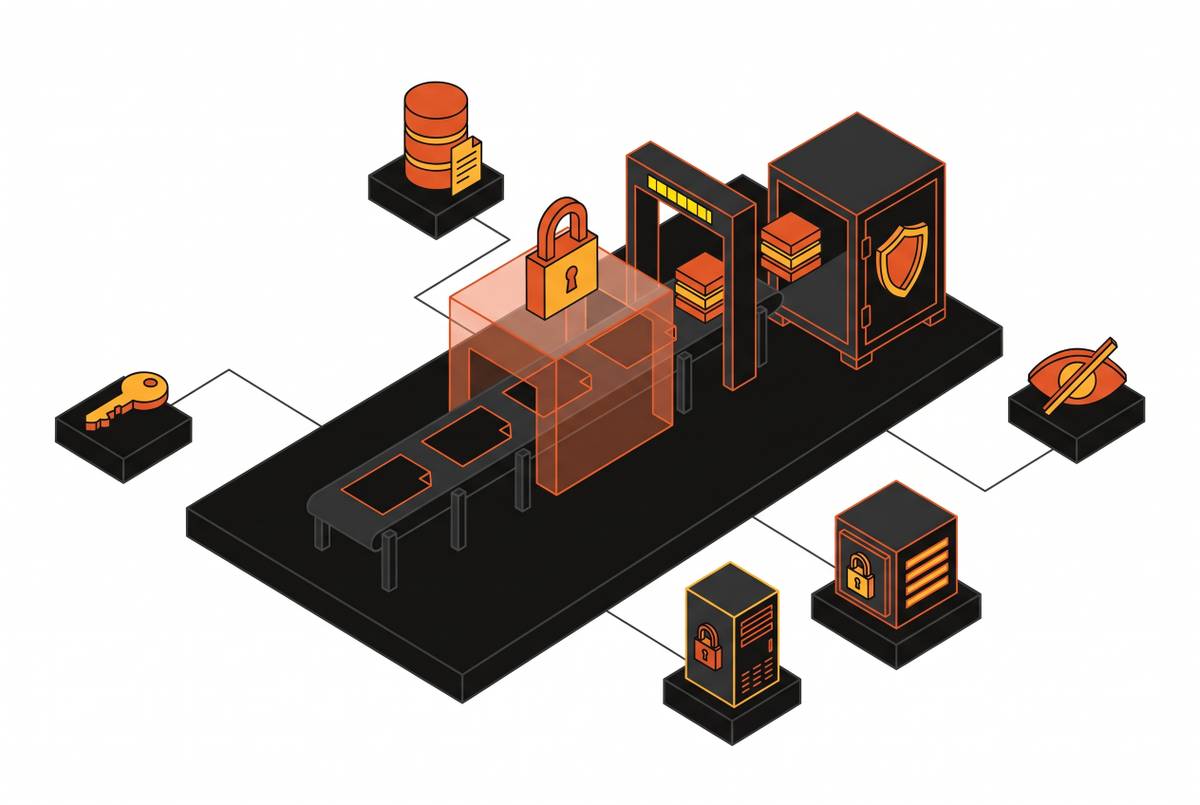
A residency-controlled retrieval-augmented generation workflow begins with documents entering an in-region ingestion pipeline. OCR, parsing, and PII detection run inside the boundary before content is allowed to leave it. Sensitive fields are tokenized using format-preserving encryption, and the keys are held in customer-managed HSMs. Chunking belongs within that controlled ingestion path. This keeps the source content and its retrieval-ready fragments under the same location constraints.
Embedding then uses an in-region model endpoint. The embedding is a derivative of the document and inherits its residency obligations. It is not exempt because its representation differs. The vector database and metadata store are kept in the local region, and network egress policies block public routing outside the boundary. Backup and disaster-recovery replicas must follow the same rules on where data is kept so they do not silently put it in another jurisdiction.
At query time, retrieval supplies chunks for prompts assembled within the controlled workflow. Those prompts go to an in-region inference endpoint for generation, and prompt and completion logs go to a regional sink. Quality sampling reads from the logs kept in that same region. If a grading model is used, it also runs in-region, so evaluation does not create a parallel export path. This preserves the boundary through retrieval, generation, and subsequent quality review.
The component map must also include the service dependencies. OCR engines, embedding models, vector databases, and observability tools need subprocessor review covering processing, storage, backup, and support locations. Vendors should provide named subprocessors and their locations, with a contractually binding list updated when the chain changes. The resulting architecture describes both where content travels and which organizations can handle it.
What to verify in a document processing vendor before signing a residency commitment
For procurement, the architecture becomes a set of evidence requests. The vendor should name physical locations for source files, parsed output, embeddings, retrieval indexes, inference logs, evaluation samples, backups, and disaster-recovery copies. One hosting-region answer does not cover that inventory. Buyers should also ask for a written account of how data crosses regions through support, security monitoring, model processing, and backup workflows. Each route needs a documented control.
Retention requires a separate review of the API data path. The vendor should state retention periods for safety and abuse monitoring logs and show how those periods apply to subprocessors. Zero data retention needs an explicit scope. A policy covering only primary storage leaves inference telemetry and evaluation samples unresolved. The vendor must also set out who owns the keys and whether customer-managed keys block access to plaintext by the vendor or through a foreign-jurisdiction access request.
Deployment evidence should distinguish BYOC, self-hosted, and shared services. In a BYOC arrangement that the customer controls, vendor support should need the customer’s explicit permission to gain access. Self-hosting can provide a tighter boundary when the full pipeline and its administration remain under customer control. A private cloud network boundary alone is not enough. Access, logging, retention, and subcontractor controls still need documentation, because network placement does not answer who may operate the service.
SOC 2 provides independent auditing of security controls, while PHI workflows require appropriate HIPAA commitments and an available BAA. GDPR documentation should identify processing locations, transfer mechanisms, and subprocessors. For cardholder data, self-hosted deployment can support an environment compliant with payment card security standards within the customer perimeter. These documents support the architecture review.
The strongest procurement outcome is infrastructure with a demonstrable boundary. Zero data retention, customer-managed keys, BYOC and self-hosted options, and security and privacy controls set out in writing give engineers specific commitments they can test against the pipeline map. A vendor that can substantiate those commitments offers more than regional hosting. It provides the evidence needed to assess cross-border document processing as a complete system.