Evaluating Document Parsing Services for High-Throughput PDF Pipelines
Three accuracy layers reveal parsing failures that character scores alone cannot predict.
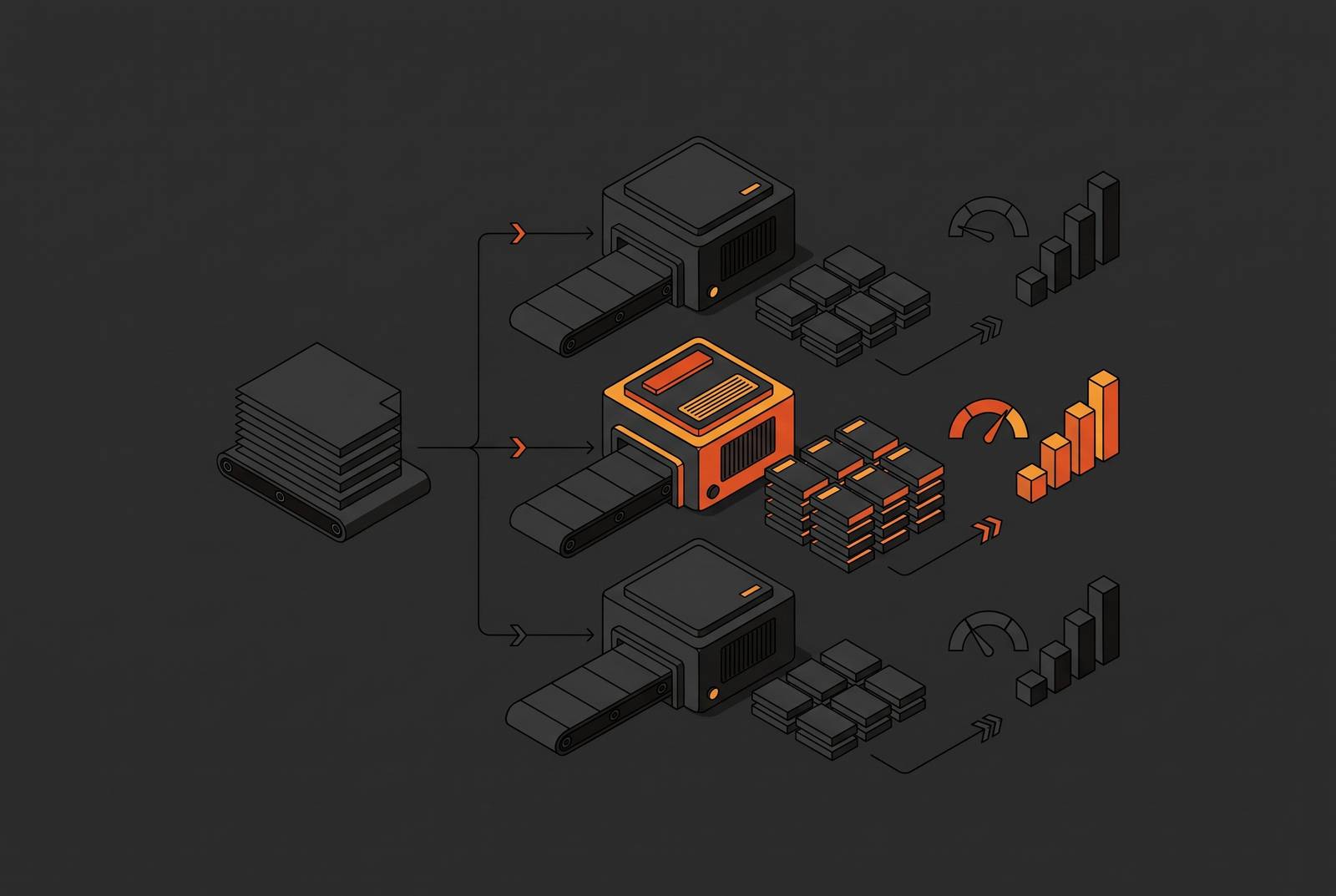
Evaluating document parsing services for high-throughput PDF pipelines requires separate tests of character correctness, schema field mapping, and structural preservation. The strongest enterprise choice is the service that meets those requirements on the pipeline’s own documents within its throughput, latency, cost, and deployment constraints. A headline accuracy score cannot establish that fit.
Why character accuracy alone cannot predict pipeline success
A parser can read every character correctly and still place a shipper location in the consignee field. It can also collapse a two-line address into a single string, preserving the text while breaking downstream validation. Neither failure requires an OCR mistake to occur. Both expose the gap between recognizing text and producing data that a downstream agent can route, validate, and use.
That gap widens when parsing runs through separate modules for layout detection, OCR, formula recognition, and table recognition. An error in one module compounds forward, so a character score measured before the remaining stages run understates the risk. The downstream record is the unit that succeeds or fails. Character accuracy therefore belongs in an evaluation, but it cannot serve as the primary measure of production readiness.
Published comparisons that stop at character recognition leave this distinction unresolved. Clean, born-digital invoices may produce strong results, while complex scanned loan packages and handwritten clinical notes expose failures that the same aggregate metric obscures. The score alone cannot explain the difference. Evaluation must locate the failure within the parsing chain before it can predict the effect on automation or review volume.
The three accuracy layers every high-throughput pipeline must measure separately
The first layer is character correctness, which measures whether individual characters were recognized accurately. Character Error Rate, or CER, is the right metric here because aggregate text similarity can hide a few mistakes in a long passage. A single transposed digit can invalidate a serial number, date, or numeric field.
The second layer is schema field mapping, which measures whether the parser assigns the right value to the right semantic field. Field-level precision measures how often the values that were extracted are correct, and field-level recall measures how often the fields that were expected are found. Both are necessary to diagnose extraction quality. High precision with low recall silently drops fields, whereas high recall with low precision sends incorrect values downstream.
The third layer is structural preservation, which measures whether tables, headers, columns, and multi-line entries retain their relationships. A row that is merged across column boundaries can pass character checks and limited field checks even though it changes what the document means. These errors often look plausible in isolation. OmniDocBench, created by Shanghai AI Laboratory and accepted at CVPR 2025, explicitly evaluates structure across nine document types, including text, tables, formulas, and reading order.
The layers compound from character recognition through field mapping to structure, but confidence calibration cuts across all three. A parser’s confidence must predict correctness at the layer where an automated decision is made. Otherwise, confidence merely disguises an unresolved error. The evaluation framework therefore needs different metrics for each layer.
What public benchmarks actually measure and where they stop
OmniDocBench tests a wide range of structures through 19 layout categories and 15 attribute labels. Its composite blends text edit distance, table TEDS, or Tree-Edit-Distance-based Similarity, and formula CDM, or Character Detection Matching. That breadth supports character and structural evaluation, but it does not directly test business-schema mapping. The sub-scores deserve more attention than the aggregate. Strong text performance can coexist with weak table structure inside a favorable composite.
The same benchmark also identifies a limitation of generic text similarity. Formulas and tables can have different valid syntactic expressions in LaTeX or HTML, so string differences do not always indicate meaning differences. Benchmarking PDF Parsers on Table Extraction with LLM-based Semantic Evaluation addresses this problem through semantic assessment of extracted tables. Table evaluation needs more than surface matching alone.
OpenBenchmarks tests a different boundary in its legal-contract document-processing benchmark. It measures whether a downstream reader answers questions correctly from parser output, using tracked-changes source files as an independent answer key. This makes stale or fused values from redline markup visible even when structural output looks sound. The method tests what the downstream reader actually receives.
olmOCR-Bench and ParseBench provide complementary evidence, and the Infinity-Parser2 Technical Report demonstrates that rankings change between benchmarks. That variation argues against treating any leaderboard as a universal ordering. Multiple tests add complexity, but collapsing them removes useful distinctions. OmniDocBench’s per-type breakdowns show why a composite on academic papers cannot establish performance on financial reports.
How document type and scan quality shift accuracy expectations at scale
Layout predictability determines which extraction problems dominate a document population. Invoices follow recognizable grids, insurance EOBs combine tables with dense prose, and handwritten forms may abandon regular structure. Template-based extraction can work well when layouts follow a pattern and fail when they break that pattern.
Scan quality adds a separate source of error before field mapping begins. Skew, noise, and compression artifacts degrade OCR confidence and make later extraction depend on less reliable text. The Ertas AI benchmark found that no tool tested consistently exceeded 92% accuracy on degraded scans below 200 DPI. That finding applies specifically to a difficult input category.
Semantic density creates another challenge because field meaning can depend on surrounding context. Medical records and legal agreements require more than correct characters and intact page layout. Benchmark leaders therefore need document-specific scrutiny before selection. The technical report places Infinity-Parser2-Pro first on olmOCR-Bench, while OmniDocBench v1.6 produces a different ordering led by PaddleOCR-VL-1.5.
The report also describes eight co-trained objectives spanning parsing, layout, tables, formulas, charts, document VQA, and general multimodal understanding. That training coverage shows that generalization is an explicit design concern. For evaluators, the practical prescription is direct. A half-day evaluation on a sample of the pipeline’s own documents is more informative about its actual risks than public benchmark results alone.
Building an evaluation harness that matches your throughput and latency constraints
The harness should measure accuracy, latency, and cost in the same evaluation runs while reporting them separately. OpenBenchmarks follows this separation by presenting parse latency and measured parser spend beside semantic accuracy. A synthetic score would conceal the tradeoff. A service that extracts accurately but misses the pipeline’s SLA still fails the operational requirement.
Instrumentation should follow the decisions the pipeline must make. CER identifies recognition failures, field precision and recall expose extraction errors and omissions, and structural tests assess relationships that text checks miss. These measures must include document-level accuracy because one wrong field can make a whole downstream record invalid.
Confidence testing should then compare stated confidence with observed correctness within each confidence band. The test population must reflect production inputs. Evaluators must check that calibration holds when the inputs change. The harness should distinguish character, field, and structural confidence so that reliable recognition scores do not conceal unreliable relationships.
A homogeneous set of born-digital PDFs can hide the variable latency introduced when scanned pages require OCR. Realistic mixed batches expose whether those stages disrupt flow under the expected workload. Testing accuracy first and speed later would miss that interaction.
The relevant decision is whether the service produces usable records at the required pace and cost. An impressive extraction score cannot compensate for an overloaded review queue, just as fast processing cannot compensate for invalid records.
Where structural preservation failures cause the most damage in regulated industries
Healthcare workflows depend on correct relationships across multi-section clinical documents. A table row merged across column boundaries in a prior authorization form can produce a plausible-looking but clinically wrong extraction. The problem may become visible only when a claim is denied. Billing and authorization therefore require structural evaluation.
Finance presents a similar problem with different consequences. A misread account balance or misaligned financial-report column can trigger validation failures or errors in regulatory reporting even when most characters are correct. Dense tables, multi-column text, and footnotes put strain on relationships that tests focused on academic papers may not test well enough. Financial reports are one of the nine document types in OmniDocBench. That coverage makes its document-specific results more useful than an undifferentiated score.
Logistics combines structured tables with dense prose and multilingual content in shipping documentation, customs paperwork, and supplier contracts. A column misalignment in a bill of lading can change field mapping and delay clearance. The text may remain readable throughout the failure. Semantic table evaluation is relevant because the operational risk lies in the changed relationship.
Across these industries, output that looks right makes structural errors hard to catch before the data is used downstream. The same documents also contain sensitive information, so the environment in which parsing occurs cannot be separated from its evaluation. Structural accuracy must hold within the permitted deployment architecture. A result obtained in an unusable deployment mode cannot establish production suitability.
Compliance and security requirements that constrain parser selection before accuracy is measured
Deployment eligibility should be the first evaluation filter. HIPAA, GDPR, and SOC 2 requirements constrain how document data can be handled, while healthcare use of a cloud parsing service requires the applicable Business Associate Agreement. These requirements for an acceptable data-processing arrangement can remove a service from consideration before benchmark testing begins.
The deployment model must then be checked against data-egress constraints. Self-hosted and BYOC, or bring-your-own-cloud, options address the need to keep sensitive documents within the organization’s perimeter. In healthcare, this can mean evaluating locally deployed OCR infrastructure or the terms of an enterprise contract. The permitted architecture must be part of the test. Workflows that handle payments also need early checks of payment-card security requirements, which may make self-hosting the workable choice.
Auditability is a distinct requirement from deployment location. Regulated workflows increasingly require records of model versions and data provenance, while non-deterministic transformer-based outputs complicate reproducibility, SLA enforcement, and compliance documentation. Evaluators should check whether the service can provide the audit trail they need. A favorable accuracy result does not answer that question.
Zero data retention also requires a separate contractual check. It means that the parsing service does not store document content after processing, and it should not be inferred from self-hosting or marketing language. Applicable compliance requirements, a HIPAA BAA where needed, suitable deployment options, auditability, and agreed retention terms define the environment in which accuracy results become relevant.
How confidence scoring and human review routing turn evaluation findings into production controls
Confidence scoring turns evaluation findings into decisions about which extractions can proceed automatically and which require human review. Output with high confidence can pass through, and output with low confidence goes into a review queue. This split makes high-throughput operation practical without reviewing every document. Its reliability, however, depends on the calibration established for the production document population.
A model that assigns strong confidence to errors in nested tables or rotated text may automatically approve the extractions most likely to be wrong. Those errors then reach downstream agents without review. Routing must therefore reflect the measured reliability of the output.
The routing decision also needs to respect the three accuracy layers. Even when character confidence is reliable, field mapping can be wrong, and even when field confidence is reliable, structural relationships can be broken. High-confidence structural extractions may still require review when structural calibration is weak. Document-level results provide the final check because field-level success can coexist with records invalidated by extraction errors.
For production teams, the operational lesson is to use the evaluation framework continuously rather than treating its initial results as permanent. Character checks show where recognition went wrong, schema checks show which values are wrong or missing, and structural checks show which relationships are broken. Calibrated confidence connects those findings to a manageable review queue. Evaluation is not a launch gate but an ongoing production instrument.