SOC 2 Type II Controls for AI Document Processing Vendors
Enterprises now require SOC 2 Type II certification to vet AI document vendors' security controls.
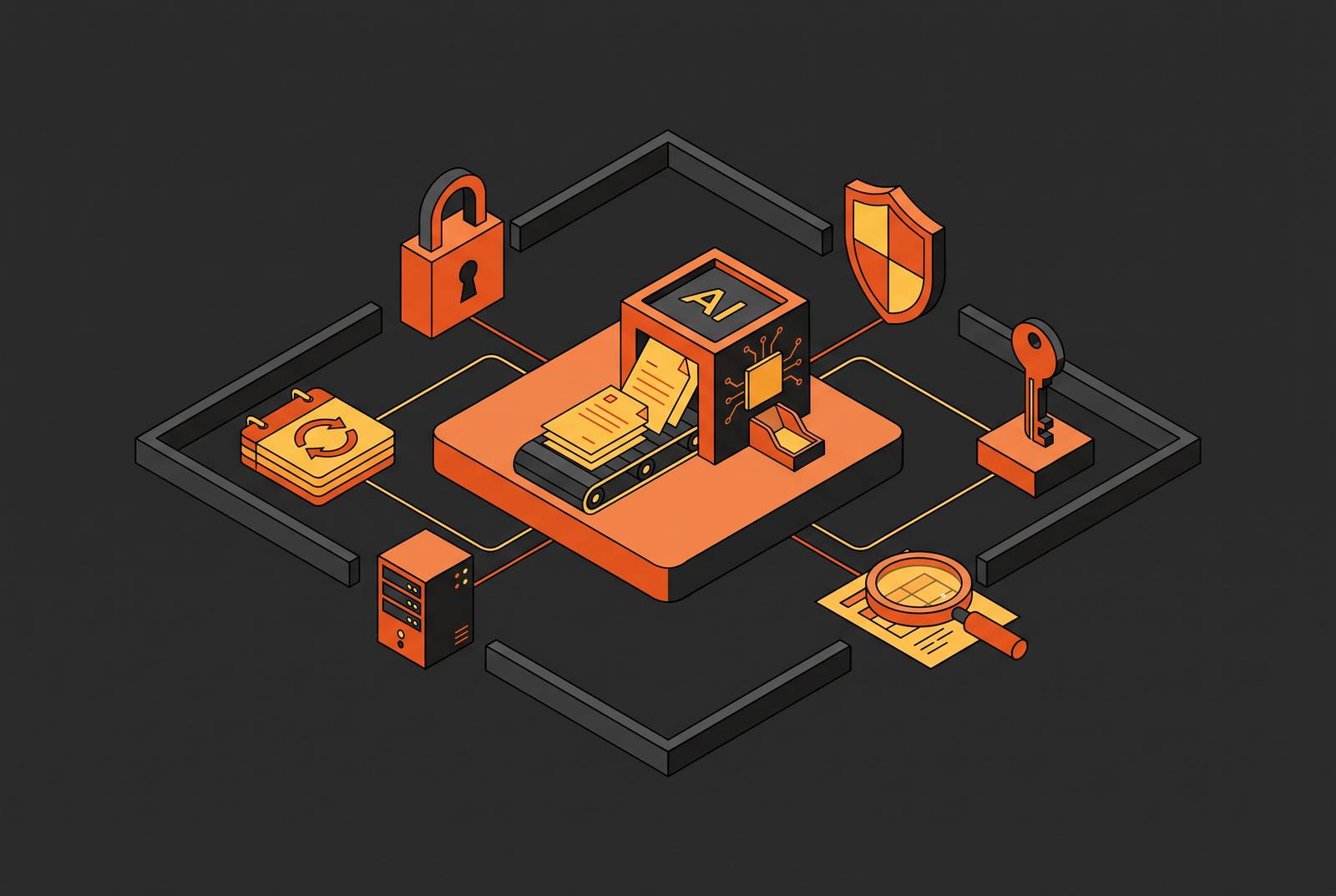
SOC 2 Type II controls for AI document processing vendors must cover how sensitive documents are ingested, processed, stored, and transmitted, including any upstream model providers. A current report is only the starting point. The stronger test is whether its scope and evidence demonstrate sustained control over the production pipeline, from document intake to extracted output and deletion.
Why SOC 2 Type II has become a hard requirement for AI document processing vendors
Enterprise procurement teams now treat SOC 2 Type II as a baseline requirement. Arriving at a security review without a current report can mean exclusion from the shortlist. The pressure is sharpest in healthcare, finance, real estate, and logistics, where documents contain personally identifiable information, financial records, and legally sensitive content. Procurement therefore depends on more than extraction performance.
The distinction between Type I and Type II is central to that review. Type I confirms that controls are designed correctly at a point in time, while Type II confirms that they operated effectively over a sustained observation period. Production pipelines need assurance that their controls worked over time. The AICPA’s Trust Services Criteria provide the operative standard, but auditors are applying sharper scrutiny to AI systems, model vendor contracts, and evidence quality than they did even two years ago.
What the five Trust Services Criteria actually require when the system processes documents
Security calls for access controls, encryption, and protection of the network. It is the mandatory criterion. For document APIs, this translates into multi-factor authentication, role-based access controls, and encryption for data in transit and at rest. Comprehensive access logging must also record every system access, data query, and administrative action with timestamps, user identification, and activity details.
Availability requires systems to remain operational as committed, supported by uptime guarantees and disaster recovery procedures. For document processing APIs, redundant infrastructure and failover capabilities must support those commitments. Service continuity needs evidence alongside an uptime promise. Compliance requires the infrastructure and recovery procedures to sustain the service the vendor has agreed to provide.
Processing Integrity requires processing to be complete, valid, accurate, timely, and authorized. For document extraction, controls must keep data from being corrupted or changed without authorization at any step in the extraction process. This is especially hard when structured output goes to agents or financial systems without human review. The evidence must address the processing path that produces and routes the output.
Confidentiality requires protection of information designated as confidential. To meet that obligation, document platforms must have strict data segregation and protocols for secure deletion. Protection cannot stop once extraction is complete. The documents and the information extracted from them remain subject to the vendor’s confidentiality commitments, making storage and disposal part of the control boundary.
Privacy governs the collection, use, retention, disclosure, and disposal of personal information under privacy policies and regulations such as GDPR and CCPA. In document pipelines, those rules apply to personal information at every step of processing. Enterprise buyers in regulated industries frequently require Availability, Confidentiality, and Privacy in addition to Security, so vendors offering only the mandatory criterion should make that limitation explicit.
Where AI-specific controls now appear inside the existing criteria
The AICPA has not issued final separate AI-specific Trust Services Criteria. Its October 27, 2026 exposure draft proposed AI-related points of focus for 17 criteria, with comments due January 15, 2027. Auditors already use the existing framework to check AI systems. Their requests address model lineage, inference logging, drift, retention, and model provider contracts through existing risk, access, and vendor-management requirements.
Under Processing Integrity, model versioning and lineage documentation must establish which model version processed which documents and when. Drift controls need records of baseline performance when the model is deployed, thresholds for automated detection, and playbooks that spell out how to respond. Incident records must then show how engineering teams responded to degradation. A threshold alone is not sufficient evidence. Documented rollback procedures complete the response path by establishing the ability to revert to a prior model version when degradation is detected.
Drift also reaches Availability because changing model behavior can undermine the service’s operation without corresponding governance evidence. Inference logs introduce a different tension under Confidentiality and Privacy. They must keep the evidence while keeping PHI or PII from being exposed through the logs. Auditors therefore examine redaction policies and prompt-and-completion retention controls, including what is retained, for how long, and under which access policy.
Under Security’s vendor-management requirements, when document data goes to a third-party model provider, that provider’s handling terms, retention policies, and BAA status are part of the audit’s scope. Upstream contracts are part of the control chain. The processing vendor must show that contracts and BAA coverage meet the requirements across its model supply chain, because its own report cannot vouch for every external model call. Shadow AI tools also fall within this scrutiny of risk, access, and vendor management.
How the document processing pipeline architecture determines which controls are hardest to satisfy
A document AI pipeline spans ingestion, parsing, extraction, verification, and output, with distinct control obligations at each layer. During intake and parsing, documents arrive from varied sources and in varied formats, often with embedded PII. Security controls must therefore cover every step of ingestion, including normalization before a document reaches the model. A protected API endpoint does not, by itself, evidence those intermediate steps.
Extraction and verification create the hardest Processing Integrity questions. Field-level confidence scoring must tell high-confidence fields from low-confidence fields, and routing records must show whether each field went to straight-through processing or human review. Document-level confidence is insufficient for that purpose. The field-level evidence must connect to specific model versions and input documents so that the routing decision remains traceable. The vendor needs calibrated confidence scoring to show that fields went correctly to automated processing or human review.
Prediction logs need to connect outcomes with model versions, input data, and extraction rationale, rather than merely record that an output was produced. That linkage supports Processing Integrity and, in regulated industries, can also address sector-specific legal obligations beyond SOC 2. The vendor’s own controls do not automatically cover processing inside a third-party model API.
Deployment choices change who controls those boundaries. Self-hosted and bring-your-own-cloud options let enterprise buyers control data flows, access policies, and retention themselves without relying on how the vendor protects its shared infrastructure. This simplifies several Security, Confidentiality, and Privacy obligations. It also makes deployment architecture part of the compliance evaluation. The relevant distinction is where control resides and which dependencies still require evidence.
What Type II evidence actually looks like versus what vendors often produce
A certificate, policy document, or configuration screenshot can help with a sale without showing that controls worked over time. Type II needs evidence from across the observation period. A screenshot taken the week before an audit does not show that an automated control operated consistently throughout that period. Continuous monitoring logs must demonstrate that operation, while manual controls require attestations from named owners with timestamps and recurrence records. A policy without execution evidence leaves a gap.
The same distinction applies to vendor management. A supplier list identifies dependencies but does not demonstrate that their controls were assessed. Documented assessments, sub-processor agreements, data processing addenda, and BAA status where it applies must be on file and up to date. This includes upstream model providers handling document content. Their contractual coverage must be examined as part of the actual processing chain independently of the document vendor’s report.
No-training-on-customer-data commitments require a similar evidentiary test. The promise must have both technical and contractual support. Auditors check whether technical controls enforce the policy and whether the terms of upstream model providers support it. Penetration testing results and continuous automated security monitoring provide further Security evidence. Annual penetration testing by an independent firm, combined with continuous monitoring, represents the evidence pattern auditors expect rather than reliance on a one-time configuration record.
For engineers evaluating a vendor, the practical shift is from asking whether a control exists to asking how its operation is demonstrated. Who owns the manual review, and where are its recurrence records? Which logs cover the report’s observation period? What assessments and agreements cover each upstream model provider? These questions distinguish a documented design from a control that has operated under production conditions.
How compliance requirements shift by vertical — healthcare, finance, logistics, real estate
Confidentiality and Privacy carry particular weight in healthcare because medical bills, insurance claims, and patient documents have PHI in them. HIPAA adds technical and administrative safeguard requirements, and a HIPAA BAA must be available on request. Extracted fields can themselves contain protected information. Patient names, dates of service, and diagnosis codes make inference-log redaction directly relevant to both HIPAA obligations and SOC 2 Privacy. The logging policy must therefore account for both extracted content and the original document.
Processing Integrity is especially demanding in finance when extracted data is used to make automated decisions about transactions, loans, or compliance filings. Banks and fintech companies require SOC 2 from vendors that handle transaction data or their customers’ financial information. Automation changes the balance of risk. Processing without human intervention reduces privacy risks associated with human access to financial documents, but it increases the importance of a traceable processing path. The audit evidence must support the decisions made from the extracted output.
Logistics emphasizes Confidentiality across shipping documentation, customs paperwork, and supplier contracts. These documents can expose proprietary fleet routes, data on where customers are, and the business logic of shippers. Retention and disposal require explicit control here. Documented retention schedules, disposal procedures, and access restrictions must address AI-processed data rather than leave it under a general policy that does not account for the processing workflow.
In real estate, Confidentiality and Privacy rules apply to contracts, title documents, and appraisal records. Data residency can further constrain acceptable deployment models. Location is therefore part of the compliance decision. A platform’s ability to process the documents is only one part of its suitability when the buyer must also control where the data resides.
What to look for when evaluating an AI document processing vendor’s SOC 2 posture
Engineers should begin with the report’s scope and observation period. Does it cover Security alone, or also Availability, Processing Integrity, Confidentiality, and Privacy? Confirm when the current report period ends and whether a bridge letter or continuous monitoring evidence is available. This establishes both what was assessed and the period for which the vendor can demonstrate operation.
The AI-specific review should then follow the document’s path. Ask whether the no-training policy is backed by technical controls and contractual terms with every upstream model provider. What is retained from document content and extracted output, and is zero retention available? Request the drift detection policy, documented response playbook, and inference-log handling rules for PHI and PII. Sub-processor agreements should identify the contractual coverage behind upstream model API use.
Deployment and companion requirements need separate attention. Self-hosted and BYOC options give buyers direct control over residency, access policies, and retention, so their availability can materially change the compliance assessment. For healthcare, confirm that a HIPAA BAA is available. For cross-border data contexts, confirm that GDPR sub-processor documentation is current. These requirements cannot be inferred from SOC 2 coverage alone.
The standard should be consistent across every vendor. An enterprise production platform should have SOC 2 Type II assurance, comply with HIPAA and GDPR where they apply, and offer a zero data retention policy, BYOC and self-hosted deployment options, and records of its AI-specific controls. Model versioning and calibrated field-level confidence belong in that evaluation because they make processing decisions auditable. A vendor’s posture is strongest when its report, contracts, deployment model, and operational records describe the same controlled production pipeline.