HIPAA Compliance Requirements for Document Processing Pipelines
Organizations must map every PHI touchpoint before selecting tools or signing vendor agreements.
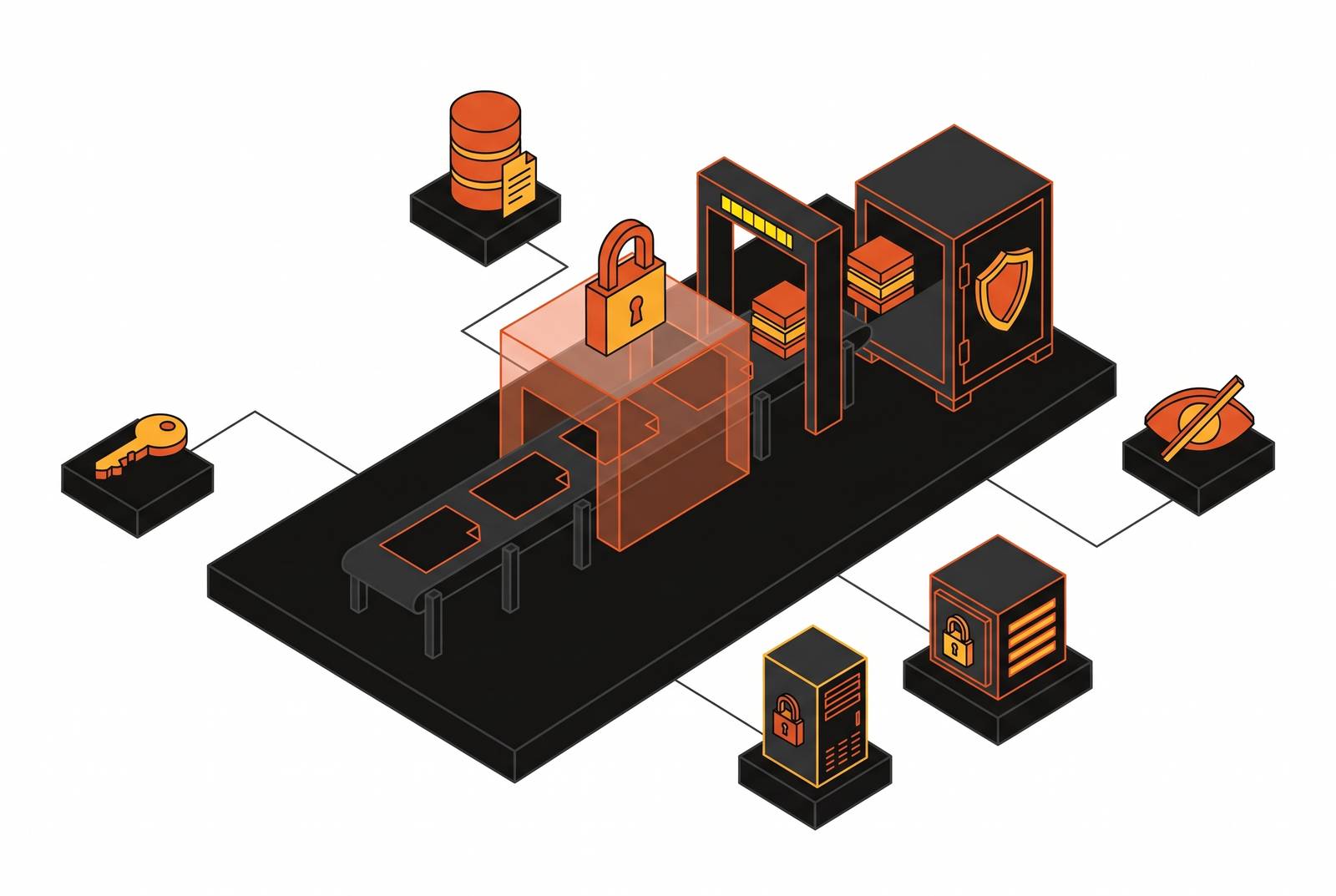
HIPAA compliance requirements for document processing pipelines are architectural and contractual obligations. Before PHI enters a system, the organization must trace its path, establish BAA coverage, and configure safeguards for encryption, access, auditing, retention, and deployment. Compliance depends on how the entire workflow operates, including its AI agents and intermediates.
Why "HIPAA compliant" is not a property any AI tool or vendor carries on its own
“HIPAA compliant” is a self-attested label for software. HHS does not offer a badge, seal, or an official program to certify software. SOC 2 Type II reports and HITRUST certifications assess security controls, but neither establishes legal HIPAA compliance. A product label cannot show whether a given workflow protects PHI as it should.
The account configuration is also decisive. PHI cannot pass through consumer accounts that have no available Business Associate Agreement, even if the same platform has an enterprise or API configuration that is eligible for HIPAA use. A signed BAA provides enforceable contractual commitments. The threshold question remains whether any component creates, receives, maintains, transmits, uses, or discloses PHI.
What counts as PHI in a document pipeline and why the boundary is wider than engineers expect
The HIPAA Privacy Rule defines PHI as individually identifiable health information. In a document pipeline, that boundary extends beyond the original clinical file. OCR output, extracted field values, and structured JSON retain PHI after the source document leaves the active workflow. API logs, prompt traces, support tickets, and debugging artifacts are also within that boundary when they hold patient information. A change in format does not remove identifiability.
Vector embeddings deserve separate attention because they can appear detached from the records that produced them. Embeddings tied to patient records require the same retention controls as their source documents. HHS OCR has not issued formal guidance specifically addressing vector embeddings, so their numerical form is not a basis for assuming de-identification.
The minimum-necessary principle requires components to access only the specific PHI elements needed for their function. Clinical summarization, coding, prior authorization, and care-management triage remain HIPAA-relevant workflows under treatment, payment, and operations. Data de-identified through Expert Determination or Safe Harbor is outside HIPAA's scope, but there must be a written record of the re-identification controls.
Mapping the full PHI data flow before writing a line of pipeline code
Consider a clinical pipeline moving from ingestion through parsing, extraction, an agent, and EHR write-back. Its data-flow map starts where PHI comes in, at the upload endpoint, fax conversion service, EHR API pull, or object store. The parsing stage then identifies the service processing the document, the intermediate text it produces, and every location where that text is written. Extraction adds the fields read, structured output produced, and destination storage. Each transformation adds a protection obligation.
The agent stage extends the map beyond files. It must identify which agent accesses which records, the authorization governing that access, and the downstream APIs, databases, or human review queues receiving the result. External inference endpoints, enrichment services, and logging platforms must also be on the map if they receive PHI. Failure detection must also be documented so that missing or misdirected data has an identifiable control.
This is a compliance artifact. It must be maintained and versioned with the pipeline because an investigator needs to understand the system that actually operated. Mapping also exposes excessive scope, such as passing a full patient record to an extraction component that needs one field. Every external PHI recipient then becomes a contractual coverage question before implementation begins.
The BAA requirement and what a compliant agreement for a document pipeline must actually cover
A vendor creating, receiving, maintaining, or transmitting ePHI on the covered entity's behalf requires BAA coverage before processing starts. The map identifies candidates including parsing APIs, inference endpoints, orchestration platforms, storage services, vector stores, and review queues. Monitoring services belong in that assessment when they capture PHI.
Subprocessor coverage is particularly important for extraction APIs. The API provider may route inference through infrastructure operated by another entity, which must also be covered. The agreement must identify PHI-touching subprocessors, require advance notice of additions, and provide an option to terminate if a new subprocessor is unacceptable. A contract covering the visible endpoint alone leaves the underlying processing chain unresolved.
The BAA must also address training, fine-tuning, and quality analytics using inputs, outputs, or intermediates, prohibiting those uses without authorization. It must specify deletion timelines or retention limits, security measures during processing, and a breach notification window suitable for rapid containment. Coverage must be re-examined when a subprocessor, model version, or pipeline stage changes. The covered entity still has to assess those commitments even if the vendor provides self-attestation.
Encryption requirements that apply at every layer of the document pipeline
Under the current Security Rule, encryption's status as an addressable specification requires an organization to implement it or document why it chose an equivalent alternative. That is not permission to ignore it. For pipelines transmitting PHI over public networks or storing it in shared cloud infrastructure, engineering to encrypted operation is the practical standard.
The proposed 2026 Security Rule update would make encryption required for all ePHI, with limited exceptions. New pipelines should nevertheless meet the stricter standard, using TLS 1.2 at minimum and preferably TLS 1.3 for ingestion and API calls. External inference requests also need encrypted transport, even when they pass through private networks that carry other tenants' traffic.
At rest, protection extends to source documents, parsing output, extracted fields, databases, embedding stores, and PHI-bearing logs. Backups and exports need the same protection as primary storage. With customer-managed encryption keys, the organization can control the key lifecycle and revocation even where the vendor hosts the environment. The proposed update also adds vulnerability scanning expectations and may require network segmentation, so new designs should provide for isolation from the outset.
Access controls and the minimum-necessary principle applied to pipeline components and AI agents
Encryption does not decide who may use the data. Under the technical safeguard framework, service accounts in the pipeline and identities used by agents need unique identification, procedures for emergency access, automatic logoff, and mechanisms for encryption/decryption. An agent acting for a workforce member is subject to that employee's access rules. Its credentials must therefore limit access to patient records to a bounded workflow.
That boundary differs by stage. Ingestion should read source documents without write access to the extraction database, and extraction should get only the fields it needs for its task. An orchestration agent should not hold broad FHIR scopes when narrower record access is sufficient. Human review interfaces should expose the flagged fields requiring review, with uniquely authenticated operators restricted by role.
Persistent session memory can also cause access to fail. For example, an agent may keep PHI from an earlier workflow invocation even though it is now working on a different record. Authorized access during the first encounter does not establish a purpose for retention across later encounters. Under a 2025 Security Rule proposal, a written technology asset inventory would have to include AI systems that handle ePHI. Teams should maintain that inventory now, recording each agent or model endpoint, its authorized PHI scope, and its human delegator.
Audit trails that satisfy HIPAA's integrity controls and support an OCR investigation
Standard API and LLM session logs do not, by themselves, establish a HIPAA-grade audit trail. The Security Rule requires mechanisms to record and examine activity in systems containing or using ePHI, without prescribing a particular log format. The investigative requirement is more concrete. An OCR investigator can name a past date and ask which records an agent accessed, under whose authority, and what it did.
An operation-level record must capture the authenticated service or agent, human authorizer, operation, affected PHI records, authorization context, and tamper-evident timestamp. A job identifier alone is insufficiently specific. The model version and raw input hash help reconstruct the generated content, and human review records must show who reviewed, changed, or approved it and when. Deletion and redaction events also need an auditable record.
Those records must be protected from pipeline operators. Append-only storage with separate access controls provides that separation, unlike logs kept in the same database the pipeline can modify. Historical records must remain queryable through the compliance retention period, including after a logging platform or vendor contract is replaced.
Data retention, ephemeral processing, and zero-retention policies for pipeline intermediates
PHI-bearing source documents and temporary representations should be deleted once they are no longer needed for their authorized purpose. Ephemeral processing makes each encounter temporary, with raw parsing output removed after extraction and no PHI cached in local or session storage. Using past patient data for training or quality analytics requires authorization.
OCR caches, extraction scratch space, prompt and completion logs, and review-queue caches can accumulate PHI independently of the source repository. Vector stores need special care because embeddings can stay there indefinitely if no deletion policy says when to remove them. Each embedding tied to a patient record needs retention controls that match those for the source document, because deleting the source does not mean every derivative is removed.
For vendor-hosted inference, a zero-data-retention commitment in the BAA is stronger than a marketing statement about privacy. The terms should establish what happens after the processing call completes. This obligation is distinct from retaining compliance documentation for six years from creation or last effective date, whichever is later. BAAs, risk analyses, policies, audit logs, and training records support accountability, while unnecessary PHI intermediates increase exposure.
Deployment configuration: when self-hosted or BYOC deployment is required rather than optional
Healthcare billing pipelines that co-process payment card data and PHI illustrate when deployment becomes a compliance constraint. PCI DSS requirements for cardholder data environments can be difficult to satisfy in a shared vendor-hosted configuration. In that setting, the organization may have to control the infrastructure directly. The decision follows the risk analysis.
Other constraints can lead to the same result. State-level AI privacy requirements may restrict processing locations, while behavioral health and substance use disorder information can require stronger isolation under heightened confidentiality protections. An organization's BAA with a downstream covered entity may also require demonstrable control of processing infrastructure. Vendor-hosted HIPAA-eligible configurations remain appropriate where the assessed risks and contractual obligations permit them.
Self-hosting changes who operates the safeguards. The organization assumes responsibility for key management, patching, vulnerability scanning, and physical safeguards, which must be documented in its policies and risk analysis. With bring-your-own-cloud, processing can run in the organization's cloud account while the vendor still provides the software and helps operate it. The BAA must then state who is responsible for each infrastructure layer, while hosted alternatives need written evidence of the vendor's segmentation and controls.
The risk analysis that ties the checklist together and the ongoing operational obligations that follow
The Security Rule's foundational administrative safeguard is an accurate and thorough risk analysis covering ePHI confidentiality, integrity, and availability. For a document pipeline, a general IT assessment is insufficient. The analysis must look at every flow on the map, every vendor and subprocessor, and the residual risk after controls are in place. It must also address inference logging, vector persistence, agent scope, silent data drops, misconfigured retention, and the reason for the deployment choice.
The record must change with the system. A new vendor, model version, document type, or agent capability should trigger an update, producing dated analyses. Operational obligations include scheduled vulnerability scanning, periodic access reviews, regular audit-log examination, documented workforce training, and incident response procedures. Those procedures must cover detection, containment, and breach reporting to HHS OCR and affected individuals.
The compliance record requires six-year retention from creation or last effective date, and system migrations must preserve its history. Tools can help assemble that record and identify risks. Determining whether the remaining risk is reasonable and appropriate for the organization requires a named person's review and signature, keeping responsibility with the people who authorize and operate the architecture.