Invoice and Purchase Order Extraction for Accounts Payable Automation
Extraction errors at intake undermine every downstream AP automation step.
A wrong GL code, a duplicate payment, a missed early-payment discount: these are not approval-workflow failures. They are extraction failures that surfaced three steps downstream, after the damage was already committed to the ledger. Reliable AP automation does not fail because approval routing is poorly designed. It fails because bad data captured at the front of the pipeline contaminates every step that follows it. A vendor name misread at intake becomes a vendor-master mismatch at validation. None of these errors originate where they are discovered, and that displacement is what makes the extraction layer the binding constraint on how far AP automation can actually go.
The failure compounds at volume. A single misextracted field on one invoice is a nuisance. Scale does not forgive extraction errors; it multiplies them.
The common pattern inside AP teams that have already invested in automation looks like this: ERP integration is built, approval routing is configured, dashboards exist. The extraction layer is still template-based OCR, tuned to the handful of supplier formats the team tested against at rollout, and that is why the rest of the setup fails. The moment a new vendor sends an invoice in a layout the template was not built for, extraction breaks, and the exception lands on a human desk anyway. The automation was supposed to eliminate exactly that kind of manual handling, and instead it recreates it one layout variation at a time.
The objection teams raise at this point is predictable: "we already have OCR, and it works." The gap between a demo and a production supplier portfolio is where touchless processing goes to die.
What the extraction pipeline has to do, field by field
Extraction for accounts payable is the production of a typed, validated field set that the matching engine, the approval workflow, and the fraud detection layer can each act on independently, without having to reinterpret raw text themselves. A production pipeline has to deliver a defined minimum: vendor name and tax ID, invoice number and invoice date, the purchase order reference where one exists, line-item descriptions with quantities and unit prices, a tax breakdown by jurisdiction, payment terms and the due date, and bank account or remittance instructions. Each of these fields functions as an independent data point that downstream systems reason about on their own terms, so a missing or wrong value in any single one of them does not stay contained as a local error. It occurs downstream, in a pipeline break that appears several steps later, often in a form that no longer looks like an extraction problem.
Invoices do not arrive as a single document type the pipeline can optimize for. A production extraction layer has to take all of these into one unified intake queue and process them without format-specific templates built for each supplier, because the number of supplier formats in any real AP operation makes template maintenance a losing proposition.
What the extraction step produces matters as much as what it reads. An extraction agent should output into a declared schema with typed fields, not free-form JSON that a downstream process then has to interpret. Typed schemas make validation deterministic and close off the risk of a model inventing a field that was never on the source document. Once a typed field set exists, the pipeline has to validate it before anything moves forward: confirming the vendor exists in the approved vendor master, checking that the invoice number hasn't already been submitted, and verifying that line-item totals actually sum to the header total. When a validation check fails, the system needs to surface a specific error code precise enough that a reviewer can resolve it in one action, rather than re-keying the invoice from scratch because the system gave no indication of what went wrong or where.
The hardest part of the extraction problem: document variety
Extraction accuracy is not a single number a vendor can quote in a pitch deck. It varies by document type, and that variance is large enough to decide whether a pipeline is production-ready or just demo-ready. A Fraunhofer IAIS study ran eight multimodal models across three public invoice datasets and found that the same model scored markedly higher on clean digital invoices than it did on scanned receipts. A realistic mixed pipeline, combining invoices, purchase orders, and utility bills of varying scan quality, averages meaningfully below what a vendor demonstrates on a curated set of clean PDFs.
Template-based OCR struggles here for a structural reason, and no amount of tuning can fix it. Template systems extract characters from a known, structured layout, and they break the moment a format changes in a way the template didn't anticipate. Modern AI-based extractors work differently: they identify fields by their semantic role on the page, the thing that looks like an invoice number regardless of where it sits, rather than by fixed coordinates, which lets them adapt to layout variation without a template rebuild for every new supplier.
A finding from recent benchmarking complicates the assumption that bigger models solve this problem by brute force. Model size does not predict extraction accuracy. If you default to the largest available frontier model for an extraction layer, you can still lose to a smaller model purpose-built for documents. The implication for anyone building or buying an AP pipeline is that it has to be tested against its own actual supplier mix. A vendor demo built entirely on clean PDFs says nothing about what will happen once that pipeline meets the paper invoices and low-resolution scans a real supplier base still generates.
How confidence scoring turns extraction accuracy into routing logic
Extracted fields only help a touchless AP workflow if each one carries a confidence score, and that score has to decide, automatically, whether the invoice goes straight through or stops at a human reviewer. So medium-confidence extractions route to a reviewer with fields already pre-filled, not a blank form to key from scratch. That routing split is the structural mechanism that allows a pipeline to be touchless for the bulk of volume while still catching the cases that need a human eye, and it only works if the confidence score attached to each field is actually trustworthy.
Standard confidence approaches have a specific blind spot here. Most LLM-based extractors measure confidence in the generated token sequence, the statistical likelihood of the words the model produced. A model can give you a high-confidence, high-probability answer that is simply wrong, because the thing that made the extraction wrong never entered its confidence calculation to begin with. In a high-stakes AP context, that kind of silent, confidently wrong extraction is more dangerous than an extraction the system flags as uncertain, because the wrong value passes downstream validation checks that were built to catch missing data, not confidently incorrect data.
A multi-signal confidence approach addresses this by combining token-level probability with visual layout signals and cross-field consistency checks, producing confidence bands that are actually predictive of whether the extraction is correct rather than just predictive of how fluent the model's output sounds. That distinction matters for a second reason: most exceptions a pipeline encounters are business-rule failures or vendor data problems, not extraction failures. Confidence-score routing has to separate "the extraction is uncertain" from "the extraction is correct but the invoice doesn't clear a business check," because conflating the two sends clean exceptions to the wrong queue and genuinely uncertain extractions through to auto-approval. Confidence scoring and human-in-the-loop routing are the mechanism that converts raw extraction accuracy into a touchless rate a business can actually measure and improve over time.
Three-way matching as the validation layer the extraction pipeline feeds
Three-way matching is only as reliable as the extracted fields it consumes. A matching engine built on poorly extracted line items, quantities, or PO references does not function as a control; it produces a false sense of assurance that invoices have been checked when they haven't been, not really.
The three-way match exists to confirm that three independent documents agree before any invoice gets paid: the purchase order, representing what was agreed to buy and at what price, the goods receipt, representing what actually arrived, and the invoice, representing what the supplier is billing for. You have to compare all three at the line-item level, not just against each other's header totals, because header agreement can mask line-item discrepancies that matter. AI-based matching can read context that rule-based matching cannot: multilevel purchase orders, partial receipts, service contracts, and blanket orders all require the system to reason about which line items on one document correspond to which line items on another. That is semantically harder than header-level matching, and it fails outright when the line-item extraction feeding it is incomplete or imprecise.
Four scenarios illustrate what the extraction layer has to deliver for matching to function. A missing PO reference has to be flagged explicitly as an absence, not silently passed into the match engine as a null field that the system then has to guess around.
Two-way matching, which compares only the PO and the invoice with no goods receipt in the loop, is appropriate for services where no receiving event exists, such as SaaS subscriptions, retainers, or recurring fixed-fee arrangements. It loses the control that confirms delivery actually happened, so using it for goods procurement is a deliberate risk acceptance that teams should make consciously. The fraud implication runs through the same logic: automated three-way matching catches phantom delivery fraud and price creep systematically, across every invoice rather than just the largest ones a human reviewer might flag for manual scrutiny. That protection holds only if the line-item extraction feeding the match engine is complete to begin with.
The full pipeline stack from intake to governed posting
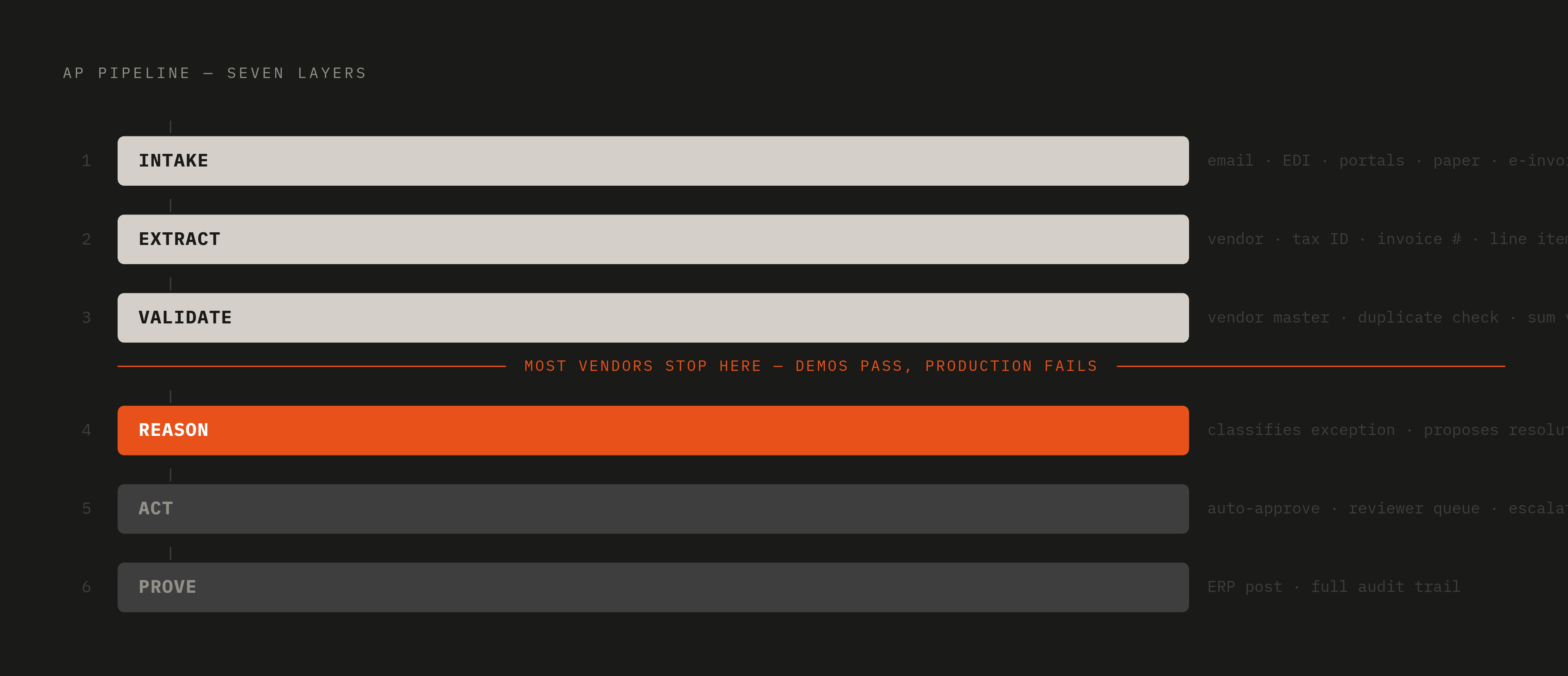
A production AP pipeline is a seven-layer stack in which each layer's output serves as the input contract for the layer after it, and a gap anywhere in that stack pushes the resulting work downstream onto a human.
Intake handles unified ingestion from email, vendor portals, EDI, scanned paper, and e-invoicing networks such as Peppol or ZATCA, and classifies each document by type, invoice, credit memo, or statement, before extraction begins. Extract produces the typed schema itself, vendor name, tax ID, invoice number, date, PO reference, line items, tax breakdown, payment terms, and remittance details, each field carrying its own confidence score. Reason classifies exceptions and proposes resolutions, distinguishing an extraction failure from a business-rule failure from a vendor data problem, and grounding its proposed fix in historical outcomes. Act carries out confidence-score-based routing: high-confidence clean matches auto-approve, medium-confidence cases route to a reviewer with context pre-filled, and failed matches escalate with structured error codes attached. Prove posts the governed result to the ERP under approval policy, with a full audit trail covering every extraction value, confidence score, match result, and approval decision along the way.
Most vendors in this space ship the first three layers, intake, parse, and extract, and market the result as a platform. The Verify, Reason, Act, and Prove layers are where you find the gap between a demo and a production deployment. The practical architecture that holds up under real volume is hybrid: a fixed, deterministic pipeline handles the happy path of extraction, validation, and routing, and an agent gets invoked only for the exceptions that pipeline cannot resolve on its own. ERP integration sits inside this stack as a load-bearing component rather than an afterthought tacked on at the end: AP automation that doesn't sync structured, coded, approved data back into the ERP without re-keying simply relocates the manual bottleneck to the posting step, undoing much of the touchless rate the earlier layers worked to establish. The audit trail requirement follows the same logic. Every extraction value, confidence score, match result, tolerance decision, and approval needs to be stored and queryable, both to satisfy internal controls and to hold up under regulatory review in jurisdictions that mandate e-invoicing.
Where extraction requirements differ by industry
The seven-layer architecture holds across industries, but what counts as correct extraction in each one is not the same, because the field schemas, compliance requirements, and document types that define "correct" shift from sector to sector.
Financial services needs invoice OCR that supports precise record-keeping and strong internal controls, so you have to build automated AP that enforces approval policies holding up under compliance and transparency review. Healthcare brings invoices from providers, suppliers, and payers that carry complex line items alongside strict compliance obligations, so HIPAA compliance and a complete audit trail are non-negotiable selection criteria, not optional extras; the extraction layer also has to parse explanation-of-benefits documents and clinical supply invoices whose terminology routinely defeats generic extraction models. Real estate introduces a different problem entirely: property management AP requires coding invoices to specific properties, entities, GL accounts, and allocation splits, fields that don't appear anywhere on a standard invoice and have to be inferred or pulled from property master data instead. Solutions built specifically for this vertical, such as PredictAP, address that gap directly, learning coding patterns from historical data and integrating natively with Yardi PayScan and Nexus to generate fully coded invoices that include property, entity, GL, and allocation details without manual re-coding. A generic extraction layer, however well it performs on a standard commercial invoice, has no basis for inferring which property or entity a given line item belongs to. That context lives outside the document, in property master data the extraction layer has to be built to consult.