Vision Model Approaches to Healthcare Document Processing at Scale
Vision models solve layout and context problems that break traditional document processing.
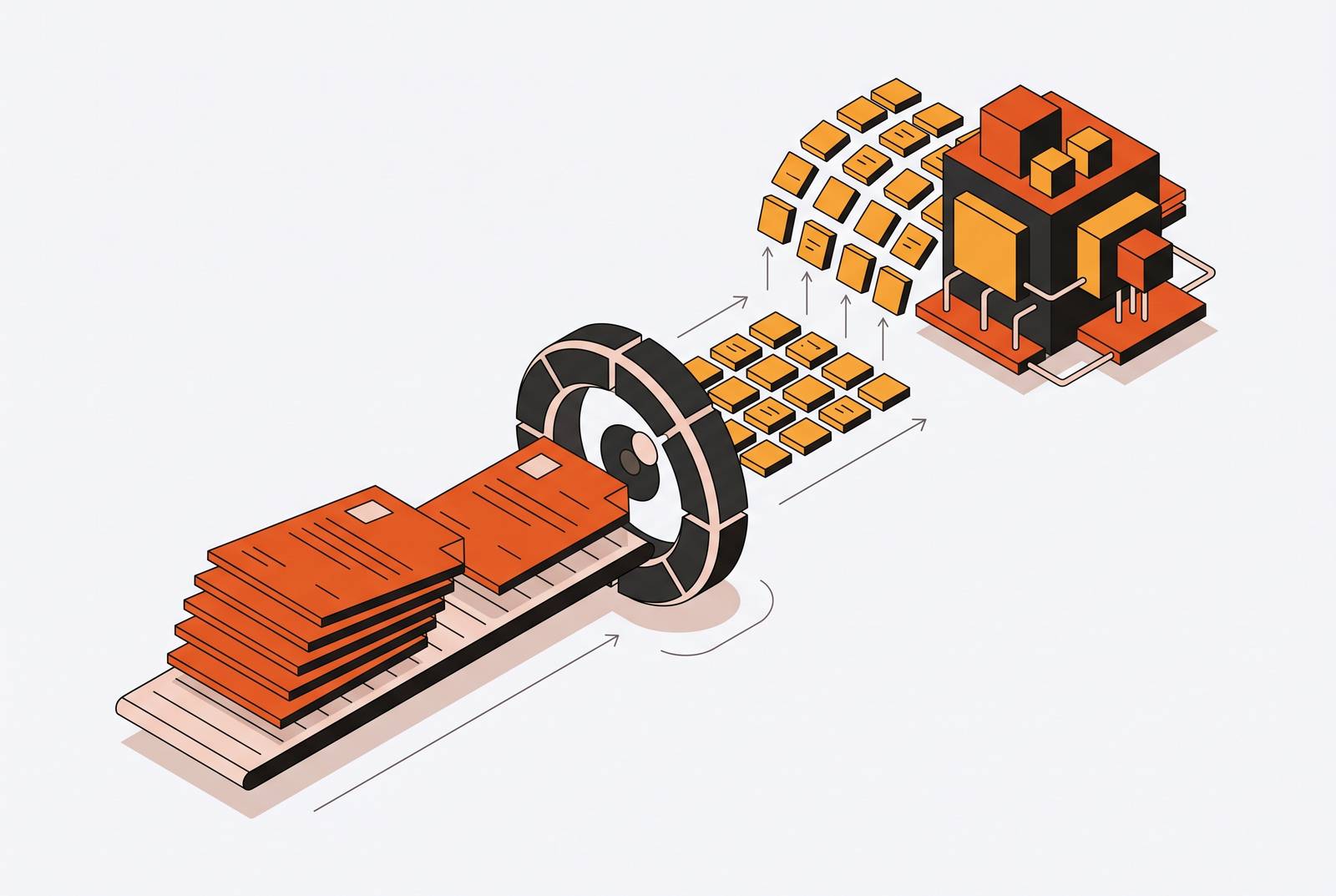
Healthcare document processing at scale fails or succeeds on one question: can a system read a page the way a trained reviewer does, holding layout, handwriting, and context together at once? Increasingly, you can answer that with vision-language models, and the architecture built around them.
Why healthcare documents break conventional document processing pipelines
A CMS-1500 claim form, an explanation of benefits, a pathology report: these documents carry their meaning in position as much as in text. A diagnosis code can mean one thing in one column and something else three rows down. A handwritten dosage note can change the clinical picture entirely, depending on which field it sits beside. Legacy document processing pipelines were not built to read that way, and the gap shows immediately once volume climbs.
Traditional OCR maps pixel patterns to character strings. It has no sense of what a field label means in relation to a value sitting two cells to its right, and it resets its understanding of the page at every boundary, so a patient name on page one and a diagnosis code on page four might as well belong to different documents. Physician handwriting compounds the problem on its own terms: character recognition models trained on printed fonts turn handwritten annotations into garbled output that nothing downstream can parse, and the distance between what a doctor wrote and what the system extracted disappears quietly into the record, with no error ever thrown. Template-based extractors, built to compensate for OCR's blindness by mapping fields to fixed coordinates, break just as fast: move a box or add a column on a vendor's new form version and the extractor misclassifies fields without complaint, sending documents into manual review queues that grow heavier with every format change. Multi-column layouts add a fourth failure on top of the rest: they stitch text from adjacent columns into strings that make no structural sense, so the row-level organization that billing and compliance systems need is destroyed.
How these failure modes create clinical and operational risk
These failures rarely halt a pipeline outright. They corrupt the structured data moving into clinical decision support tools, billing systems, and compliance validators, and the damage becomes visible only after the document has already been processed, filed, and forgotten.
On the revenue cycle side, CMS-1500s and EOBs feed directly into automated payment posting and compliance checks. A misread field buried in a nested table doesn't trip an exception. It produces a bad record, and that bad record turns into a claim rejection, a manual correction cycle, and a delay in reimbursement that didn't need to happen. On the clinical side, the stakes run higher still. A radiology report that says "no mass identified" carries a different clinical meaning than one that says "possible lesion," and a pipeline that flattens or drops that distinction isn't just inefficient: it introduces diagnostic risk into a record that a physician may trust without rereading the source document. Research evaluating document-heavy workflows across several model families found that only about half of tested configurations cleared a production bar that requires sustained accuracy, reproducible results, verifiable attribution, and a confidence signal worth trusting. Most setups that look solid in a demo fail once they meet production volume. And volume is where the math turns unforgiving: organizations processing hundreds of thousands of documents a year cannot absorb even a small error rate in staff hours, because a small percentage of a large number is still a large number of documents needing manual correction. Template maintenance adds its own tax on top of that, since every new layout variant means a new template, and the maintenance backlog grows in step with document variety rather than shrinking as engineers improve the system. None of this is a tuning problem. The failure sits in the architecture itself, in pipelines that process layout, text, and meaning as separate, disconnected steps, and that structural flaw is what makes a different approach necessary.
What vision-language models do differently at the architectural level
Vision-language models address that structural flaw directly by reading layout, semantics, and field identity together, in a single pass over the document image, rather than chaining separate steps that each throw away context the next step needs.
Conventional pipelines split the work into layout detection, text extraction, and field parsing, and these three stages don't talk to each other. A VLM instead takes the raw image and reasons about structure, meaning, and field identity at the same time, which matters most exactly at the points where OCR pipelines keep failing. Table structure is one of them: a VLM reads a table as a spatial object, tracking cell boundaries correctly across column spans instead of flattening everything into linear reading order and scrambling the rows in the process. Handwriting is another: because a VLM treats handwritten text as visually and contextually distinct from printed text, it handles a physician's handwritten annotation without a separate preprocessing stage, avoiding the garbled output that printed-font recognition models produce when they meet handwriting they weren't built for. Cross-page context, the third recurring failure point, gets solved by maintaining understanding across the entire document rather than resetting it page by page, so an entity referenced on page one still means the same thing on page four. And because the model reasons about the relationship between fields rather than their fixed coordinates, it generalizes across layout changes without retraining: a vendor reformatting its EOB template doesn't break anything downstream. Each of these is a direct answer to a failure named above, not a new capability layered on for its own sake.
Where general-purpose VLMs reach their ceiling in medical document contexts
General-purpose vision-language models clear the layout and context hurdles that defeated template OCR, but they were trained on web-scale image and text data, not on the visual and semantic patterns specific to medical imaging, clinical notation, or regulated healthcare forms. That gap is invisible in a demo and becomes visible once the documents get harder.
Radiology makes the limit concrete: reading an X-ray, an MRI, or a pathology slide calls for visual feature recognition that simply isn't present in general training corpora, and the cost of getting it wrong is measured in missed or misread clinical findings, not in a rejected claim. MedVLMBench, built specifically to compare generalist vision-language models against specialist medical counterparts, found that specialist models carried real but conditional advantages, strongest when the target imaging modality matched what the specialist model had actually been trained on, with those advantages varying across datasets and model families. Adapted generalist models, meanwhile, frequently matched or beat adapted specialists once the task moved outside the specialist's narrow training scope, which argues against treating "specialist" as a synonym for "better" in every case. The existence of Aloe-Vision, a model built specifically to deliver robust, open, and reproducible vision-language performance for healthcare, says something about the field on its own: if general-purpose models already handled medical robustness reliably, a dedicated robustness-focused model wouldn't need to exist. Assertion detection is another place generalist understanding runs out: telling "no mass identified" apart from "possible lesion" takes a level of fine-tuned sensitivity to clinical language that a model trained on general web text doesn't automatically have. JMed48k, a multi-profession Japanese medical licensing benchmark built for evaluating vision-language models, reinforces the same point from a different angle: a model that performs well on standard document parsing can still underperform badly on structured clinical knowledge tasks, because the two call for different kinds of competence.
The generalist-vs-specialist VLM debate
None of this supports a blanket claim that specialist medical vision-language models beat generalists across the board. The benchmark evidence from 2026 points somewhere more specific: performance advantages are tied to the task, and the real engineering decision sits at the level of document type and use case, not model category.
MedVLMBench's findings bear this out directly. Specialist advantages were domain-specific and inconsistent across model families: they were strongest only when the target modality matched the specialist's pretraining scope, and in cross-domain or mixed settings, adapted generalist models frequently matched or exceeded the specialists. Separate evaluation of open medical vision-language models across a range of clinical applications shows the same boundary isn't fixed in practice: models trained on broad medical visual data can hit clinical-grade performance across several task types at once. John Snow Labs' Medical VLM-24B, released in May 2025, is a working example of that breadth: it processes X-rays, MRIs, pathology slides, anatomical illustrations, and associated clinical text within a single model, and the company reports top-tier benchmark results across medical evaluation frameworks, including cases where general-purpose models fall short for lack of medical training data. Yet John Snow Labs' own radiology pipeline doesn't rely on one model for everything. It splits the work: separate fine-tuned language models handle named entity recognition, assertion detection, and relation extraction in sequence, while the Medical VLM operates as a distinct component for visual interpretation. No single model carries the full pipeline, and that modularity is a design choice, not a limitation. Research into cost-quality tradeoffs for document vision-language models adds an economic dimension to the same decision: it proposes difficulty-aware data curation and quality-adjusted deployment costs as a framework for choosing between approaches. Curating training data by document difficulty can close much of the performance gap without the cost of a full specialist retraining effort. For regulated form extraction, the kind found in CMS-1500s and EOBs, a well-tuned generalist vision-language model paired with a structured extraction harness is often enough, and you pay considerably less to run it. For imaging interpretation and clinical note parsing, specialist or fine-tuned models with built-in assertion handling are necessary.
How production healthcare pipelines are architected
Choosing a vision-language model is just one decision inside a larger system. A production-grade healthcare document pipeline is a staged structure in which the VLM does the extraction work, while preprocessing quality, classification accuracy, validation logic, and human review routing together decide whether the whole system clears a production accuracy bar.
The hybrid architecture used for multi-stage claim document understanding shows the canonical shape for revenue cycle work: a classification stage, an extraction stage, and a deterministic resolution stage, running in sequence. That final stage removes the variability a language model can introduce, because it relies on code trained on known document examples and their expected outputs, so the last word doesn't fall to a model's generated response. Before any of that runs, ingestion normalization has to happen. Scanned PDFs, phone photographs, digital-native files, and email attachments arrive at wildly different resolutions, orientations, and quality levels, and steps like deskewing, denoising, contrast enhancement, and resolution normalization have an outsized effect on how accurately anything downstream performs, whether the batch in question is a stack of claim packets or a week's worth of radiology reports. Classification has to come before extraction, not after. A pipeline that sends a pathology report and a CMS-1500 through the same extraction configuration will underperform on both, because document family classification is what tells the system which model configuration and output schema to apply to which document. For multi-document packets, a common case in claim submissions where several document types arrive bundled into one file, split detection becomes its own necessary stage: without it, the pipeline can't route the separate pieces correctly, and this kind of failure doesn't even register on a field-level accuracy metric, since the field was extracted correctly from the wrong document. Research into vision-language models for templated document extraction treats robustness, cost, and governance as separate, explicit concerns rather than afterthoughts, which reflects what production teams actually have to decide: which model tier to use for which document class, how to control cost at volume, and how to keep an audit trail that holds up under compliance review. At the end of the pipeline, output has to land as a structured, schema-validated record rather than a document summary, because it has to map onto defined EHR fields. That means extraction schemas get defined at design time, before the pipeline runs, not inferred after the fact from whatever the model happens to return.
Confidence scoring and human-in-the-loop routing as production reliability mechanisms
No vision-language model hits perfect accuracy across the full range of documents a healthcare pipeline will encounter in production. Reliability depends on the system's ability to catch uncertain extractions and route them for review before they reach clinical or billing systems downstream.
The scale of the gap is already measured: evaluation of document-heavy workflows across multiple model families found that only about half of tested configurations cleared a production bar requiring sustained accuracy, reproducibility, verifiable attribution, and a confidence signal that actually means something. A confidence score is a numerical read on how trustworthy an extraction is, built from optical clarity, consistency with the document's expected structure, cross-checks against related fields, and whether the expected fields are even present. That score is what makes automated quality gates possible in the first place: extractions above a threshold move forward, and extractions below it get pulled for human review before they touch a claim system or a patient record. None of that works if the confidence score isn't calibrated. A score has to be right at the rate it claims to be right. An uncalibrated score that reports high confidence on a bad extraction actively misleads a threshold-based routing system into treating a risky document as a safe one, defeating the purpose of building the safeguard.
Sources
- OCR & AI: Vision Models Replace OCR (August 2026)
- Beyond Accuracy: Robustness, Cost, and Governance Trade-offs for Vision-Language Models in Templated Document Extraction
- A Hybrid Architecture for Multi-Stage Claim Document Understanding: Combining Vision-Language Models and Machine Learning for Real-Time Processing
- JMed48k: A Multi-Profession Japanese Medical Licensing Benchmark for Vision-Language Model Evaluation
- Aloe-Vision: Robust Vision-Language Models for Healthcare
- Can Generalist Vision Language Models (VLMs) Rival Specialist Medical VLMs? Benchmarking and Strategic Insights
- Closing Cost-Quality Gap in Document VLMs: Difficulty-Aware Data Curation and Quality-Adjusted Deployment Economics
- Beyond Accuracy: Robustness, Cost, and Governance Trade-offs for Vision-Language Models in Templated Document Extraction