Evaluating Document AI Vendors With Real Enterprise Documents
Test Document AI on your messiest documents before trusting vendor demos.

A high-accuracy document extraction API for complex real-world layouts must show how well it works on the buyer’s own documents, since clean demonstration PDFs are not enough. To test Document AI vendors fairly, buyers must check field-level accuracy, missing rows, how much they can trust confidence scores, and end-to-end behavior under the same conditions. The defensible choice is the API that handles those documents predictably and exposes uncertainty before errors reach downstream workflows.
Why vendor demos reliably hide the failure modes that matter most
A demo is designed to show that a system can succeed, while an evaluation must establish where it fails. A demonstration uses clean data, a narrow happy path, and a scenario selected by the vendor. Those choices set a reference point that favors the vendor before the buyer has decided what the system must do in production. Once established, that reference point can become the decision criterion by default.
The buyer, however, is purchasing an operating model. That model includes behavior on messy documents, maintenance responsibilities, and what happens when an extraction is wrong. Testing vendors on different data under different conditions leaves buyers without a consistent way to answer those questions. Instead, incomparable results push the decision back toward whichever demo looked strongest. The evaluation must replace that reference point with evidence from the buyer’s environment, measured against the buyer’s success criteria.
How accuracy convergence across top vendors makes demo-based evaluation even less reliable
By 2026, top intelligent document processing platforms say they have 90–99% extraction accuracy on common formats. These platform claims lack results from a shared enterprise benchmark. As advertised performance converges on invoices, receipts, and ID documents, the headline number becomes a weaker discriminator. The useful distinction shifts toward the hardest documents, uncertainty handling, and downstream integration.
Extend has addressed this convergence by building specialized vision models for complex document layouts alongside general-purpose foundation models. That approach makes difficult layouts a relevant test category, but it does not remove the need for buyer-specific evidence. Strong results on common invoices say little about how well a system handles the documents used in healthcare, logistics, or real estate workflows.
Why strong OCR at one pipeline stage does not guarantee strong end-to-end performance
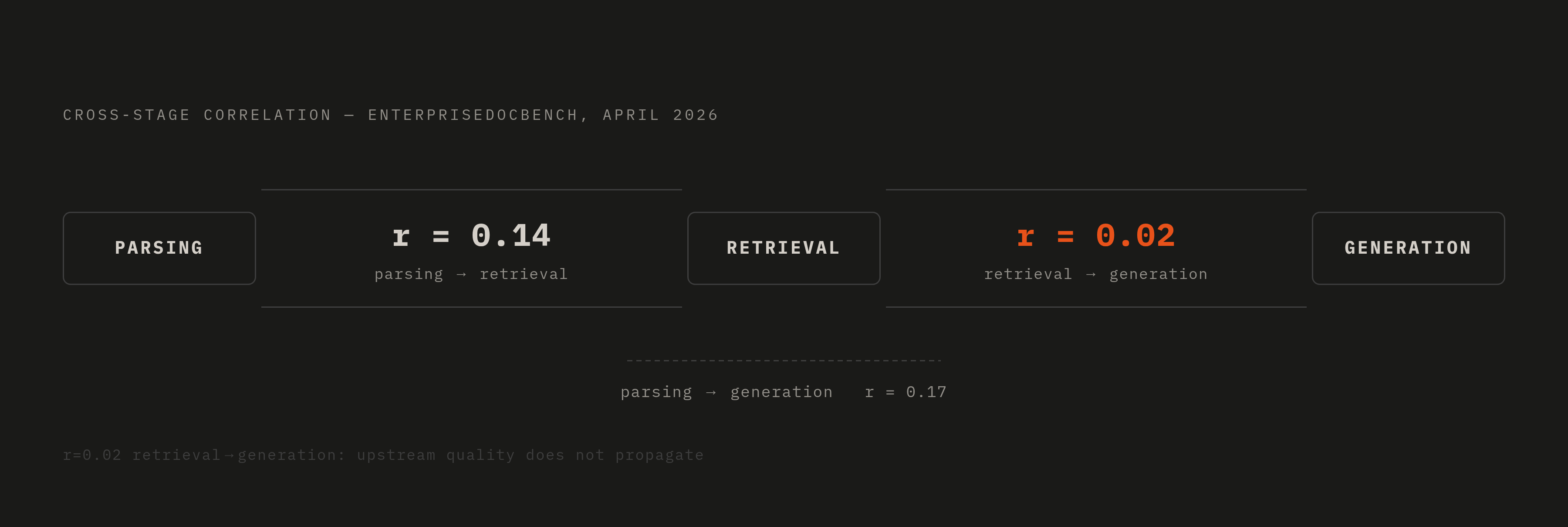
Enterprise document AI can span a pipeline of parsing, indexing, retrieval, and generation. Testing each stage on its own does not show whether the whole system will produce a result that can be used. EnterpriseDocBench, submitted in April 2026, tests those stages on the same corpus across six enterprise domains, of which five are in the current pilot. Its cross-stage correlations are weak, with parsing-to-retrieval at r=0.14, parsing-to-generation at r=0.17, and retrieval-to-generation at r=0.02. Only the last is close to zero, but none supports treating strong parsing as a guarantee of downstream quality.
EnterpriseDocBench also finds that factual accuracy on stated claims exceeds answer completeness. A system can be right about what it returns while leaving required information out. Its finding that short and very long documents hallucinate more than medium-length documents further undermines evaluation on a single selected example. For extraction workflows, infrastructure such as Extend combines parsing, classification, extraction, and splitting with confidence scoring and built-in evaluation tools. Those capabilities belong in a full-pipeline test rather than serving as reasons to assume that a strong parse carries through to the final output.
How do you pick a document parsing API for messy scans and complex layouts?
Start with the documents that govern the workflow rather than the formats that are easiest to demonstrate. Prior authorization forms, bills of lading, customs declarations, loan packets, rent rolls, and variable-layout contracts expose different demands. They combine inconsistent formatting, scanned originals, handwritten fields, and multi-page structures. Clean, digital-born PDFs with consistent layouts cover only part of that estate. A benchmark limited to them excludes the conditions most likely to distinguish vendors.
The relevant test dimensions include low-resolution scans, skewed images, nested or merged table cells, multi-column layouts, and multilingual content with accented characters. Scanned invoices with irregular layouts must therefore be evaluated as their own production category. Mixed-format submissions also belong in the sample when they occur in the workflow. Field-level accuracy is the operational measure because a single character error in a currency amount or account number can cause downstream processing failures. A page-level score cannot establish that these critical fields are correct.
The industry-specific stakes when a Document AI evaluation gets it wrong
In healthcare, the quality of extraction from prior authorization forms and billing documents affects delays in patient payments and the risk of compliance failures. A system that handles clean forms but fails on variable layouts has not demonstrated fitness for that workflow. The relevant outcome is not whether text was recognized, but whether the required information can support the process.
In logistics, invoice and goods-received note matching depends on complete line-item extraction. Bills of lading with hundreds of line items reveal silently dropped rows that averages can hide. Those omissions create reconciliation failures that propagate into clearance delays and billing disputes. In real estate and finance, complex leases and loan packets create a related completeness problem through key terms, financial schedules, and escalation clauses. Missing a clause is a production failure even when every returned clause is accurate, so scoring only the fields a system chooses to return rewards the wrong behavior.
Why confidence scoring is an evaluation criterion, not a feature comparison point
Confidence scoring decides whether uncertain extractions go to human review or pass downstream without anyone checking them. It assigns a numeric certainty value to each extracted field and supports a threshold for automatic processing. Fields below that threshold route to a reviewer. The evaluation must therefore establish whether confidence scores reliably identify uncertainty on the buyer’s documents.
Thresholds create a tradeoff between accuracy and processing coverage. Higher thresholds increase precision at the cost of coverage, while lower thresholds increase throughput at the cost of accuracy. That balance must be calibrated against the actual document distribution. In compliance workflows, the distinction between reviewed and auto-populated fields also matters for audit readiness. The PoC must test both uncertainty routing and the evidence of review, because a confidence feature alone does not demonstrate that the workflow fails safely.
How to design a benchmark that uses your own documents and produces comparable vendor results
Decide what the system must do in production before choosing documents or looking at vendor results. The task must be clear enough to show which fields, rows, document boundaries, or answers make an output correct. Then choose a sample that includes common cases, difficult cases, edge cases, and domain-specific patterns. The mix must match the document estate described earlier, including how complex the layouts are and the quality of the scans. Public benchmarks can inform the design, but they cannot replace that sample.
Set ground truth and metrics before running any vendor test. Use Field-level F1 score as the main measure of extraction accuracy, and make sure missing fields and silently dropped rows lower the score. Otherwise, a system can receive a favorable score by returning only the easiest information. Use the same documents under the same conditions for every vendor, with metadata removed. Define validation, human review, and audit-readiness criteria at the same time so that extraction is not scored in isolation.
Run out-of-the-box performance separately from fine-tuned or customized performance. The first shows what is available immediately, while the second shows what may be achievable with further investment. The gap makes the work required to reach acceptable performance visible. Ask each vendor for accuracy on the specific data category under the defined criteria, including the confidence interval on that result. A point estimate needs a measure of its uncertainty if it is to help buyers compare close results.
What the evaluation must cover beyond extraction accuracy, including data residency, model deprecation, and integration behavior
Data residency is a hard filter in many regulated settings. Confirm where data will be processed and stored before committing resources to evaluation. Check whether any part of the pipeline crosses jurisdictional boundaries to improve models or for fine-tuning, and ask for a map of the full data flow. Unclear answers leave a disqualifying constraint unresolved.
SOC 2 Type II provides a meaningful baseline because it confirms that internal controls were independently audited. It does not settle how a model provider handles data, how transcripts are retained and deleted, or whether agentic actions produce an acceptable audit trail. Those questions require separate examination. Model deprecation also belongs in evaluation and contracting, including the portability of fine-tuned assets and the vendor’s migration commitments.
Integration depth requires more than an available API. Evaluate connectors, identity management, ERP and system-of-record compatibility, and event handling. Outputs must also have enough structure for downstream AI agents and RAG pipelines to use them without adding errors. These decisions affect the ability to change systems later, so resolving them before signing preserves options that become harder to recover after integration.
How to run the proof of concept and score vendors on your evaluation criteria
Run the PoC on actual enterprise data in the standardized environment already defined. Include both the representative sample and the difficult patterns specific to the domain. Measure latency and cost at production volume, since demo speed and trial pricing are not enough to judge them. These dimensions can change the vendor ranking even when extraction scores are close. A vendor-standard deployment on vendor-selected data is another demo.
Set scorecard weights based on what the business needs before looking at the results. The criteria should cover business outcome fit, data security and privacy, integration and workflow fit, governance and risk controls, implementation readiness, cost structure, vendor maturity, and change management. Use the same weights for every vendor, even when a result looks good enough to tempt a change. Keep the underlying measurements visible so that a weighted total does not conceal a critical failure.
Exercise the human-in-the-loop workflow during the PoC. Test what happens below the confidence threshold, how exceptions are routed, how the reviewer interface works, and whether the audit trail captures both auto-populated and reviewed fields. Extend’s open-source benchmarks, RealDoc-Bench, LongArray-Extract, and PoliTax Split, provide reference methodology for parsing, large-array extraction, and splitting on real-world documents. Buyers can adapt that methodology to their own domain-specific benchmark rather than treating public results as a vendor selection. The test should produce a scored dataset that lets the buyer compare vendors and see which one best meets the buyer’s criteria.
What a Document AI vendor evaluation that survives production actually looks like
A production-relevant evaluation produces more than a preferred vendor. It establishes which document categories work, which failures remain, and what level of human review is required. Its results distinguish immediate performance from performance dependent on customization. They also document the deployment constraints and integration obligations that make an otherwise accurate system usable. That is a different decision record from a collection of favorable demonstrations.
The evaluation also reveals how a vendor responds to scrutiny. A vendor that is willing to work with the buyer’s documents and answer questions about confidence intervals, data handling, and difficult cases gives the buyer more to judge than a prepared presentation. The vendor’s tools and deployment options make those checks possible, but buyers still need to test how well they meet their requirements. For Extend, those include open-source benchmarks, BYOC and self-hosted deployment options, and a zero data retention option for plans that are eligible. None substitutes for running the agreed test.
The practical standard is whether the evaluation predicts production behavior. A selected system should perform as measured on the documents that matter, with known limits and tested paths for handling uncertainty. If those expectations hold when real workloads arrive, the evaluation has done its job.