Where Google Document AI Falls Short on Mixed Document Type Accuracy
Google Document AI struggles with mixed layouts and line-item accuracy without custom handling.

For complex real-world layouts, a high-accuracy document extraction API must keep the relationships between fields, handle mixed-document packets, and show where it is unsure beyond OCR. With Google Document AI’s processor-scoped architecture, engineers must handle those needs separately, because a single parser call does not cover them all. How well it fits depends on the mix of documents, how much line-item accuracy matters, and whether the team can maintain the surrounding pipeline.
Why Google Document AI's architecture is processor-scoped and what that means in practice
Google Document AI has two distinct product paths under one brand. The prebuilt path provides task-specific processors, including Invoice Parser, Expense Parser, W-2 Parser, and Bank Statement Parser. These processors use closed schemas, so customers cannot define their own extraction contracts. The Custom Processor path includes Custom Extractor, Custom Classifier, and Custom Splitter. That path permits an open schema, while the customer owns the labeling, training, and deployment lifecycle.
The distinction also determines how processing costs accumulate. Prebuilt parsers are billed per document, while Custom Processor processing is billed per 1,000 pages and adds hosting charges for deployed versions. Those units cannot be compared meaningfully until they are mapped against the actual document mix. Teams therefore need to plan for a workflow’s page count, document boundaries, and processor choices together. The processor is the unit of capability, while the surrounding application coordinates the workflow.
How the fixed OCR layer caps accuracy when document quality varies
The first constraint appears before field extraction begins. OCR accuracy measures how well characters are read, while structured field extraction accuracy measures whether that content is turned into the right entities and relationships. Google Document AI’s OCR is strong on clean printed documents. That strength does not establish how well a parser will understand tables, distinguish subtotals from line totals, or associate values with the correct row.
When recognition itself fails, the fixed OCR layer limits the available remedies. Mixed-script documents, low-DPI fax scans, heavy stamps and signatures, and handwritten fields over printed forms are problem inputs. Schema tuning and custom extraction training do not substitute a different OCR engine. Within the Google Document AI pipeline, preprocessing the document before submission is the available lever for addressing these recognition failures. The ceiling concerns a particular input type that the engine misreads.
Control over the vision layer changes that constraint. In platforms such as Extend, teams can swap or layer specialized models for handwritten fields, low-DPI scans, or mixed scripts without rebuilding the entire extraction pipeline. This is an architectural distinction rather than proof that one platform will outperform another on every input. It matters when the failure originates in reading the page, because downstream extraction logic cannot repair that layer simply by changing field definitions.
Why processing a mixed-document PDF requires a mandatory three-stage pipeline
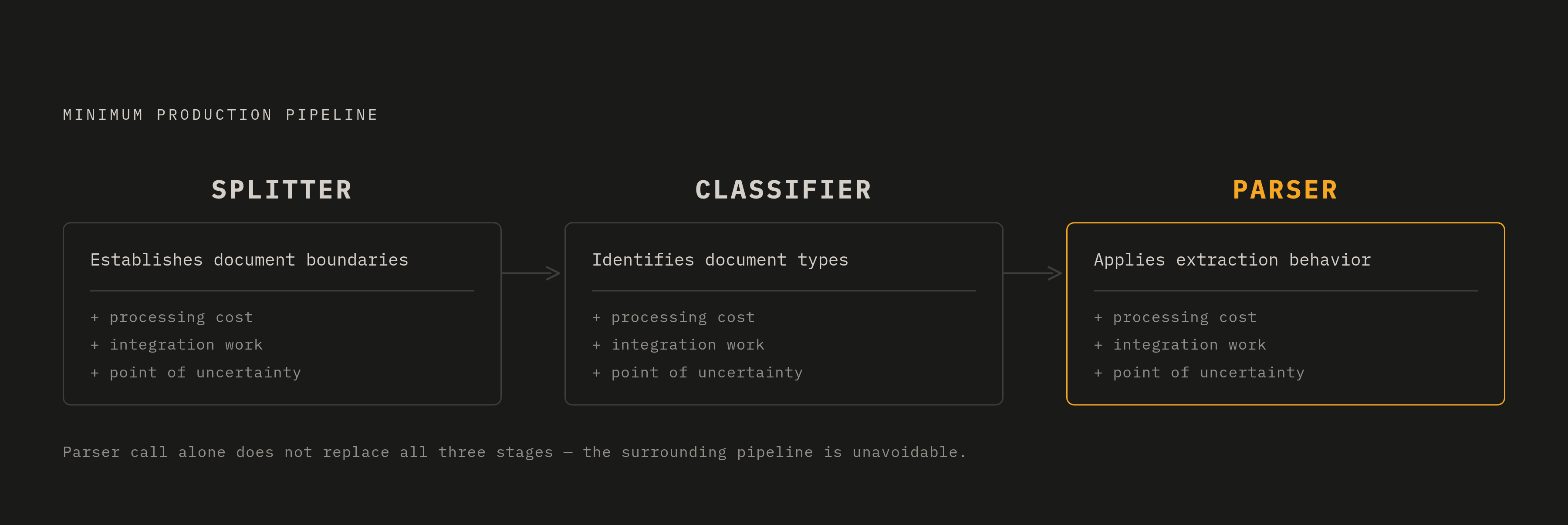
The minimum production workflow is Splitter → Classifier → Parser. Splitting establishes document boundaries, classification identifies the document types, and parsing applies the relevant extraction behavior. These are logical responsibilities even where a splitter model also supports classification. A prebuilt parser call does not replace the complete workflow.
Each responsibility introduces processing cost, integration work, and another point where uncertainty affects the result. Splitting and classification add work before the parser’s own charge, while custom deployments can also incur version hosting costs. The production architecture must account for routing as well as reading.
Boundary errors make this more than an orchestration concern. Before GA confidence scoring on the splitter, a misclassified boundary could silently corrupt downstream extraction for a packet without an automatic signal at that stage. Splitter confidence scoring has now reached GA, making uncertainty available as an explicit pipeline output. Extend embeds confidence signals and evals at the splitting and classification layers to surface boundary and routing errors before they affect downstream extraction. In either approach, final field confidence alone is insufficient evidence that the correct document reached the parser.
Where structured field extraction accuracy actually breaks down, and what the confidence scores reveal
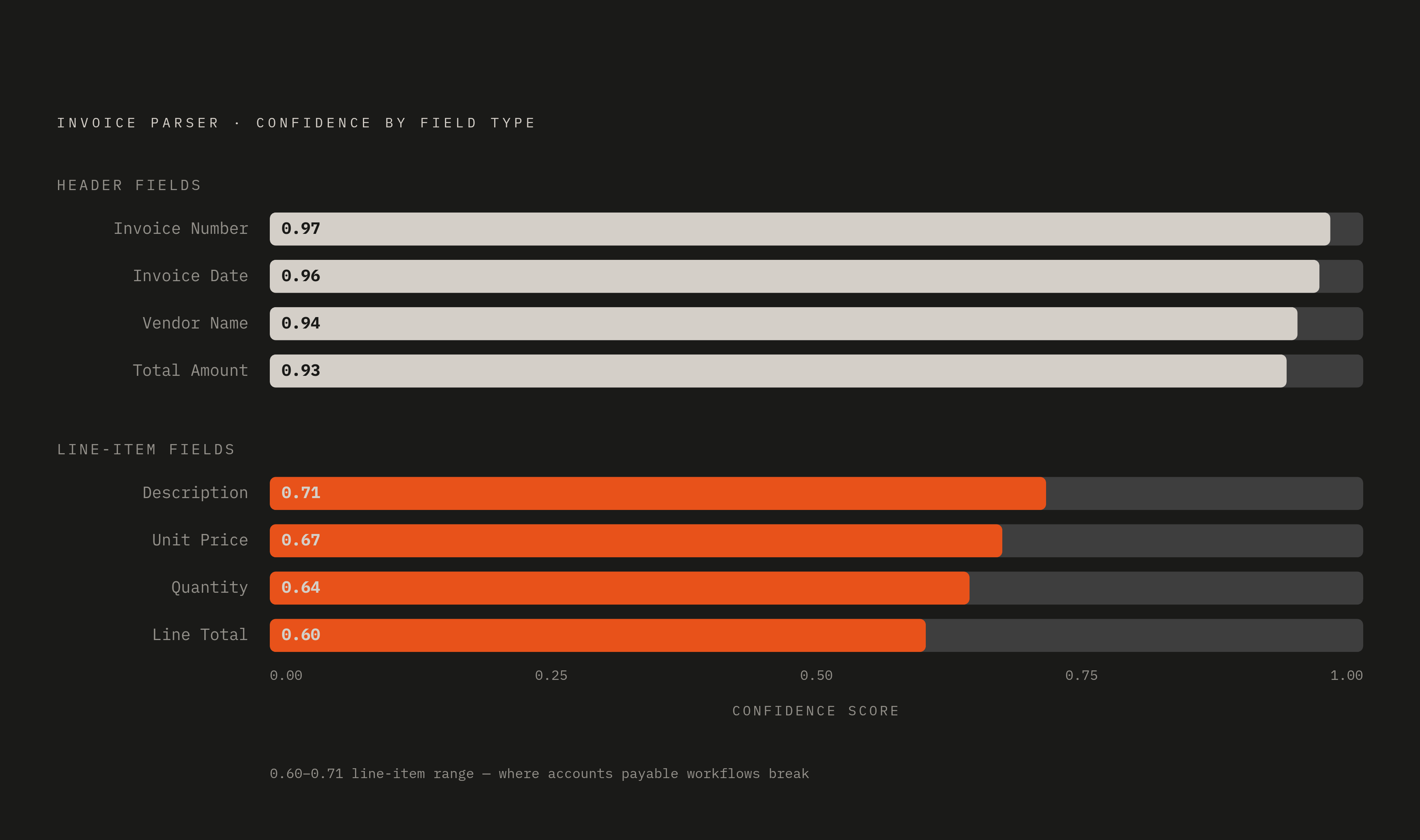
The practitioner Invoice Parser evaluation documents a clear contrast between header fields and line items. Header fields, including invoice number, invoice date, vendor name, and total amount, consistently return confidence scores in the 0.93–0.97 range. Line-item fields, including description, quantity, unit price, and line total, fall to the 0.60–0.71 range on the same documents. These evaluation-specific confidence scores are distinct from measured accuracy percentages and Google’s general performance guarantees.
Merged cells, multi-line descriptions, subtotal rows inside item tables, and non-standard column ordering degrade line-item extraction. Recognizing a number is the OCR task. Assigning that number to the third line item’s total is the extraction task. A document can therefore be read correctly at the character level and still produce an incorrect invoice record.
The raw API response also leaves important structural work to the customer. It returns an entity list. The customer still has to map entities to internal fields, group line items, handle multi-page invoices, and filter by confidence threshold during post-processing. The practitioner evaluation identifies row grouping as non-trivial, which explains why reliable headers do not remove the main source of errors in multi-vendor accounts payable workflows.
Publicly verifiable tests on real-world documents are necessary to expose this distinction before production. Extend’s open-source benchmarks, including RealDoc-Bench, PoliTax Split, and another benchmark, address complex layouts, merged cells, and line-item grouping failures. Their relevance is that they make structural extraction problems visible rather than leaving evaluation at the level of vendor confidence numbers. Before a team uses these test results to decide what to buy, the tests still need to match the workflow it plans to run.
How schema immutability and processor versioning create production fragility over time
Schema immutability becomes most consequential when the document population changes. Prebuilt processor field names and schemas are fixed, so a team cannot add a field within the prebuilt parser itself. Google provides an uptrain path that uses a prebuilt processor as the base for a custom version with additional fields. That path is a move into a custom lifecycle.
Custom Processor schemas are open, but changing fields or behavior requires labeling, training, and deployment. A new vendor template, form version, or regulatory field can therefore become a retraining event. Each version kept deployed also accrues hosting charges. Teams with several document types, tenants, or regulatory variants must keep those versions running and maintained in production. The fragility comes from tying ordinary document change to model lifecycle work.
Managed model updates add another source of change. Extraction quality can improve without application changes, but behavior can also shift in ways that break downstream parsing without a warning signal. Storing raw API responses with extracted values is therefore necessary for diagnosing regressions. Google’s release notes state that legacy processors will be discontinued on June 30, 2026. This is a processor version-management issue rather than a universal service cutoff, so deployed versions and migration targets require review and testing before production traffic moves.
Where these structural gaps cause the most damage in practice — healthcare, financial services, insurance, and logistics
The constraints become most costly where document variety is high and error tolerance is low. Healthcare workflows combine patient intake forms, referral letters, insurance authorization requests, clinical trial data, and discharge summaries. Handwritten annotations over printed forms, clinical codes, and multi-page records show where both recognition and routing can go wrong. Financial services and insurance workflows likewise include claims packets containing claim forms, receipts, medical records, police reports, and repair estimates. Their extraction quality depends on correct boundaries and classification before a specialized parser can do useful work.
Logistics adds a timing constraint to the same architectural concerns. Customs documentation may need processing in minutes, while Google’s batch processing jobs are explicitly not designed for real-time applications. Most finish within 24 hours after they start running, and incomplete jobs are canceled at that threshold. That batch profile does not fit transaction-speed processing simply because extraction quality is otherwise acceptable.
Sensitive documents also make governance part of the system’s fitness for use. Databricks says access controls, lineage, audit logging, and retention policies matter more and more as teams start to use document AI. In healthcare, financial services, and insurance, confidence signals and auditability support more than debugging. They help make the processing of clinical, financial, and personal data accountable. The same structural errors that threaten accuracy also increase the importance of retaining evidence about how an output was produced.
The strongest counterargument — Google Document AI's genuine strengths and who it actually serves well
Google Document AI remains a rational choice for homogeneous document types and teams already invested in Google Cloud. Its integration with IAM, VPC-SC, regional endpoints, BigQuery, and Cloud Storage has real operational value. A published uptime SLA also matters to enterprises operating a managed production service. For GCP-fluent teams with integration resources, that fit can outweigh the cost of assembling the surrounding workflow.
Its recognition capabilities also deserve a fair assessment. Strong performance on clean printed documents is useful in its own right, and independent comparisons show an edge in handwriting recognition over some competing services. That does not contradict the difficulty of handwritten fields over printed forms, because comparative strength does not eliminate input-specific failures. The generative Custom Extractor can be fine-tuned with as few as ten sample documents, although the current foundation model version requires a minimum of 50 training documents. Teams therefore need to know which model version they will use when they estimate the cold-start labeling work.
Predictable documents and stable schemas make processor specialization easier to manage. Varied vendor layouts, operationally critical line items, and limited capacity to maintain routing or retraining make the same architecture less suitable. Character-level reading and semantic understanding of document structure must remain separate criteria. Conflating them either understates Google Document AI’s strengths or overstates what those strengths guarantee.
How to choose a document extraction API that won't fail on mixed layouts
For teams staying with Google Document AI, the response is to treat the surrounding pipeline as production infrastructure. Preprocessing should normalize scan quality before the fixed OCR layer. Splitting, classification, and parsing should be explicit stages whose confidence scores are first-class outputs. The post-processing layer should own entity-to-schema mapping, row grouping, multi-page handling, and confidence-threshold filtering. Raw responses should be stored with extracted values, while schema changes should be planned and budgeted as retraining events.
For teams choosing a different architecture, the requirement is integrated support for splitting, classification, and extraction. Native confidence signals and built-in evals matter because teams still need to see uncertainty at runtime, even after accurate results in the initial evaluation. Extend is a credible option for this requirement, with control over specialized vision models and confidence signals across routing stages. Google Document AI can still be the better fit when consistent documents and GCP integration matter more.
For sensitive workflows, the infrastructure baseline includes SOC 2, HIPAA, and GDPR standards, with self-hosted or BYOC deployment where required. Extend meets those standards with zero data retention, BYOC and Hybrid deployment, and a HIPAA BAA on request. Those capabilities address procurement requirements. The decisive benchmark question for any vendor, including Google and Extend, is whether its accuracy claims come from documents that match the actual production mix rather than a curated dataset designed to favor its strengths.