Document Processing Infrastructure Requirements for Production AI Agents
Build document processing infrastructure that catches extraction errors before agents act on them.
Production AI agents need document processing infrastructure that preserves text and layout, extracts schema-correct fields, verifies completeness, and routes uncertain output through calibrated confidence and human review. Splitting, classification, evaluation, and compliance belong in that infrastructure. Document-consuming agents fail when this foundation turns source documents into plausible but untrustworthy data, and better agent orchestration cannot repair information already lost.
Why document-processing agents fail in production, and where the failure actually lives
An agent approving a claim can appear to make a reasoning error when the actual fault is a misaligned table header. Better prompting targets the wrong layer in that case. The parser has attached the wrong value to a field, and the agent receives clean-looking input with no signal that its meaning has changed. A dropped row or broken reading order creates the same problem.
ParseBench describes the shift in parsing requirements from “good enough to read” to “reliable enough to act on.” That distinction locates reliability in the pipeline beneath the agent. Individual model improvements can reduce errors, but the pipeline harness either catches the remaining errors or allows them to propagate silently.
What infrastructure do AI agents need to process documents reliably?
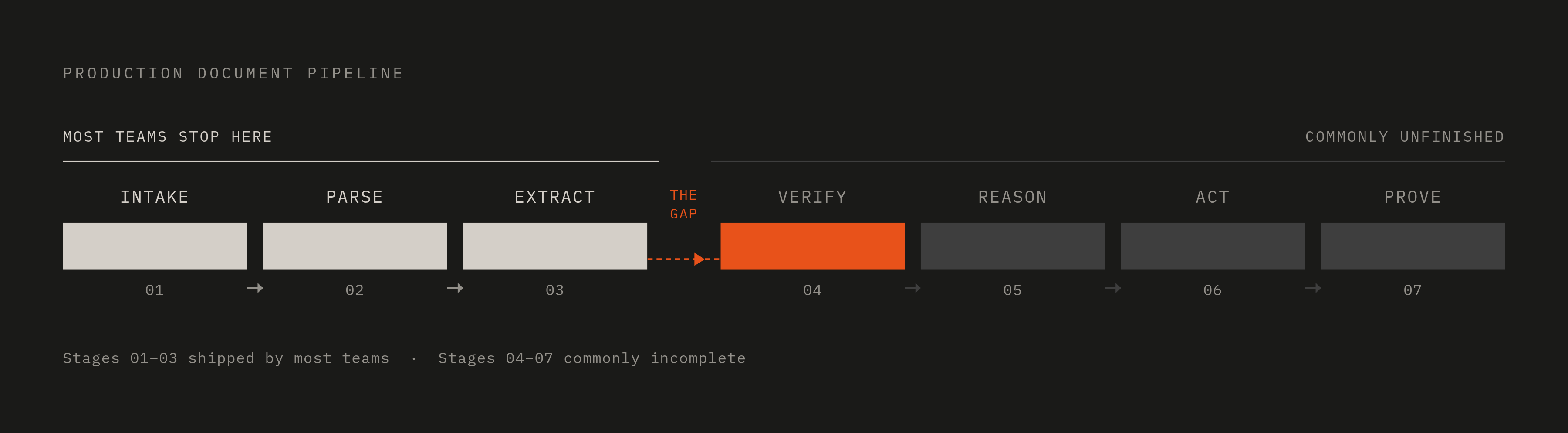
Most teams ship ingestion, parsing, and extraction, leaving verification, routing, and auditability unfinished. A complete production stack follows a broader sequence, namely intake, parse, extract, verify, reason, act, and prove. Each stage depends on what the stage before it produces. When verification is absent, structurally plausible extraction errors pass directly into reasoning and action.
The architecture therefore needs more than a parser with a high composite score. ParseBench identifies five distinct agent-critical capabilities, including tables, charts, content faithfulness, semantic formatting, and visual grounding. In each, useful information can be lost or change meaning before extraction begins. When failures span ingestion, retrieval, and synthesis, root-cause analysis is also hard at scale because an error can show up far from where it began.
Why parsing and layout detection are two separate problems, and why conflating them breaks extraction
A parser can transcribe every character in an invoice correctly while assigning a value to the wrong column. The words survive, but their relationships do not. Character accuracy measures whether text was recognized, while structural accuracy measures whether that text is attached to the right row, column, or field region. A composite score can conceal the difference, leaving an apparently accurate parser unsuitable for structured extraction.
Production documents stress these capabilities independently. Skew, low resolution, and fax compression degrade text recognition, while variable templates place the same field in different regions. Multi-page documents add another structural dependency because a header can establish context for a value three pages later. Per-page scoring misses that relationship entirely.
ParseBench finds that none of the fourteen methods it evaluated is strong across all five capability dimensions every time. Its table requirements include merged cells and header hierarchies that most benchmarks do not test. Parser selection consequently requires separate evidence for text fidelity and layout handling, rather than treating success at one as proof of the other.
How standard OCR benchmarks systematically mispredict production performance
Standard OCR rankings often reward performance on clean, typed text with consistent layouts. Scanned PDFs introduce skew and compression artifacts, while rotated headers and mixed handwriting and type challenge assumptions about where text appears and how it looks. A ranking on stable layouts does not show how well a system will work across those variations.
The scoring method creates a second mismatch. Evaluation of one page or field at a time cannot measure multi-page context resolution, and Character Error Rate treats all characters equally. Operational damage is not equally distributed. An error in a short invoice number, policy ID, or date can invalidate the field despite strong transcription across the rest of the document.
RealDoc-Bench measures parsing performance on documents that teams actually process, addressing the gap between curated tests and production inputs. ParseBench targets enterprise document distributions in insurance, finance, and government that prior benchmarks underrepresent. These approaches make the evaluation population part of the engineering decision, rather than assuming a leaderboard transfers unchanged to a production workload.
What field-level evaluation reveals that document-level accuracy scores conceal
An extraction system can get common fields right while missing signature presence, checkbox state, or payment terms in redlined contracts time after time. Its aggregate F1 can still look strong. Low-frequency fields contribute little to the overall score even when a downstream action’s validity depends on them. Field-level, schema-aware evaluation exposes which requirements fail.
Different failures also require different measurements. Character Error Rate measures OCR quality, Word Error Rate measures text accuracy, and Tree Edit Distance Similarity evaluates table structure. Normalized Information Distance measures semantic similarity between extracted and expected output. These metrics serve different purposes, so no single one substitutes for coverage of handwritten fields, multi-page tables, redlined text, signatures, checkboxes, and template variants.
For engineering teams, that visibility becomes useful when evaluation feeds back into the pipeline. Programmatic access, automated regression testing, and CI/CD integration allow benchmarks to run as documents and schemas evolve. Without that feedback, teams find out about accuracy problems when something fails in production. Evaluation establishes where extraction is reliable, while runtime confidence determines how individual outputs should be handled.
How confidence scoring turns extraction output into actionable routing decisions
A wrong answer with a high confidence score can pass directly into automated processing when it should reach a reviewer. Miscalibration makes the routing mechanism dangerous. Model self-assessment is not calibrated by default, so a threshold based on raw reported confidence does not establish a dependable boundary between automation and review. Confidence must be tested against labeled data before it governs action.
Log-probabilities can provide a more reliable signal because they reflect the model’s token-level probability distribution. Their advantage is not universal, however, because model type and alignment technique affect their relationship to correctness. They also require external calibration. Document quality adds another variable, with clean digital documents, scanned documents, and degraded scans representing distinct accuracy tiers that thresholds need to account for.
Deterministic rules provide an independent control over routing. Duplicate invoice numbers, failed three-way matches, and changed bank details should go to human review even when model confidence is high. The resulting design is tiered, with agents handling the clear majority of documents autonomously and exceptions escalating to reviewers. Even calibrated field confidence, however, does not show whether every field or row in the source was extracted.
Why silently dropped rows in large-array extraction are a critical production failure that aggregate accuracy ignores
A system can extract nineteen of twenty invoice line items correctly and return a valid array. Every returned item may look trustworthy. The downstream agent still works with incomplete data, and confidence scores on the extracted values do not show that a row is missing. Format validation passes because the output satisfies the schema.
This is a completeness failure. Precision can remain high when scoring examines the rows that were returned, while aggregate scores dilute the penalty for missing content across other fields. Recall can register an omission without distinguishing its operational significance. A benchmark that treats row loss as an ordinary recall miss therefore does not show the risk to large arrays on its own.
Production benchmarks need to penalize row dropping explicitly and test completeness on large arrays, including invoice items, lab findings, and logistics entries. Extraction infrastructure must also check row counts against the source document structure as well as check fields through field-format validation.
How document splitting and classification shape what extraction even sees
Loan packages, insurance submissions, and healthcare records often arrive as multiple document types concatenated in one file. A split at the wrong boundary leaves pieces that do not make sense on their own for extraction. Classification can corrupt the next step just as quietly. A clinical summary classified as an administrative form receives the wrong extraction schema, yields the wrong fields, and can still pass schema validation.
These upstream decisions need their own benchmarks because extraction scores do not isolate split and classification errors. Chunking also affects downstream retrieval, with hierarchical chunking suited to multi-page contracts, semantic chunking to heterogeneous documents, and fixed-size chunking to uniform corpora. Those choices are not interchangeable. Extraction quality is bounded by the document boundaries and type assignments established before any field is read.
Where industry-specific document complexity changes the infrastructure requirements
Invoice and accounts payable workflows are the most mature deployment context because their documents are structured enough to verify and their exception costs are well understood. The production loop includes packet segmentation, schema extraction with field confidence, three-way matching against the PO and goods receipt, and deterministic variance rules. Exceptions go to review, and governed posting has a limit on value. Extraction alone cannot provide those controls.
Healthcare changes the stakes from transaction correctness to patient safety. A weak extraction control can produce a missed abnormality, delayed escalation, or billing error. Handwritten annotations on typed forms and tables within narrative notes put both text recognition and layout handling to the test. Chemical formulas in pharma batch records add another parsing challenge. Life sciences workflows also place extraction inside regulated study reports, safety narratives, label content, and clinical evidence packages, where errors have regulatory consequences.
Manifests and bills of lading have nested tables, multi-page structures, and many rows, so losing rows without warning is an especially serious risk. Format variability across carriers and jurisdictions also raises the risk of classification and splitting errors. A misrouted document type can delay an entire shipment. The same infrastructure layers apply, but the domain determines which failures demand the strongest controls.
Why enterprise compliance is an infrastructure requirement, not a procurement checkbox
Compliance constrains the pipeline from intake through storage in financial services, healthcare, and similarly regulated industries. It cannot be confined to vendor procurement. Documents containing PII, PHI, or financial data require explicit data processing agreements for third-party storage, and intermediate extraction results cached for debugging can create exposure. Zero-data-retention requirements therefore affect both how the pipeline operates and its contract terms.
Deployment boundaries shape the available architecture as well. Rules that require document data to stay within an organization’s infrastructure can rule out API-only processing and require self-hosted, on-premises, private cloud, or BYOC deployment. HIPAA requirements and SOC 2 certification belong in that deployment assessment. BAA availability determines whether a vendor can be used for PHI-bearing documents at all.
Many regulated workflows require audit trails showing which fields were flagged, which reached human reviewers, and which were posted automatically. “The AI decided” is not an adequate record. Designing these controls late can require rebuilding layers that assumed unrestricted storage or processing. Compliance-aware design is faster to certify, cheaper to audit, and safer to operate at scale.
What production-ready document infrastructure looks like end to end
Production-ready infrastructure brings these capabilities together in one controlled path from the source document to action. Its parsing, extraction, splitting, and classification APIs expose accuracy, cost, and latency tradeoffs. Confidence scoring includes calibration support, while evaluation surfaces field-level errors and array-completeness failures through CI/CD integration and schema versioning. Mixed-packet handling does not require bespoke engineering for every document type. The deployment model incorporates SOC 2, HIPAA, GDPR, retention controls, and self-hosted or BYOC options.
For teams building document agents, these are selection criteria for the foundation before launch. Developer experience belongs among them because months spent stitching together prompt workarounds and parsers delay delivery and complicate production debugging. Purpose-built infrastructure makes the controls part of the system that engineers integrate. The decisive test is whether an extracted value can be trusted enough to authorize action, and whether the pipeline can prove why.